E-Paper



Number riddle test: You're a true brainiac if you crack this tricky maths puzzle that confused the internet
A maths brain teaser posted on X challenged users with a tricky pattern-based puzzle.

 Prefer HTon Google


Maths brain teasers have always held a special charm—twisting logic, playing with perception, and often turning simple equations into complex mind games. These puzzles aren't just exercises in arithmetic; they test reasoning, attention to patterns, and the ability to think beyond the obvious. If you’re someone who relishes solving numerical riddles, the latest one doing the rounds on internet is likely to pique your interest.
(Also read: This challenging brain teaser has left the internet perplexed. Can you crack it?)
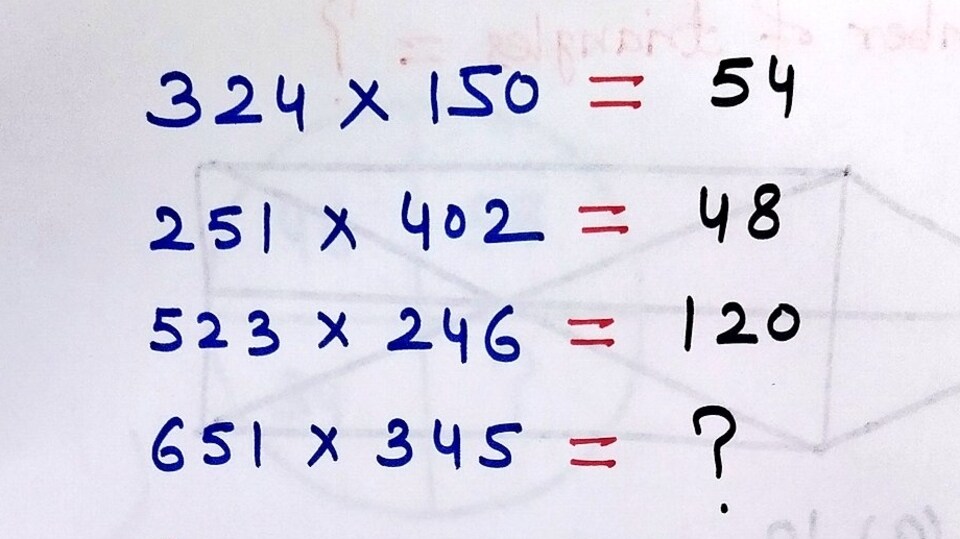
The maths teaser was recently shared on X (formerly Twitter) by an account named Ganesh UOR. The puzzle has caught the attention of many for its unusual patterns and tricky logic. It presents a series of mathematical equations that don’t seem to follow conventional rules:
"324 × 150 = 54, 251 × 402 = 48, 523 × 246 = 120, 651 × 345 = ?"
Four possible answers are provided:
(a) 120, (b) 85, (c) 60, (d) 144
Check out the puzzle here:
The challenge, of course, is to find the hidden logic behind the numbers. It’s not standard multiplication, and that's exactly what makes such puzzles go viral—they force the brain to search for an unconventional solution.
Earlier puzzle
This isn’t the first time a maths riddle has baffled the internet. A puzzle previously shared on Facebook by a page called Minion Quotes dared users to refrain from using calculators and trust their mental arithmetic. The puzzle read:
“Plz don't use calculator. Use your brain:
50 + 10 × 0 + 7 + 2 = ??”
Simple on the surface, this problem plays with order of operations, something even adults tend to overlook under pressure.
(Also read: Brain teaser: Only those with exceptional IQ can crack this tricky puzzle that 90% fail to solve)
Why do maths brain teasers go viral?
In the age of quick scrolling and short attention spans, brain teasers provide a momentary pause for mental stimulation. They offer a refreshing challenge, spark debates in comment sections, and trigger waves of nostalgia for schooldays spent solving tricky problems. Many users see them as a fun way to keep the mind sharp, while others find satisfaction in cracking what stumps the majority.
So—have you managed to crack the puzzle yet? Or are you, like many others, still trying to decode the pattern?