
 E-Paper



Has 2020 been the sweepstakes for introverts?
No communal chai breaks, office meet-ups or weekend parties. For the first time, introverts can just be, and they’re thriving. But is there a downside to being left alone for too long?


In the normal world, we interacted with strangers every day — the taxi driver, the Uber pool co-rider, the barista. At work, we were encouraged to be interactive, collaborative, friendly. In the lift, you chatted with Harish (is that his name?) from accounting or Tanya from HR.
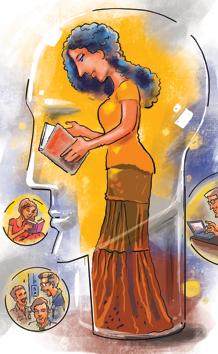
All this came naturally to a majority of people. For one slice, it was uncomfortable every time. Introverts have long wished they could just get on with it, without having to smile, nod, chat, party, share plates and discuss types of coffee. In the pandemic, they finally have the upper hand.
“In the pandemic, they get to focus on themselves, and live life without the frills,” says psychologist Nisha Khanna. “Now they have the space to dive into their work, and the things they like to do. Set up a routine any way they like.”
By definition, introverts are energised by spending time alone. Unlike extroverts, they draw their energy from time away from the noise of engagement with other people. Social situations can be draining rather than refreshing for introverts, who would then have to recharge spending time alone, getting lost in a book, going for a drive, etc.
“That is not to say introverts don’t like human company. In fact, introverts like to have deep and meaningful conversations, usually one on one, usually with someone from a small inner circle,” says Khanna.
In the pandemic, then, they are reporting higher efficiency levels, heightened productivity, a sense of tranquillity and ease. Most of all, there is the freedom to choose each interaction, with no follow-up questions and no explanations required.
For Aishwarya (last name withheld on request), 27, a business analyst in Bengaluru, the tea break is no longer something to be dreaded. “We have an open office concept that would get overwhelming at times. People speak non-stop and there was a lot of cross-talking. I’d have my headphones on all days, but sometimes I would just want quiet,” she says. “So when people would call me out for the tea break, I’d stay back, they’d feel bad. Now I don’t have to deal with that.”
At 35, Shivsharan Trasi, whom a personality test categorises as an ambivert or a social introvert, says going to the office was something he only did because he had to do. “Now, I spend eight hours delivering on the job and then I look forward to some alone time with a good book, or a quiet evening with my wife.”
“While the situation itself is something no one wants repeated, I do hope I have the option of continuing the way I have been,” Trasi says. “I have felt much more efficient at work, which has left me with time to balance work with family, hobbies like staying fit and reading, make time for all the things I didn’t have enough of earlier.”
Aishwarya is able to indulge her non-stop inner monologue. “I am constantly introspecting,” she says. “Sometimes it gets personal. It helps me understand how my childhood has affected my adult life.”
Before the lockdown, she would take as many work-from-home days as her company would allow. “This is great,” she says. “The work gets done more efficiently. I always knew I would thrive in such an environment and this is the path I want to take my career on.”
Paradoxically, in the long-term, introverts could fare worse, studies and experts suggest. There has long been a correlation between introversion and higher incidence of mental health issues such as depression and anxiety. “Though on the face of it, introverts derive pleasure from solitude and being alone, this personality type is prone to certain mental health issues. More rumination can mean more worry, and it has a tendency to spiral from there,” says Dr Rajesh Sagar, professor of psychiatry at the All India Institute of Medical Sciences (AIIMS), Delhi. “Introverts tend to refrain from seeking help, to a greater degree, especially outside their circle. As self-management and self-care become important in the pandemic, introverts will need to keep an eye on their coping mechanism — maintain a routine, spend time on hobbies, find ways to seek help when needed. Because it is in the nature of humans to need company, conversation, and to know that there is someone out there who is interested in them and cares for them, even though they might resist or refrain from much contact.”
Catch your daily dose of Fashion, Taylor Swift, Health, Festivals, Travel, Relationship, Recipe and all the other Latest Lifestyle News on Hindustan Times Website and APPs.


