
 E-Paper



Al-Qaeda threatens India and Bangladesh, the suspect is Pakistan
While Intelligence inputs indicate the presence of Al Qaeda terrorist Ayman Al Zawahiri in Afghanistan, the Taliban denies it and points fingers at Iran.

 Prefer HTon Google


On Sunday, the proscribed Al Qaeda in the sub-continent (AQIS) released a statement condemning Bangladesh government for sentencing seven “innocent” persons to death for killings of Islamophobes Shafiul Islam Lilion and Ananta Bijoy on charges of blasphemy.

The AQIS release describes Bangladesh government as “obedient agents of Hindutva menace and Taghut” who did not bring the Islamophobes to justice but has put so-called “innocent” persons on death row while it was AQIS mujahideen who had killed those who defamed Islam.
_1654684224062.jpeg "The Al-Qaeda letter calling Bangladesh government a messenger of ‘Hindutva’.")
A day later, AQIS threatened to conduct suicide bombings in Delhi, Bombay (Mumbai), Uttar Pradesh and Gujarat and teach a lesson to “Hindu terrorists” occupying India after the now suspended spokesperson of the BJP was accused of blasphemy.
While the threat to India comes after the comments made by the then BJP spokesperson days ago, the government of Sheikh Hasina was blasted for Lilion and Bijoy, both of whom were done to death for alleged blasphemy in 2014 and 2015 respectively. Intriguingly, the only country which has an axe to grind with both India and its ally Bangladesh is Pakistan, from where this blasphemy storm was generated in the social media by using twitter handles based in Af-Pak region.
While the Pakistani establishment is aware of the rising radicalisation and spread of terror in the Islamic republic, the Indian worry is the inability of Pakistan Army to stamp out the jihadi factories and radicalisers in that Islamic republic.
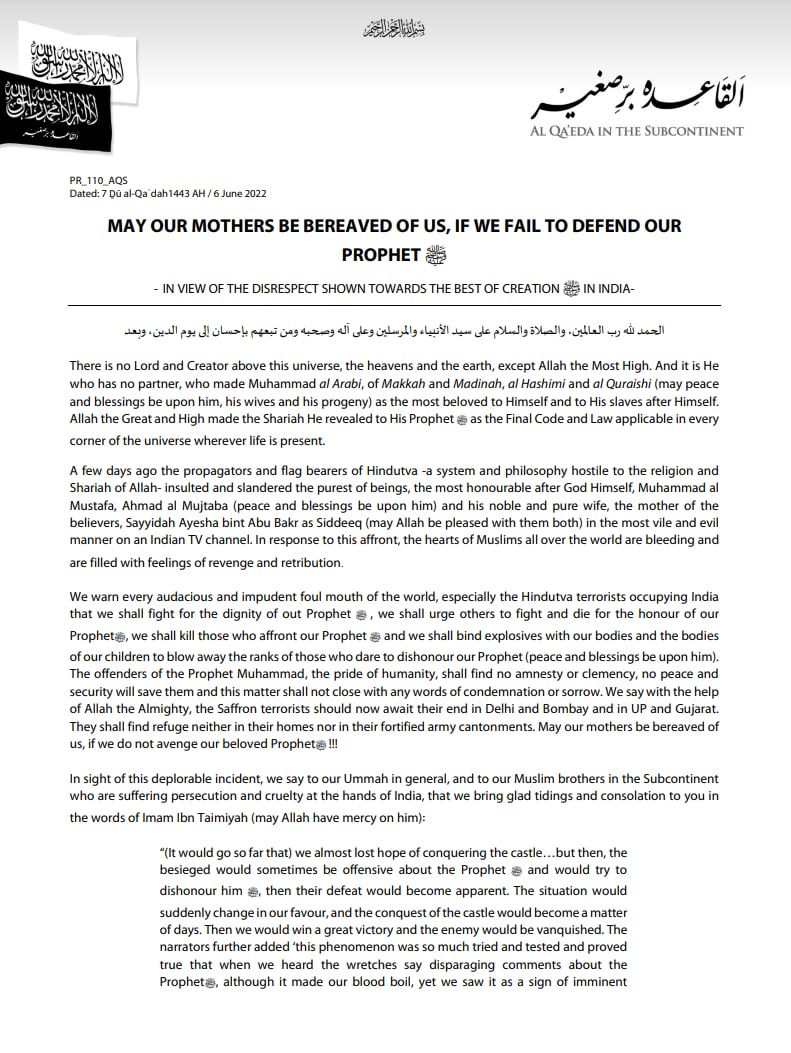
The two statements are also indicative of the fact that there is a rise of Al Qaeda in Af-Pak region after the Taliban virtually chased out the American troops on August 15, 2021. Intelligence inputs indicate that Al Qaeda chief Ayman al-Zawahiri is based in Afghanistan through the ruling Taliban denies it and has conveyed to India that the global terrorist has taken shelter in neighbouring Iran.
Tehran too denies the presence of Zawahiri in Iran and has conveyed that the Al Qaeda leader is based in Afghanistan under the shelter of the ruling Taliban. Al Qaeda chief Osama bin Laden was killed by US troops in Pakistan in 2011.
While the Muslim countries at large have made an issue about alleged blasphemy in India by former BJP spokesperson, fact is that the radicalisation is on the rise in Af-Pak region with Taliban occupying Kabul and giving shelter to Al Qaeda. Just as the majority cadre of Islamic State of Khorasan Province (ISKP) come from Pakistan, the AQIS also gets its cannon fodder from Islamabad.
According to national security planners, the AQIS statements against both India and Bangladesh seem to have been orchestrated by the Pakistani deep state with the sole objective of making New Delhi and Dhaka targets of Islamists on charges of blasphemy. Analysis of social media in the past few days after the controversy indicates that the agenda against India and Bangladesh is driven from Pakistan with the use of unverified twitter accounts and bots.
While India has conveyed the rise of Al Qaeda in Af-Pak region to their US inter-locutors, the jihadists are at an advantage as the entire US and the west is focused on Ukraine war. The rising economic instability in Sri Lanka, Pakistan, Maldives, and Nepal will lead to more public agitations, which later become fertile grounds of jihadists. AQIS is just a front for Pakistani deep state practising dark arts and spreading radicalization in the entire sub-continent.


