
 E-Paper



Brazil Won’t Take Orders From Trump, President Says
Relations between the U.S. and Brazil deteriorated after Trump sought to halt criminal proceedings against former leader Jair Bolsonaro


 Prefer HTon Google


MANAUS, Brazil—Relations between the U.S. and Brazil descended into crisis after President Trump sought to halt criminal proceedings against his right-wing ally in the country, former leader Jair Bolsonaro, by imposing steep tariffs on Latin America’s biggest nation.
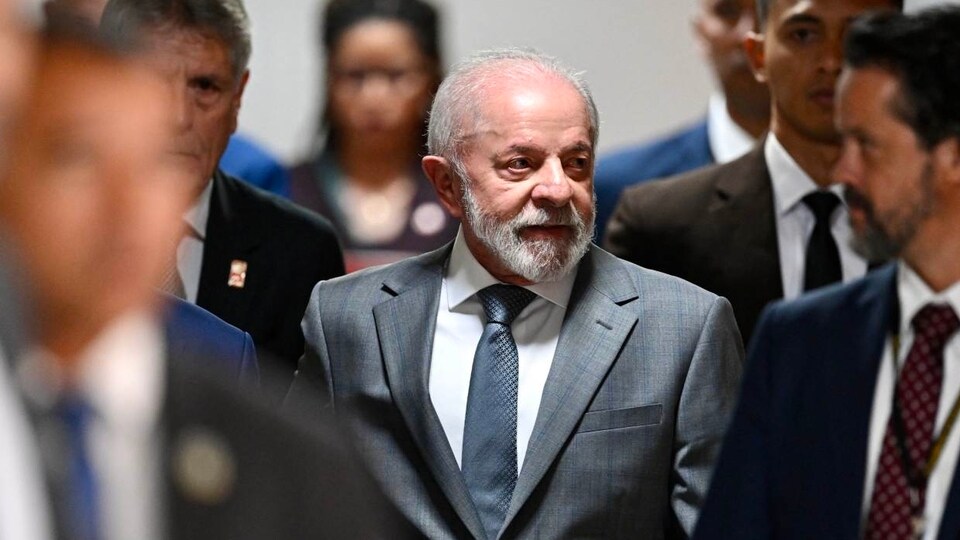
The U.S. will charge a 50% tariff on Brazilian goods starting Aug. 1, Trump told Brazilian President Luiz Inácio Lula da Silva on Wednesday, citing legal action against Bolsonaro as part of his reasoning.
Bolsonaro, a former army captain-turned-conservative icon, is on trial in Brazil after police accused him of plotting a coup in 2022 and conspiring to kill da Silva by poisoning him—charges that could land him in jail before next year’s elections.
“Brazil is a sovereign country with independent institutions, and it will not take orders from anyone,” da Silva wrote late Wednesday, when he called an emergency cabinet meeting to discuss Trump’s announcement. He said the Brazilian government would respond with reciprocity, without giving further details.
Bolsonaro has long said he is the victim of a witch hunt by the political left and that the country’s courts will stop at nothing to keep him out of office. Recent polls have shown he would win an election against da Silva, whose approval rate recently slumped to a record low of 24%, partly over dissatisfaction with the economy.
“This is nothing more, or less, than an attack on a Political Opponent,” Trump said of Bolsonaro’s trial in a message posted to social media Monday.
“He is not guilty of anything, except having fought for THE PEOPLE,” Trump wrote, drawing a parallel with his own legal problems: “LEAVE BOLSONARO ALONE!”
Bolsonaro responded with a passage from the Bible he posted to social media Wednesday: “When the righteous are in authority, the people rejoice: but when the wicked beareth rule, the people mourn.”
Brazil’s currency slumped more than 2% against the dollar late Wednesday, and exporters scrambled to calculate what the tariffs would mean for a country that already struggles to be competitive abroad.
Trump said the 50% tariff was necessary to level the playing field with Brazil and to “rectify the grave injustices of the current regime,” incorrectly stating that the U.S. had a trade deficit with Brazil. Brazil hasn’t run a trade surplus against the U.S., its second-largest trading partner, for more than a decade.
“This measure has the potential to severely impact jobs, production, investment, and integrated supply chains between the two countries,” said the American Chamber of Commerce in Brazil, urging both governments to reach an agreement.
Brazil’s National Industry Confederation called on da Silva to negotiate with Trump. “There is no economic factor that justifies a measure of this size,” said Ricardo Alban, head of the industry body.
For Bolsonaro’s supporters and the country’s conservative movement, Trump’s message was the validation they had been waiting—and lobbying—for since he retook office in January.
“Trump’s letter to the Brazilian president is clear, direct, and unequivocal,” Bolsonaro’s son, Eduardo Bolsonaro, who is also a politician, wrote a joint statement Wednesday with Paulo Figueiredo, a right-wing journalist. Both men, who are living in the U.S., are also under investigation over the coup allegations,
“This is a moment of national choice: will we follow the path of freedom, prosperity, and sovereignty, as the United States has? Or will we become a controlled and submissive society, much like China—so openly admired by Brazil’s Supreme Court?” they wrote.
Brazil’s government has three weeks to back down over the coup investigation or accept the tariff, they wrote, nicknaming it the “Moraes Tariff,” after Alexandre de Moraes, the Brazilian Supreme Court justice who has led criminal proceedings against Bolsonaro.
The Trump administration has been fighting de Moraes over his attempts to stamp out what he says is hate speech online by Brazil’s far-right, at home and in the U.S.
Elon Musk called de Moraes a dictator last year after the justice shut down his X platform in Brazil for more than a month. Trump’s media company, the parent of Truth Social, and video-sharing platform Rumble also sued de Moraes earlier this year, accusing him of illegally censoring political discourse on social media in the U.S.
Bolsonaro told The Wall Street Journal in November that he was banking on Trump to use economic sanctions against da Silva’s government to help him return to power in Brazil, where he also faces an electoral ban that prevents him from running for office until 2030.
Many analysts and politicians thought it was wishful thinking. But Trump has taken an increasing interest in the case.
Bolsonaro, who was president from 2019 through 2022, has been one of Trump’s closest foreign allies. Sharing similar views on the culture wars and scorn for the political left and the media, the two men deepened ties when their presidencies overlapped in 2019 and 2020. They also presented a united front against Venezuela’s authoritarian leader, Nicolás Maduro.
Write to Samantha Pearson at samantha.pearson@wsj.com


