Donald Trump’s latest climbdown suggests he may want to end the war
On Monday Mr Trump did the rounds of American business television channels, repeating his claims of “great conversations” with Iran.
Updated on: Mar 24, 2026, 15:57:27 IST
The Economist
Prefer HTon Google
Share via
Copy link
EARLY ON MARCH 23rd Donald Trump posted on social media that he was suspending for five days “ANY AND ALL MILITARY STRIKES AGAINST IRANIAN POWER PLANTS AND ENERGY INFRASTRUCTURE”. Less than an hour later the Israel Defence Forces (IDF) said that its planes were “currently conducting strikes on Iranian terror-regime targets in the heart of Tehran”.
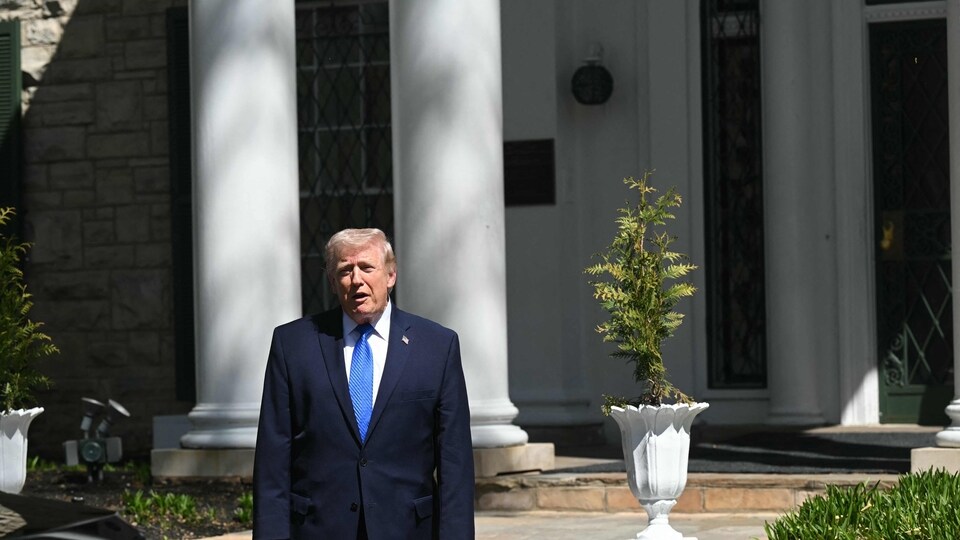
US President Donald Trump speaks to the press after departing from Graceland, the estate of Elvis Presley, in Memphis, Tennessee on March 23, 2026. (Photo by SAUL LOEB / AFP) (AFP)
That did not directly contradict Mr Trump’s post, which promised to spare only Iranian energy targets that he had previously threatened to strike should the Islamic Republic not halt its attacks on shipping in the Strait of Hormuz (it has not). Israeli raids are co-ordinated with the Americans, who continue to refuel Israeli fighter jets. But Mr Trump also claimed that America was in talks with Iran about the “COMPLETE AND TOTAL RESOLUTION OF OUR HOSTILITIES”. The IDF statement can be read as an expression of concern that Israel’s senior partner in the war with Iran may be about to bail out.
Is he? On Monday Mr Trump did the rounds of American business television channels, repeating his claims of “great conversations” with Iran. Iran has firmly denied the existence of such talks in public and rejected offers from America in private, according to a Gulf official. Meanwhile, an American marine expeditionary unit is still on its way to the Gulf and may yet be unleashed on Iranian positions overlooking the Strait of Hormuz or on Kharg Island, Iran’s main energy hub. Israelis hope that, by delaying strikes on Iran’s power plants, Mr Trump is merely playing for time to calm the energy markets.
But Mr Trump’s climbdown could also signal a divergence in American and Israeli war aims. Israel sees this war as a crucial step towards neutralising Iran’s military threat, its nuclear-and ballistic-missile programmes and support for proxies in the region, an objective it believes can only be achieved through regime change. Mr Trump has at times appeared to share these aims. But recently he has appeared more concerned with ensuring that oil flows out of the Gulf. He has twice criticised Israel during the war, both times after Israeli jets bombed targets related to Iran’s energy industry.
Mr Trump’s focus seems increasingly to be on averting a global energy crisis for which he would be blamed, including by trying to make a deal with whatever remains of Iran’s regime. Israel thus faces the prospect that the war will end without the attainment of the main objective stated by Binyamin Netanyahu, its prime minister: to prepare the ground for a popular uprising that would topple the Iranian regime.
The assassination of Supreme Leader Ali Khamenei and of other senior leaders, including Ali Larijani, secretary of the Supreme National Security Council, may have disrupted decision-making in Iran. But the Israeli government is frustrated that there are no signs of the regime’s implosion. Nor has Iran’s ballistic-missile programme been destroyed.
Israel claims that it has destroyed or buried around three-quarters of Iran’s missile-launchers and flattened the regime’s missile-production lines. But though its launch rate has slowed, Iran is still firing at least a dozen missiles a day towards Israel. The IDF claims it continues to intercept more than 90% of them, which would be an impressive rate. But those that get through can do real damage: on March 21st direct missile hits on the Israeli cities of Dimona and Arad injured around 180 civilians.
American and Israeli war planners did not begin the war thinking Mr Trump would be in it for the long haul. His record suggests a preference for speedy and flashy operations, such as the abduction of Venezuela’s president, Nicolás Maduro, in January. Last June he ordered an abrupt end to Israel’s previous war with Iran less than two days after the lone strike in which American B-2 bombers hit nuclear-enrichment facilities. The most important air strikes of the current war were concentrated in the first 100 hours of the conflict, in case the president called time on it.
Nevertheless, as the war progressed, Israeli ministers began to believe that Mr Trump would stick with it as long as Israel wanted. On March 22nd the IDF chief of staff, Lieutenant General Eyal Zamir, said the war was only “halfway through” and that it would continue throughout the seven-day festival of Passover, which begins on the evening of April 1st.
That may still happen. But it may not be in either Mr Trump’s or Mr Netanyahu’s gift to decide. The war’s unexpectedly long duration, as well as Mr Trump’s latest climbdown, undermine the idea that Iran’s regime is fragile and that regime change is possible. Instead, it is looking more likely that the ill-judged campaign will either drag on or end messily, with an Iran that is battered but defiant, and still able to inflict considerable damage on the region and the world.
Get the latest World News, breaking headlines and global updates from the US, UK, Pakistan, Bangladesh, Russia and other countries. Follow major international events on Hindustan Times.
Home/World News/Donald Trump’s Latest Climbdown Suggests He May Want To End The War

 E-Paper





 Prefer HTon Google