THE EGYPTIAN government likes to call Sharm el-Sheikh the “city of peace”. Every few years the resort town plays host to a big diplomatic confab. Sadly, the nickname is usually unearned. An agreement signed there by Israel and the Palestinians in 1999 was never implemented; an emergency summit the following year failed to end the second intifada, or Palestinian uprising.
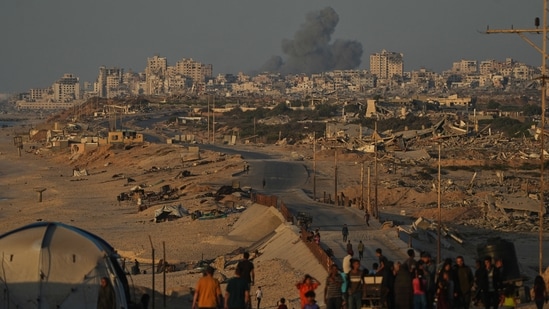
Israel, Hamas Peace Plan Deal. The peace plan calls for an immediate ceasefire in Gaza. (AP)
Perhaps this time will be different. Since October 6th negotiators from Israel and Hamas, a Palestinian militant group, have been in Sharm el-Sheikh to discuss Donald Trump’s plan to end the Gaza war. After two years of ruinous fighting, 67,000 dead Gazans and an ongoing famine in Gaza city, everyone is desperate for the talks to succeed.
Mr Trump sent his Middle East envoy, Steve Witkoff, and his son-in-law, Jared Kushner, to join the talks. Spymasters from Egypt, Qatar and Turkey flew in to put pressure on Hamas. The mood music is upbeat. Mr Trump says he is optimistic. Hossam Zaki, the deputy chief of the Arab League, says there is a better-than-even chance of a deal.
So far, however, no deal has been reached. The first two days of negotiations (billed as “technical” talks) yielded no real breakthroughs. The extent of Israel’s withdrawal from Gaza has emerged as a central disagreement. Diplomats hope that the arrival on October 8th of both Mr Witkoff and the Qatari prime minister would bring added pressure for Israel and Hamas to reach a compromise. If they cannot, Mr Trump may present a final offer in the coming days. There would be no further negotiations: Israel and Hamas would have to decide whether to take it or leave it.
The early impasse is dispiriting but predictable. Broadly speaking, there are two halves to the Trump plan, the first of which would be implemented within days of an agreement. Fighting would stop. Hamas would release the 48 Israeli hostages still in captivity, 20 of whom are thought to be alive, in exchange for 1,950 Palestinian prisoners held in Israeli jails. Israel would allow a big influx of humanitarian aid and pull back its troops from cities in Gaza, though a map published by Mr Trump on October 4th suggests it would continue to occupy around half of the enclave.
The second phase would stretch far into the future. It envisions a scheme to disarm Hamas; a transitional authority to govern Gaza; and a multinational peacekeeping force to provide security. The Israel Defence Forces (IDF) would eventually withdraw to a narrow buffer zone on Gaza’s periphery. At the end, if all goes well, Israel and the Palestinians would resume talks about a two-state solution.
Negotiators are trying to reach a deal on the first half while leaving the details of the second fuzzy. But the plan is not so easily cleaved in two. In public, some Hamas officials insist that Israel must withdraw completely from Gaza once the last hostage is released. That is a major change to the Trump plan, and a non-starter for Israel. In private, according to sources involved in the talks, Hamas might accept something less expansive. But it still wants firmer guarantees that Israel eventually will leave Gaza.
Optimists think there is still hope for a breakthrough. For the first time in two years, an American president is putting real pressure on Israel. The arm-twisting of Hamas is no less intense. In July the entire Arab League called on the group to disarm. Officials from numerous Arab countries have told Hamas that it has no choice but to accept the Trump plan. If they refuse, the consequences would not just fall on civilians in Gaza: the political leaders of Hamas themselves also risk exile from Qatar (and it is unclear who else might accept them).
But even as Arab leaders try to end the war, they are nervous about their role in what comes next. Reconstruction is one worry. Rich Gulf states will be on the hook to help pay for the rebuilding of Gaza, which the World Bank guesstimated in February would cost $53bn. They have endorsed an Egyptian plan to clear the rubble, build new homes and repair Gaza’s wrecked infrastructure. But they are reluctant to put money into Gaza if their investment might be blown up in a future war, a real concern if Hamas or other militant groups keep their weapons.
A peacekeeping force might help alleviate that fear, but the force is itself another worry. The idea of an international force is clever on paper but fraught in practice. Much of the Middle East thinks Israel is committing genocide in Gaza. No Arab leader wants to deploy their troops to police Palestinians alongside the IDF.
The strategy of splitting the deal and focusing on the short-term elements is also smart. The prospect of bringing home all of the hostages at once should be a powerful inducement for Israel to accept. It would also remove Israel’s main justification for continuing the war. Pressure from Mr Trump would then ensure it does not renege on the ceasefire. From there, diplomats would have time to negotiate about the future of Gaza; the promise of reconstruction could provide powerful leverage over Hamas.
But it is hard to solve one issue without addressing the others. Israel wants Hamas to disarm before it withdraws. Many of Hamas’s leaders say they will only relinquish their weapons to a future Palestinian state. Mr Netanyahu insists that state will never exist (as do many of his would-be successors). Negotiators are focused on the first few days after a two-year war—but after nearly eight decades, everything in the Israeli-Palestinian conflict is connected.
Get the latest headlines from US news and global updates from Pakistan, Nepal, UK, Bangladesh, Russia and US Iran war Live, get all the latest headlines in one place on Hindustan Times.
Home/World News/Hamas Says There Is “a Spirit Of Optimism” Over Peace Talks

 E-Paper