How Britain’s new prime minister can revive Labour
His supporters are more northern and more Green than Sir Keir’s
Published on: Jul 20, 2026, 16:58:47 IST
The Economist
Prefer HTon Google
Share via
Copy link
Moving house is always stressful. Around noon on Monday July 20th, Andy Burnham will move into 10 Downing Street and become prime minister. His predecessor, Sir Keir Starmer, will leave his house keys, Larry the cat and an unhelpful political legacy.
Around noon on Monday July 20th, Andy Burnham will move into 10 Downing Street and become prime minister. (AP Photo)
Labour MPs hope that by picking the former Greater Manchester mayor to replace Sir Keir they can clean the slate after two troubled years in power. Opinion polls suggest they might be right—at least for now. Mr Burnham is more popular than Sir Keir (a low bar), but he also has better ratings than the outgoing prime minister did two years ago, when he came to power. Sir Keir squandered the political capital he had at astonishing speed with a series of u-turns and reinventions that voters hated. Though Mr Burnham’s popularity might be equally short-lived, the data suggest that the new Labour leader could build a more enduring electoral base by uniting Britain’s fragmented centre-left voters.
To dig into Mr Burnham’s base of support, The Economist analysed a survey of 5,070 Britons conducted by Stack Data Strategy, a polling firm, between July 7th and 14th. The pollsters asked respondents which party they would vote for if an election were held tomorrow. They then repeated the question, asking respondents to consider how they would vote if Mr Burnham were leader of the Labour Party and prime minister. The effect was to add 2.1 percentage points to Labour’s vote share—a small but meaningful improvement (see map).
The new prime minister has tied his political identity to the north of England. Northerners have noticed. Across the region Labour’s vote share under Mr Burnham improves by around six points. In his stomping ground around Manchester the improvement is closer to ten points—not to be sniffed at. Only 26% of seats in Parliament are in the north of England but over the past decade the region has been rising in political salience. The Economist’s election model suggests that around 45% of the marginal constituencies which Labour needs to win for a parliamentary majority are in the north.
Mr Burnham’s northern roots are also an asset in Britain’s fraught class system. Despite his enjoying a relatively comfortable upbringing (his father was a BT engineer, his mother a doctor’s receptionist) followed by a degree at Cambridge University, around 46% of Britons say that Mr Burnham is working class. That compares with only 14% for Sir Keir (the son of a toolmaker) and 18% for the former health secretary, Wes Streeting, who was raised by a single mother in an east London council flat. According to Stack’s data, replacing Sir Keir with Mr Burnham would leave Labour’s vote share unchanged among respondents in the most middle-class occupations, while increasing it by 3.6 percentage points among those in the most working-class occupations.
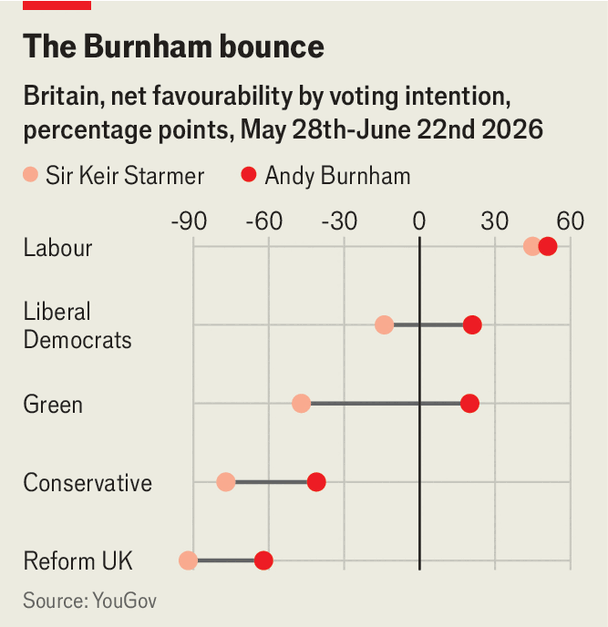
With Mr Burnham’s northern, working-class hue, some commentators mistakenly believe he is particularly appealing to supporters of the populist-right Reform UK (many of whom are northern or working class). In Stack’s polling, just 2% of Reform supporters switch to Labour when Mr Burnham is listed as party leader—compared with 4% of Liberal Democrats, 5% of Conservatives and 6% of Green supporters. According to YouGov, another pollster, Mr Burnham has a net favourability rating of +20 points among Green supporters and +21 among Liberal Democrats, compared with -62 among Reform supporters (see chart). The same voters gave Sir Keir ratings of -47, -14 and -92, respectively.
Winning tactics
Faced with this evidence, Mr Burnham might be encouraged to tack to his left, attempting to unite Britain’s broadly left-of-centre bloc in order to defeat Reform. This approach brings risks. The first is that left-wing voters tend to be concentrated in relatively few constituencies. On current polls, most Labour MPs will face Reform as the leading challenger in their constituencies. In these contests, switchers from Reform to Labour are in effect worth double.
The second risk is that left-wing voters might not reward Mr Burnham for left-wing policies. There is little evidence that Sir Keir’s most left-leaning policies have won him any friends. His approach—presenting himself as a moderate while pursuing a solidly centre-left agenda—has alienated voters to both his left and right, pleasing nobody.
In this respect, Mr Burnham begins his time in Downing Street with a head start. Before becoming prime minister, Sir Keir had to contort himself in order to be elected Labour leader by the party’s left-wing membership. As leader of the opposition, he then strained to persuade voters that he was in fact a moderate who had changed the Labour Party. Finally, in government, he had to satisfy the demands of left-wing backbenchers. The whiplash was too much: by May 2026 nearly three quarters of Britons thought the prime minister was indecisive, according to YouGov. By contrast, voters are still open to finding out what Mr Burnham stands for.
His first electoral test will come sooner than most predecessors’. On July 30th voters in Greater Manchester will elect Mr Burnham’s successor as mayor. Reform won the region with a clear margin in May’s local elections, but polls now suggest that Labour’s candidate—an ally of Mr Burnham—is on course for victory. It would be a good start for Labour.
Get the latest World News, breaking headlines and global updates from the US, UK, Pakistan, Bangladesh, Russia and other countries. Follow major international events on Hindustan Times.
Home/World News/How Britain’s New Prime Minister Can Revive Labour

 E-Paper





 Prefer HTon Google