E-Paper



Hyundai Raid Exposes Shortage of Visas for Asian Companies Trying to Move Staff
Asian companies are having trouble getting enough work visas for personnel needed to get U.S. factories running, immigration specialists say.


 Prefer HTon Google


The Trump administration wants tougher immigration enforcement. It also wants Asian manufacturing powerhouses to pour investment into U.S. factories.
Those goals are now clashing because Asian companies are having trouble getting enough work visas for personnel needed to get the U.S. plants running, say immigration specialists.
Last week, the contradiction was highlighted when the U.S. carried out an immigration raid in Georgia and arrested some 300 South Koreans helping to build a Hyundai Motor joint-venture battery plant.
Now the South Koreans are expected to head home soon under a diplomatic deal, and experts say it might take longer and cost more for Asian companies to build their U.S. factories without the specialists they need.
President Trump hinted at such concerns when he wrote on social media that his administration “will make it quickly and legally possible” for foreign investors “to LEGALLY bring your very smart people, with great technical talent to build World Class products.”
One cause of the issue is America’s shortage of skilled technical workers, which stems from a long-term decline in manufacturing employment and the offshoring of production. The U.S. lacks the workforce needed to support advanced industries such as semiconductors and biotechnology, according to a July report by the Center for Strategic and International Studies, a Washington think tank.
In semiconductors alone, an estimated 67,000 technical jobs are at risk of remaining unfilled by 2030 unless the workforce pipeline is expanded, according to the Semiconductor Industry Association.
Asian companies—mostly from South Korea, Japan and Taiwan—are investing hundreds of billions of dollars in U.S. manufacturing at the urging of both the Biden and Trump administrations.
The detention of South Korean workers at the Hyundai “Metaplant” site in Georgia unfolded as Seoul and Washington were finalizing a trade deal in which South Korea agreed to $350 billion in U.S. investments. In exchange, the U.S. said most South Korean exports to the U.S., including cars, would be subject to a 15% tariff instead of an earlier proposed rate of 25%.
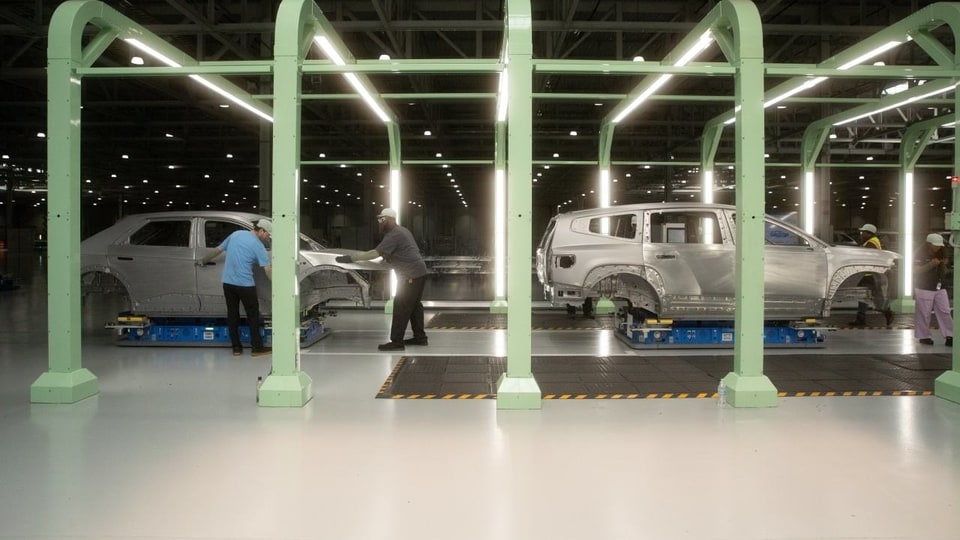
A production line at the Hyundai facility.
Companies say they are willing to hire and train an American workforce but can’t meet tight deadlines to get their plants running with Americans alone.
That is why it is common for hundreds of employees from the home country to descend on big project sites. Companies such as Hyundai and its battery-making partner, LG Energy Solution, often bring along the same contractors they work with at home. Around 250 of the roughly 300 South Koreans arrested worked for contractors, LG Energy said.
The detainees largely held temporary visas suitable for short-term training and supervising purposes, such as the B-1 visa, and many were working at the site as instructors, according to South Korean officials. Some had arrived in the U.S. through a visa-waiver program that allows entry for up to 60 days for travel and certain limited business activities, they said.
Don Southerton, a consultant who has advised South Korean companies including Hyundai on operating in the U.S., said some Korean firms and their contractors in the past used visa-waiver programs for short-term travel or business visits without triggering scrutiny.
“I don’t think they ever had to worry about it,” he said. “And there has been so much encouragement for these plants to be” in the U.S., he said.
U.S. authorities said those arrested illegally crossed the border, entered through a visa waiver program that prohibited them from working or overstayed their visas.
Hyundai said it was reviewing its processes to ensure that its partners “maintain the high standards of legal compliance that we demand of ourselves.”
Other nonimmigrant employment visa types allow companies to bring in workers for longer periods, but they aren’t easy to get.
The H-1B visa lets companies operating in the U.S. hire foreign workers in specialty jobs such as tech and engineering. The annual cap recently has been under 100,000 visas.
The E-2 visa is designed for specialized workers at U.S. units of companies from regions with commerce treaties with the U.S., a category that includes Taiwan, South Korea and Japan. Approval standards have been getting tougher as applications surge in South Korea, whose firms are overseeing many large projects in the U.S., said Hong Chang-hwan, a lawyer at Seoul-based firm Kookmin Emigration who specializes in U.S. immigration matters.
“The U.S. might say such workers can be hired locally, but Korean firms say such talent is difficult to find and deploy quickly in a plant that you’re trying to get going on schedule,” he said.
In 2023, Taiwan Semiconductor Manufacturing sought to bring in some 500 experienced workers to accelerate construction, igniting a protest by Arizona’s construction unions. TSMC said the workers were there only for short-term support, with no impact on local hiring.
South Korea’s trade and industry minister said last year that visa challenges have made it hard for many South Korean conglomerates to dispatch workers to the U.S. and increase investments there.
In July, Rep. Young Kim (R., Calif.) and others introduced a bill that would allot 15,000 visas for South Koreans with specialized education or expertise. The bill, proposed in varying versions over the past decade, hasn’t moved forward.
Similar visa categories have been created for countries such as Australia and Singapore through free-trade agreements. The U.S. grants more than 10,000 E-3 visas annually to Australian nationals in specialized fields, enabling them to work for up to two years in the U.S., renewable indefinitely.
Wendy Cutler, a former U.S. trade negotiator who is now at the Asia Society Policy Institute, said South Korea pushed hard for special visas like those granted to Australia and Singapore when it negotiated its own free-trade deal with the U.S., which took effect in 2012. Seoul ultimately didn’t get them, although it did get included in the visa-waiver program.
With investment a U.S. priority, “a longer-term solution is urgently needed,” Cutler said.
Write to Jiyoung Sohn at jiyoung.sohn@wsj.com and Yang Jie at jie.yang@wsj.com