
 E-Paper



John Clarke, Michel Devoret and John Martinis get Nobel Prize in Physics 2025
The Nobel Prize in Physics is awarded by the Royal Swedish Academy of Sciences.

 Prefer HTon Google


The Nobel Prize in Physics 2025 has been awarded to John Clarke, Michel H Devoret and John M Martinis “for the discovery of macroscopic quantum mechanical tunnelling and energy quantisation in an electric circuit.”
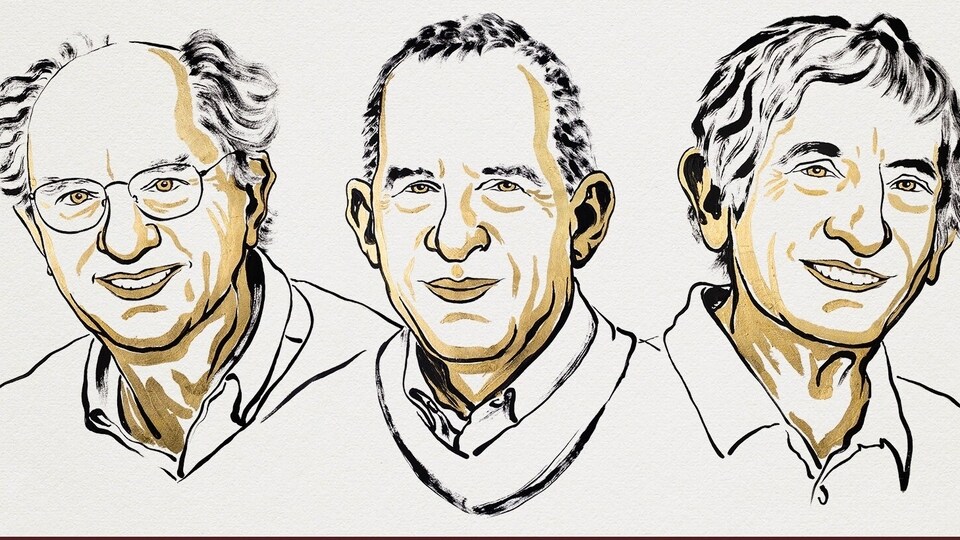
The Royal Swedish Academy of Sciences, which announced the award, said the laureates used a series of experiments to demonstrate that the bizarre properties of the quantum world can be made concrete in a system big enough to be held in the hand.
"Their superconducting electrical system could tunnel from one state to another, as if it were passing straight through a wall. They also showed that the system absorbed and emitted energy in doses of specific sizes, just as predicted by quantum mechanics," the release said.
Last year, the Nobel Prize in Physics was awarded to John Hopfield and Geoffrey Hinton. They were recognised for their use of physics tools to develop methods that form the basis of today's powerful machine learning.
Hopfield created an associative memory that can store and reconstruct images and other patterns in data, while Hinton invented a method that can automatically find properties in data, allowing it to identify specific elements in images.
Earlier on Monday, scientists Mary Brunkow, Fred Ramsdell, and Shimon Sakaguchi were awarded the Nobel Prize in Physiology or Medicine 2025. They were recognised for their pioneering discoveries in peripheral immune tolerance: a process that allows the immune system to fight harmful microbes without turning against the body's own cells.
Nobel Prizes are also handed out for outstanding achievements in chemistry, literature and peace, and they come with a prize amount of 11 million Swedish crowns ($1.2 million). The award bestows instant fame on the recipients that is unthinkable for the vast majority of scientists.
ALSO READ | AI pioneers Geoffrey Hinton, John Hopfield win 2024 Nobel Prize in Physics
The Nobel Prize was created by a wealthy Swedish chemist and entrepreneur, Alfred Nobel. He dictated in his will that the bulk of his estate should be used to fund "prizes to those who, during the preceding year, have conferred the greatest benefit to humankind".
The awardees are selected by the chosen institutes, category-wise. The Royal Swedish Academy of Sciences for chemistry and physics, the Swedish Academy for literature, Sweden's Karolinska Institute medical university for physiology and medicine, and the Norwegian parliament for peace.
Additionally, the Prize in Economic Sciences in the memory of Alfred Nobel was established by Sweden's central bank in 1968, when it was celebrating its 300th anniversary. It also carries a donation to the Nobel Foundation.


