Pakistan Prime Minister Imran Khan has acknowledged that some terrorists in Pakistan had fought in Kashmir while asserting that he had the army’s support for disarming them and for overtures to India.
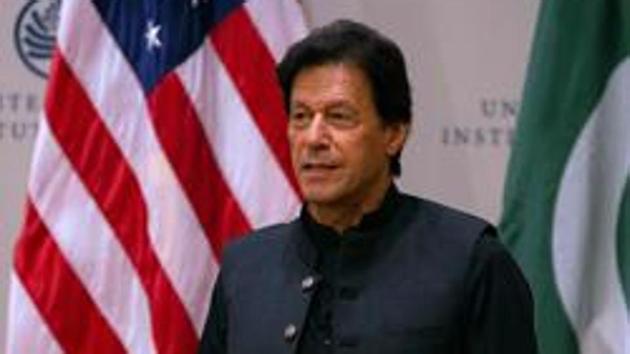
Speaking at the US Institute of Peace in Washington on Tuesday, he tried to make the case that the army and the security forces were not patronising the terrorist groups and backed the crackdown, while letting slip about their role in Kashmir.
He also admitted that the Pakistan-based terror group Jaish-e-Mohammed was operating in India.
He said that because some of the terrorists were trained and had experience of fighting in Kashmir, the police can’t handle them and the army’s help is required.
Khan said: “It was said normally that the security forces patronised the groups. We would not be disarming if the security forces were not standing behind us. You cannot disarm because the police is incapable of disarming these groups. They are trained, these people have experience of fighting in Afghanistan, some in Kashmir. The police cannot go after them, so it is the army that is helping us disarm all militant groups in our country.”
In a country where the military has ruled directly or from behind the scenes ensuring its hardline policies were followed and toppling elected governments there is skepticism about how far a civilian government can set the agenda.
{{/usCountry}}In a country where the military has ruled directly or from behind the scenes ensuring its hardline policies were followed and toppling elected governments there is skepticism about how far a civilian government can set the agenda.
{{/usCountry}}Khan tried to dispel this notion where his elected civilian government was concerned, even in regard to India, and assert that he had the military’s backing.
But he stopped short of claiming that the military establishment was under civilian control as it should be in a democracy.
“Whatever our policies from the day we arrived, on peace with India, they were behind (me), when I decided to release the Indian pilot who had been shot down in Pakistan, the army was right behind me,” Khan said. “So today as we speak, you know, there is no difference between the policies of the Pakistan security forces or Pakistan’s democratic government”.
Wing Commander Abhinandan Varthaman was captured by Pakistan when his Mig-21 was shot down along the Kashmir border in the days after the Phulwama attack in February and returned to India.
He said that even before the Phulwama terrorist attack in which a convoy of Indian security forces were attacked by a car bomb, Pakistan had decided to disarm “all militant groups” and all the political parties had backed it.
“But because this group claimed responsibility, which was in India as well -- Jaish-e-Mohammed was operating in India -- Pakistan suddenly came in the limelight,” he said.
“Even before this had happened, we had already decided that we will disarm all militant groups in Pakistan. And it is Pakistan’s interest, I repeat it is in our interest, because the country has had enough of militant groups,” he added.
However, Khan tried to brush off the role of Pakistan-based terror groups in the Phulwama incident claiming that it was an indigenous attack by a “Kashmiri boy radicalised by the brutality of the security forces”.
Khan admitted that whenever there was progress in improving ties between India and Pakistan it was met by some incident that caused a reversal. But he did not say who was behind the incidents that setback peace.
He said, “Unfortunately because of one issue of Kashmir whenever we have tried, whenever our relationship has started to move in the right direction with India, some incident happens -- and that is all related to Kashmir -- we go back to square one.”
Khan claimed that two of the three former Foreign Ministers who had joined his party “told me that actually, they came pretty close in the time of General (Pervez) Musharraf and when (Atal Behari) Vajpayee was the Prime Minister of India, apparently they came pretty close, there was some sort of convergence on a phased movement on Kashmir, on various steps to be taken and over a period of time some sort of a referendum”.
He did not say who they were, but one of the former foreign ministers with him is Shah Mehmood Qureshi, who holds the portfolio now, and another is Khurshid Mahmud Kasuri, who was in office when Vajpayee was Prime Minister.
“Anyway, I don’t want to say anything right now because it is a delicate issue, but there is a solution and the solution has to be with the will of the people of Kashmir”, he added.
(This story has been published from a wire agency feed without modifications to the text.)