
 E-Paper



President Xi faces growing dissent in China over enforced Covid lockdowns
In the year when Xi Jinping will get third term as party boss and President, Shanghai, Shandong, Beijing, Hong Kong and Anhui have become hot spots for public venting their anger against the government on streets and triggering off retaliation from the enforcement agencies.

 Prefer HTon Google


Despite the iron-clad authoritarian rule of the Communist Party of China led by President Xi Jinping, fault lines are perceived to be deepening between Beijing and public with the rising number of demonstrations and strong response from the government across major population centers in China.
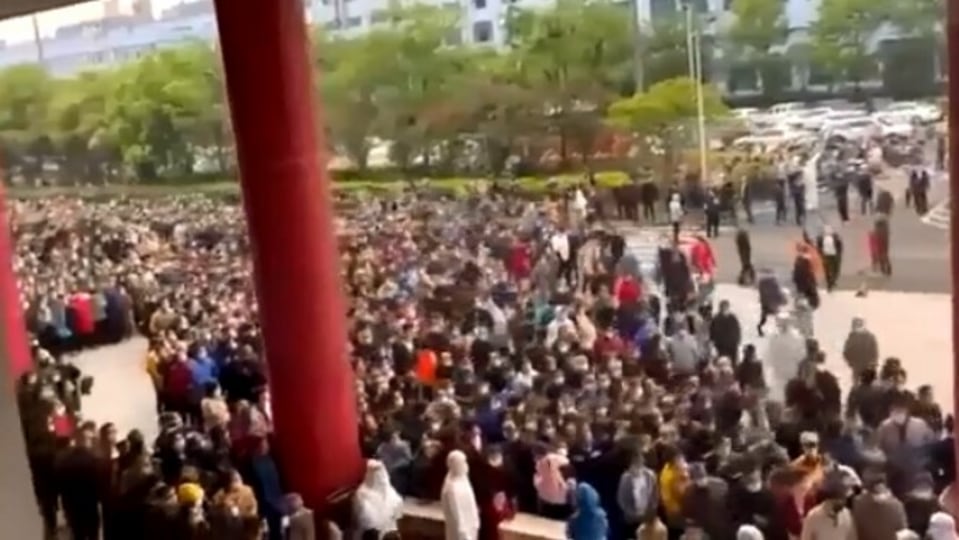
According to data collated by Hindustan Times from open sources, no less than 430 civilian demonstrations have taken place since January 2022, triggering some 120 strong authoritarian responses from the Xi Jinping regime. The primary trigger of the protests has been brutal enforcement of Covid lockdowns in high population density areas leading to delay in salary disbursement, scarcity of daily commodities and apparent apathy of the local governments. The cities which have been vulnerable to such protests are Shanghai, Shandong, Beijing, Hong Kong, and Anhui.
While such protests are considered normal in democracies like India, US, UK and Europe, public reaction is rather unheard in the Chinese hinterland with the CPC dealing with dissent with an iron hand. This growing anti-establishment sentiment in flash zones is a matter of concern for Beijing as President Xi will be re-elected as the eternal leader for the third term this October-November.
China has been witnessing an uptick in civilian protests and subsequent crackdown by authorities in the most vulnerable areas since January 2022, indicating a growing anti-establishment sentiment in these flash zones. In some places, the protests turned into violent riots which elicited a coercive response by the administration, fuelling the vicious cycle of violence and dissent.
Shanghai
In Shanghai, the violent state response to civilian demonstrations against extended lockdown caused rioting. While the capital city of Beijing reported the forced disappearance of protestors in the aftermath of peace protests, Hong Kong – the semi-autonomous region that has implemented the draconian national security law – witnessed a clampdown on public services and intimidation of protesters by local law enforcement in response to the protests.
At least six municipality districts in Shanghai have reported violent crackdowns by the administration or clashes between civilians and police. In Jinze township of Qingpu district, dozens of rioters clashed with police on May 3, 2022, as they tried to prevent the arrest of a man who accused a supermarket of reselling pork donated by another province during the Covid lockdown. The rioters were frustrated by the claim that the supermarket was reaping profits from food donations, especially at a time when they were facing difficulty in obtaining affordable food.
In the Songjiang district, over 100 workers at a Taiwanese-owned Apple supplier industrial compound threw rocks at their Taiwanese manager’s dormitory against their confinement and overtime work during the lockdown. They were reportedly frustrated with inadequate pandemic prevention measures that led to some of the employees testing positive for Covid.
The authoritarian response to minor violations during the lockdown was on display in the Pudong district where epidemic prevention personnel beat up a professor outside his residential building for leaving home to collect food delivery. The man was diagnosed with brain concussion and eye injuries after the assault.
Shandong
Daily wage labourers, factory workers and other industry unions mobilised in Shandong province over delayed payments and salary dues. The administration's response ranged from intimidation with violence to the detention of protesters. In April-May, a large group of construction workers protesting were intimidated with violence by the state-owned construction firm into calling off the demonstrations. In the Laishan district, schoolteachers protesting in Yantai Development Zone Senior High School were detained by the local authorities resorted to, fuelling increased demonstrations.
Beijing
The reports of forced disappearances of civilians in response to peaceful protests in Beijing show the growing unrest. Last month, a petitioner from Sichuan was held by police in incommunicado detention at an unknown place after the petitioner was taken to the police station in Fengtai district, a municipality in Beijing. The government officials intercepted a female human rights defender from Suzhou when she was boarding a train in Beijing on Jul 20, 2022.
Hong Kong
The semi-autonomous region saw the most number of peaceful protests and clampdown measures. Hong Kong authorities have responded to protests with strategic regulations including warrants for home searches and arrest of protestors, regulating access to public spaces, terminating railway services, and diverting public bus services. At least 13 incidents were reported within seven weeks, with Hong Kong city and Central and Western Hong Kong being the centre of coercive action.
A crowdfunded investigative news platform, Factwire, announced its immediate disbandment for unclear reasons. This was followed by the disbandment of a pro-democracy medical alliance, The Hospital Authority Employees Alliance (HAEA), due to 'pressure from all sides and the current political stalemate’. HAEA became one of at least 58 civil groups that have disbanded since the passage of the national security law. On June 26, Hong Kong police arrested three people in separate cases for possessing offensive weapons and posting threats against government officials or selling weapons for illegal assembly.


