E-Paper



‘Rigged tribunal’: Former Bangladesh PM Sheikh Hasina on death sentence
Sheikh Hasina and two top aides were tried by the International Crimes Tribunal, a domestic war crimes court, for their role in handling the student-led protests last year.

 Prefer HTon Google


Former Bangladesh premier Sheikh Hasina on Monday reacted to the death sentence given to her for crimes against humanity by saying it was announced by a “rigged tribunal established and presided over by an unelected government” and aimed at nullifying her Awami League party as a political force.
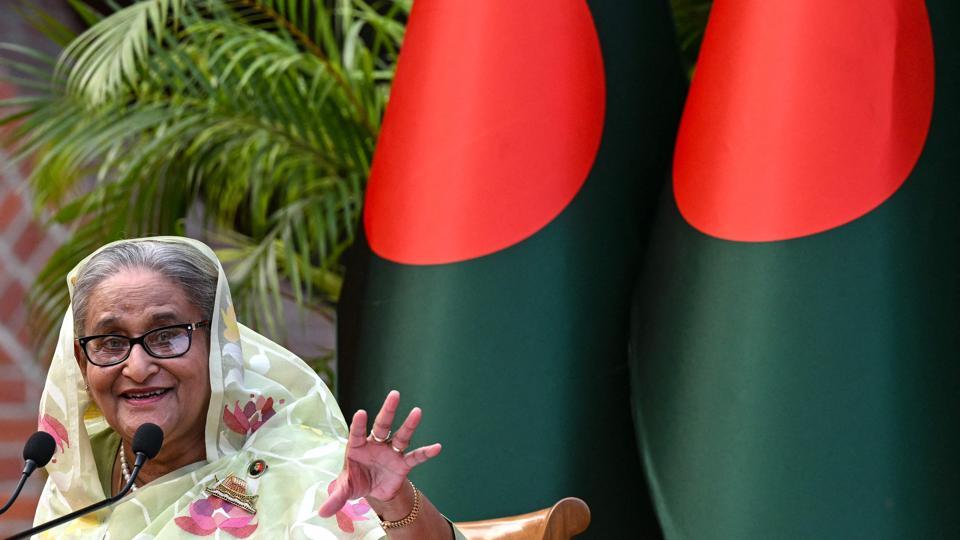
“Millions of Bangladeshis toiling under the chaotic, violent and socially regressive administration of Dr Mohammad Yunus will not be fooled by this attempt to short-change them of their democratic rights,” Hasina said in a statement issued shortly after the International Crimes Tribunal (ICT) gave her the death sentence for ordering the use of lethal force against protesters last year.
“They can see that the trials conducted by the so-called International Crimes Tribunal (ICT) were never intended to achieve justice or provide any genuine insight into the events of July and August 2024,” said the 78-year-old former premier who has lived in self-exile in India since she fled Dhaka after the ouster of her government in August 2024.
The ICT’s verdicts – a death sentence and a separate sentence of imprisonment until death for inciting, facilitating, being complicit in, and failing to prevent crimes against civilians – were “made by a rigged tribunal established and presided over by an unelected government with no democratic mandate”, she said.
“They are biased and politically motivated. In their distasteful call for the death penalty, they reveal the brazen and murderous intent of extremist figures within the interim government to remove Bangladesh’s last elected prime minister, and to nullify the Awami League as a political force,” Hasina said.
Hasina and two top aides were tried by the ICT, a domestic war crimes court, for their role in handling the student-led protests last year that led to the fall of the Awami League government after 15 years in power. The Indian government has so far not acted on a request made last year by the interim government led by Muhammad Yunus to extradite Hasina to Bangladesh.
Hasina also attacked Yunus, saying public services had fallen apart under the interim government and police have “retreated from the country’s crime-ridden streets and judicial fairness has been subverted, with attacks on Awami League adherents going unpunished”.
She added: “Hindus and other religious minorities are assaulted, and women’s rights suppressed. Islamic extremists inside the administration, including figures from Hizb-ut-Tahrir, seek to undermine Bangladesh’s long tradition of secular government.”
Hasina alleged that Bangladesh’s economic growth has stalled and Yunus has “delayed elections and then banned the country’s most longstanding party (the Awami League) from participating in those elections”.
Yunus has said that the general election will be held in February, along with a referendum to amend the Constitution. He has also said that Hasina’s continued presence in India, and her engagement with the media, has strained bilateral relations.