
 E-Paper



Russia faces test of support at special UNGA session
India on Sunday had abstained on a UN Security Council resolution to convene this rare emergency special session of the UN General Assembly on Russia’s aggression against Ukraine.

 Prefer HTon Google


Responding to a call by the United Nations Security Council (UNSC) — a vote in which India abstained — the 193 member-strong United Nations General Assembly (UNGA) held an emergency special session on Monday to discuss a resolution “deploring” Russian aggression in Ukraine and calling on Moscow to withdraw troops.
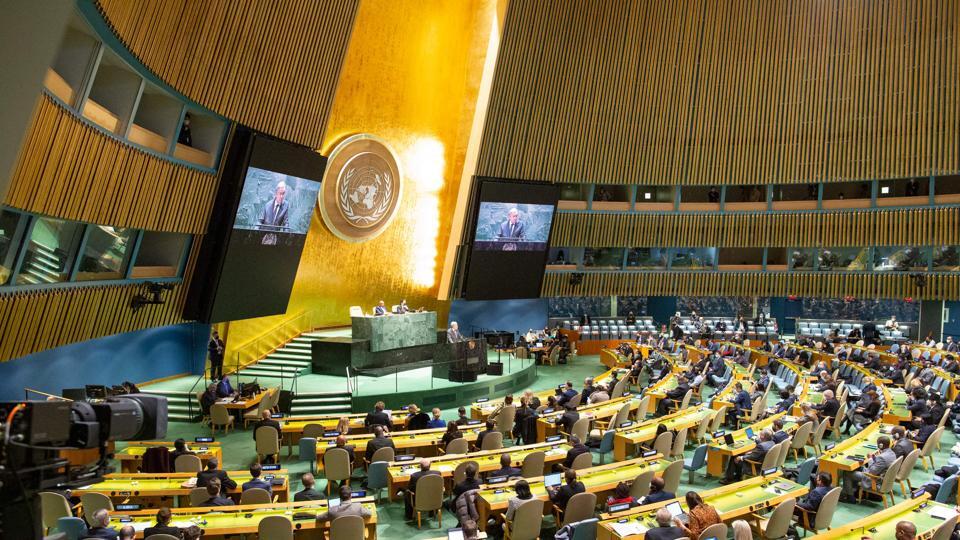
It is only the 11th such UNGA session since 1950, and is being held in the backdrop of a worsening military and humanitarian situation in Ukraine.
UNGA deliberations are still underway, but the US-backed resolution is likely to get the support of an overwhelming majority of countries.
The US is hoping to use the UNGA resolution, which is non-binding in nature, to add to the international momentum against Russia.
“Russia cannot veto our voices. Russia cannot veto the Ukrainian people. And Russia cannot veto the UN Charter. Russia cannot, and will not, veto accountability,” US ambassador to the UN, Linda Thomas-Greenfield said on Sunday.
Also read | Russia, Ukraine end peace talks in Belarus, to hold second round after consultations
UNGA president Abdulla Shahid said that Russia’s military offensive was a “violation of territorial integrity and sovereignty of Ukraine”, and called for an immediate ceasefire, maximum restraint and a full return to diplomacy and dialogue. Shahid said that the current military offensive “was an affront to the founders of the UN” and everything it stood for, and warned of the humanitarian consequences of the conflict, including “mass exodus of refugees” and the conversion of checkpoints at borders into choke-points.
UN Secretary General Antonio Guterres was more pointed. “The fighting in Ukraine must stop. It must stop now….Russian missile and air bombardments are pounding Ukrainian cities day and night.”
He also called Russia’s decision to put its nuclear forces on alert “a chilling development” and said that he had assured Ukraine of continued UN humanitarian assistance.Guterres warned that the world was facing what could “easily become Europe’s worst humanitarian and refugee crisis in decades”.
“Some of the possibly consequences of a worsening conflict are terrifying to contemplate. Regional tensions are rising. The latest security measures underline the high stakes for all. The economic repercussions of the crisis will have widespread impact,” he said.
After a deadlock in its last meeting on Friday due to Russia’s veto, the UNSC, on Sunday, had called for a rare emergency special session — the decision was backed by 11 members, while India, China and United Arab Emirates abstained from the vote. Since this was a procedural vote, Russia’s veto was not applicable.
On Sunday, in its explanation of the vote, India maintained its partially critical stance on Russia it had taken during Friday’s UNSC meeting, but while focusing on principles and without naming Russia, emphasised the importance of a return to the diplomatic path, and flagged the importance of the safety of its nationals and the need to ensure smooth cross border movement as a humanitarian necessity.
India’s permanent representative to the UN, TS Tirumurti, said that it was “regrettable” the situation had taken a turn for the worse since the Council last met. Russia has continued its military offensive in Ukraine’s biggest cities, while Ukraine’s resistance has intensified.
A humanitarian crisis has emerged with mounting casualties and massive outflow of people from Ukraine — according to UN high commissioner for refugees, 368,000 people had left Ukraine since February 24 as of Sunday. So far there have been 352 civilian casualties, including 14 children, and over 1600 people have been injured, according to the Ukrainian government.
Russian president Vladimir Putin ordered the military to put nuclear forces on alert, which the US has called an “unnecessary and escalatory step that threatens us all”. For their part, the US, other G7 countries, and the European Union have imposed unprecedented financial and export control sanctions on Russia.
India said there was no choice but to return “to the path of diplomacy and dialogue” — it had on Friday said that it regretted that the diplomatic route was given up, an indirect critical reference to Russia’s decision to take the military route — and pointed out that Prime Minister Narendra Modi had urged, in his conversations with Russia and Ukraine’s leaders, for a return to this path. India welcomed Sunday’s announcement of talks between both sides at the Belarus border. These talks were held in Minsk on Monday.
India also reiterated that the global order was “anchored on international law, UN charter and respect for the territorial integrity and sovereignty of all states”.
“We are all agreed on these principles.” The reiteration of commitment to the principles — which was first articulated by India on Friday at UNSC — has been read a signal that while Russian aggression may not draw India’s public opposition, Delhi is uncomfortable with the action.
Reiterating that its priority was the safety of its nationals, India said that evacuation efforts had been “adversely impacted” by the “complex and uncertain situation at the border crossings”, highlighted the importance of maintaining an “uninterrupted and predictable” movement of people, and called it an “urgent humanitarian necessity” that must be addressed.
India’s position comes in the backdrop of foreign secretary Harsh Vardhan Shringla saying that there have been challenges at the Poland border crossing.
India has now abstained from three votes in the UNSC on the Ukrainian crisis — first at the end of January on a procedural vote to take up the matter in the UNSC, then during Friday’s discussion on the resolution deploring Russian aggression, and then on Sunday on whether to take it to the UNGA.
The UNSC’s resolution calling for a special emergency session of the UNGA stems from a rarely-used instrument available in UN procedure — the last time the Security Council did this was four decades ago, and there have only been seven instances of UNSC referring a matter to the UNGA in the manner that did it on Sunday. The resolution is based on the argument that due to the lack of unanimity among the permanent five members, UNSC has failed to discharge its responsibility of the maintenance of international peace and security.


