
 E-Paper



Scientists to use NASA's James Webb telescope to track asteroid as odds of hitting Earth rise
NASA's James Webb Space Telescope will study asteroid 2024 YR4, which has a 2 per cent risk of striking Earth in 2032, up from 1 per cent since its discovery.

 Prefer HTon Google


Scientists are using NASA's James Webb Space Telescope to study an asteroid, dubbed as ‘city-killer’, that has a small chance of striking Earth less than eight years from now.
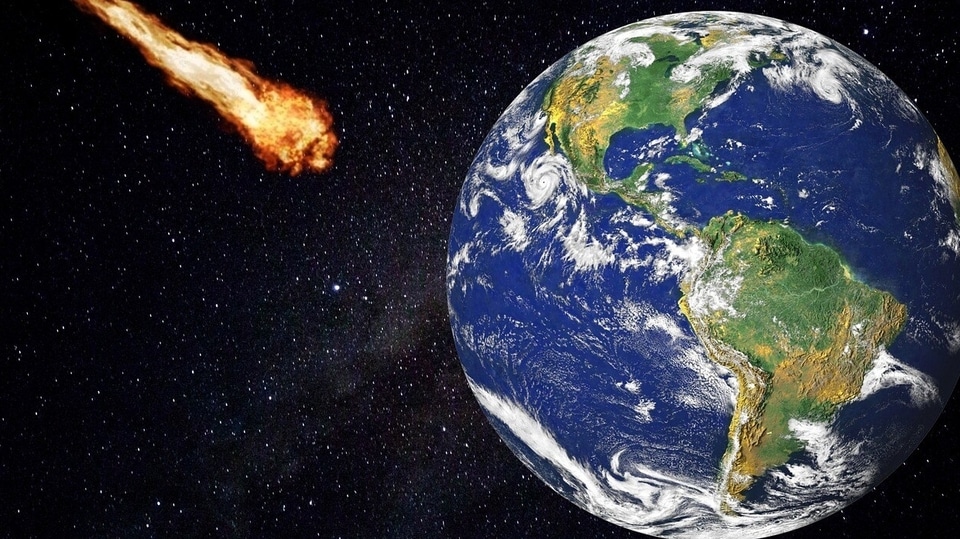
The space rock is formally named 2024 YR4. According to scientists, the asteroid currently carries a 2 per cent risk of making contact with Earth when it eventually reaches near it on December 22, 2032. While the odds of it crashing into the planet are minuscule, they have risen considerably since it was discovered late last year.
According to the European Space Agency, the odds stood at 1 per cent in January. NASA's Jet Propulsion Laboratory raised the estimated risk to 1.6 percent towards the end of the same month.
Officials at both agencies acknowledge the unlikelihood of 2024 YR4 causing problems. According to the ESA, current risk estimates are probably unnecessarily high because the people studying the asteroid are still uncertain about some of its key features.
Current estimates put the asteroid somewhere between 40 meters and 90 meters wide.
"It is very important that we improve our size estimate for 2024 YR4," CBS News quoted the ESA statement, which noted, "the hazard represented by a 40-meter asteroid is very different from that of a 90-meter asteroid."
The ESA said that to gain a greater understanding of the asteroid and better prepare for whatever is to come, astronomers will use the Webb Telescope to collect data on its size that could not be observed as accurately without the telescope's technology.
Where scientists are generally limited to observing the asteroid based on the amount of visible light it reflects from the sun, with brighter light typically signaling a larger asteroid, the Webb telescope can calculate its infrared emissions, allowing for more accurate estimates.
The telescope will begin studying the asteroid at its brightest in March this year, and again in May, according to the ESA. 2024 YR4 will disappear from view till 2028.
What would be 2024 YR4’s impact if asteroid hits Earth?
Even if the 2024 YR4 asteroid does end up hitting Earth in 2032, its impacts would be localised. It has nonetheless received a Level 3 rating, out of 10, on the Torino Impact Hazard Scale, which is a fairly rare distinction meant to represent "a close encounter" that warrants public and scientific attention.
"An asteroid this size impacts Earth on average every few thousand years and could cause severe damage to a local region," the ESA said in a previous statement about 2024 YR4.
According to NASA, its potential impact sites could include areas over the eastern Pacific Ocean, northern South America, the Atlantic Ocean, Africa, the Arabian Sea, and South Asia.
If it ends up hitting a populated area, it would be devastating but local, hence the nickname ‘city-killer'.


