E-Paper



The Catholic Church Has a Manpower Problem: Fewer Priests Every Year
Seminary enrollment is declining in most regions. It’s creating a historic shift that will reshape the Church.


 Prefer HTon Google


VENEGONO, Italy—One of Pope Leo XIV’s biggest quandaries is a question God himself asked: Whom shall I send? As in the book of Isaiah, few are answering “Here I am.”
A sharp, decadelong decline in the number of young men who want to become priests has only accelerated since the pandemic. The lure of other career options and a growing wariness about a lifelong—and celibate—commitment is leading Catholics to turn away from a once honored path, even in the faithful global South.
“We live in a culture caught in the paralysis of endless options, where choosing one path feels like closing the door on countless others,” said Pietro Ferrera, a 30-year-old seminarian in Italy who has a degree in physics. It has had a cascading effect.
Since 1970, the global Catholic population has doubled, but the number of priests has dipped. As aging clergy die, the ranks of those waiting to take their place has dwindled, leaving some parishes with no leader. Seminaries are closing or merging across the Church’s European heartland, which for centuries trained most of the world’s priests and sent them to evangelize the furthest corners of the globe.
The new pontiff, American Robert Prevost, has appealed to those considering the priesthood to not give up.
“Despite the signs of crisis that pervade the life and mission of priests, God continues to call and remains faithful to his promises,” Pope Leo told seminarians and priests in Rome in June. He spent much of his own adult life abroad as a missionary and parish priest in Peru.
Pope Leo called on believers to do more to attract young people to the Church. He’s doing his part: The pontiff this summer hosted Catholic social-media influencers at the Vatican and participated in a Catholic youth festival in Rome that was attended by around one million teens and young adults from Europe and beyond. Earlier this month, the church recognized its first millennial saint, the tech-savvy teenager St. Carlo Acutis.
From countless cardinals to a clergy crisis
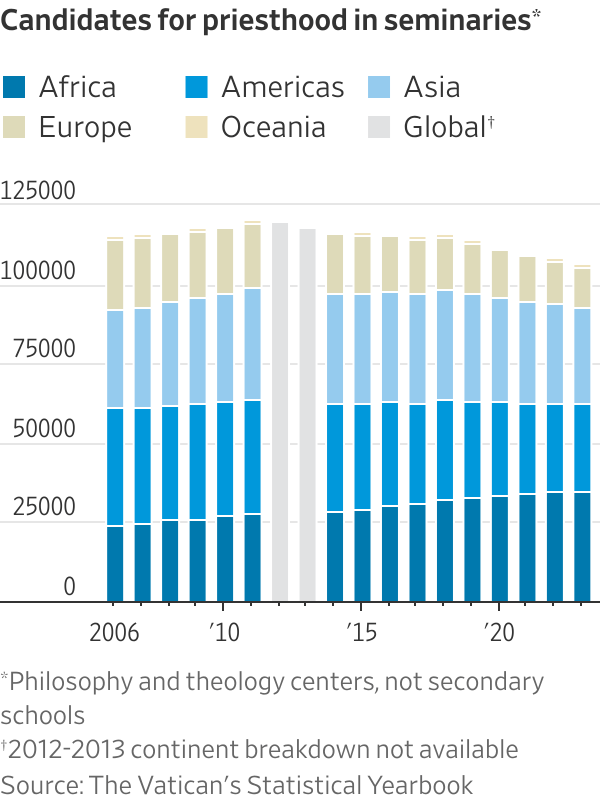
Seminary enrollment in the West has atrophied for decades as the culture became more secular. In the past five years, the number of young men entering seminary to become priests has also consistently declined in Latin America and Asia, leaving Africa as the only region still growing. Globally, the number of seminarians tumbled by some 14,000 between 2011 and 2023 to 106,495.
St. Patrick’s seminary near Dublin, Ireland, once the world’s largest with room for 500 seminarians, is down to an average of 15 new seminarians a year. The 130-year-old St. John’s seminary in southern England, built to accommodate 100 seminarians, closed in 2021 after getting no new applicants.
The decline has also hit the Church’s traditional home in Italy, the wellspring of most popes and countless cardinals.
“Decades ago, being born in Italy was almost synonymous with belonging to the Church. That’s no longer the case,” says the Rev. Enrico Castagna, dean of the Archdiocese of Milan’s seminary in Venegono.
The sprawling campus in this small town outside Milan has a towering Basilica, two vast wings and rambling gardens. It was built a century ago to house about 600 students, including those at a parish high school.
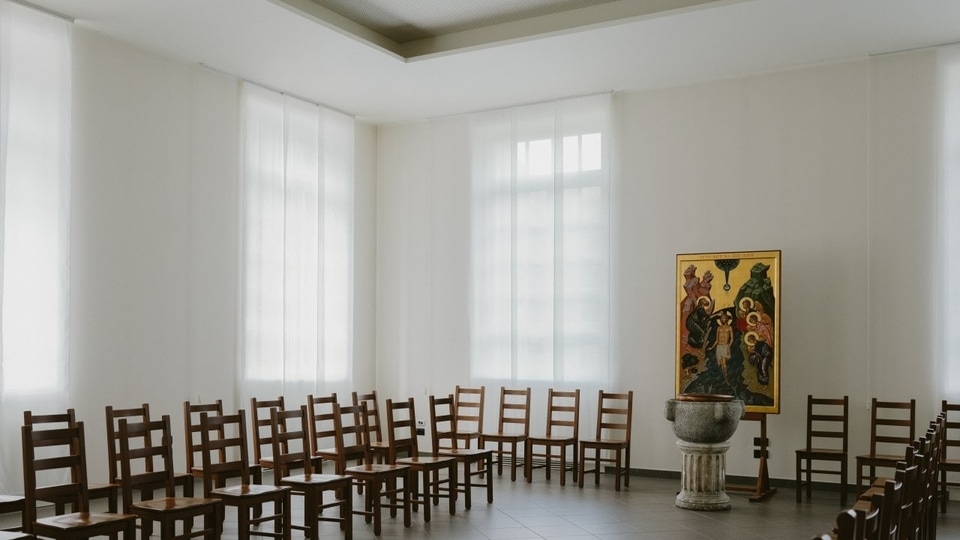
Now, the high school is closed from lack of demand and one of the seminary’s two wings is shuttered. Castagna is considering turning the wing into a nursing home. Just 54 seminarians study here today—a third of the number a decade ago.
Castagna has come to terms with the new reality. “Our generation has processed a form of grief—grief for a certain type of Christianity,” said the 52-year-old, a jovial, father-like figure to Venegono’s seminarians. “But we shouldn’t live this moment as a defeat. No phenomenon is necessarily irreversible.”
There is some hope, he says: Last year’s incoming class was seven, this year, it’s 12.
For centuries, becoming a priest in Italy was, beyond a spiritual calling, a chance for an education and a lifelong job in a country where many were illiterate and poor. Having a priest in the family was a point of pride.
The Venegono seminary is a testament to that glorious past. It has a rich theological library with a collection of first editions and manuscripts, including a 15th-century pocket prayer book decorated in gold leaf. It even has its own small natural history museum with stuffed alligators and kangaroos and fossils.
Growing secularization, Church abuse scandals, the hardships of celibacy and more economic opportunities have all contributed to the shift away from religious work.
The seminary today has a total of 54 men studying to become priests.
Italy’s falling birthrate means families are less likely to encourage their sons to become priests than in the past, especially if they are only children. Priests have also lost their exalted place in society; surveys show the number of Italians who consider themselves Catholic has declined to two-thirds, down from nearly everyone 50 years ago.
“If you go on the metro wearing a priestly collar, people may swear blasphemously at you as you pass,” said Andrea Swich, an earnest 29-year-old who recently started his sixth and final year at Venegono. He gave up a career as a physiotherapist and a girlfriend to pursue the path to priesthood. His two sisters didn’t take it well.
Swich sees an upside to the diminishing appeal of a priestly life: “No one these days becomes a priest for the salary or because of social status.”
Out of the 20 seminarians who enrolled with him, eight have quit.
Marco Ammirabile was in his fifth year when he met a young woman and realized he had feelings for her. He started questioning his choice.
Thrown into crisis, Ammirabile spent part of the following summer at a silent retreat. His feelings grew, nurtured through WhatsApp messages and occasional in-person encounters. He formally quit the seminary in February. Weeks later, the young woman became his girlfriend.
“I thought that I could love God by dedicating my life to others by becoming a priest,” said Ammirabile, 28. “But that is not how he was calling me to him, through a priestly life.”
While his fellow seminarians were ordained a few months ago, he now teaches religion to middle-school kids. He is still dating his girlfriend.
The new pope has encouraged family members and others to support young people considering a life in the Church. To those considering vocations, he said: ‘Do not be afraid!’
Pressed priests
For the Church, the scarcity of vocations—a term that encompasses a range of ways to serve God in the world, and in this case applies to men who decide to become priests—means those who do answer the divine call must do more with less.
At St. Patrick’s church in Belfast, Northern Ireland, the Rev. Eugene O’Neill is now the lone priest—the first time the parish has had just one priest in the past two centuries. The diocese is also dwindling. When O’Neill became a priest in the early 1990s, there were more than 200 priests in the Down and Connor diocese. Now, there are 27.
The lack of manpower means less time for pastoral care. When he first arrived nine years ago, O’Neill and three other priests continued a tradition of visiting housebound parishioners—usually 80 or so people—at least once a month. That soon changed to once every two months, then just once a quarter.
“Now, even that’s not possible for me anymore,” said O’Neill, a talkative 57-year-old with an athletic build and trim beard.
He’s increasingly focused on training lay ministers to take communion to the sick, visit grieving families and participate in the school boards of parochial schools—all duties O’Neill no longer has time for.
“I’ve moved from seeing myself as the doer of everything to more as a convener or enabler of the priestly ministry of all baptized,” he said.
O’Neill says the lack of new vocations in Europe and other Western countries means the future of the priesthood looks more like its diverse global flock. When he took a vacation over the summer, his temporary replacement flew in from Uganda.
“Ireland used to send priests to the world. Now, they will have to come here,” he said.
A changing Church
The Church’s increasing reliance on new priests from Latin America, Africa and Asia marks a historic shift.
There are now more seminaries in the Democratic Republic of Congo than Poland, more in India than Italy, according to Vatican figures. At the recent papal conclave European cardinals were in the minority for the first time, said the Rev. Thomas Gaunt, a Church demographics expert at the University of Georgetown.
But as living standards rise in other parts of the world, the number of seminarians is starting to fall there, too. Vocations declined 1.3% in the Americas in 2023, and plunged 4.2% in Asia. Africa, the only region with a growing number of seminarians, rose just 1.1%.
In the Philippines, a bastion of Asian Catholicism, there is growing concern about young men turning away from the priesthood, says the Rev. Randy De Jesus, executive secretary of the commission on vocations at the Catholic Bishops’ Conference of the Philippines. Social media is shifting priorities, he said. “There’s competition.”
In November, the Philippines held its first National Vocation Month, with churches around the country hosting fairs exalting the spiritual path, hoping to encourage young people to consider the priesthood.
Still, the Church’s reliance on certain pockets of the global South will only increase.
A major source of new priests is a cluster of religious institutions near the small town of Ledalero in Flores, a mountainous island in remote eastern Indonesia known as a jumping off point for adventurous tourists looking for Komodo dragons. They graduate about 50 seminarians a year.
The island is one of the poorest parts of Indonesia, and job opportunities are limited. Many young men say they are willing to cast off girlfriends and other worldly pleasures for a chance to become missionaries abroad and to restore the global influence of the Church.
“We come to Europe to bring the faith that Europeans in the past gave to us,” said seminarian Louis Diego Liko, who said he hopes to be a missionary in a European country like Italy.
With many Westerners alienated from religion, the 22-year-old thinks devout Catholics from other parts of the world can help remind them of the power of faith.
Priests from Ledalero have been working as missionaries since the 1980s, dispatched to countries like Papua New Guinea, Australia and the U.S. For many, the transition can be bumpy.
The Rev. Yori Sodanango, now a 40-year-old priest in Phoenix, grew up on Flores and rarely left the region until he graduated from his Ledalero seminary. He recalls being astonished when he landed in Jakarta and saw his first skyscrapers. Then he arrived in Los Angeles.
The Rev. Yori Sodanango answered the call to come to the U.S. from Indonesia, part of a growing trend as the future of the Church rests increasingly outside its one-time Western heartland.
His first parish was in Banning and Beaumont, a suburban area east of Los Angeles known for its retirement communities and proximity to the San Bernardino mountains. There was a lot to get used to, including learning how to drive and navigate a new culture. Sodanango encouraged his mainly white parishioners to correct his grammar and tell him if he did anything that violated social norms.
Many of the problems his parishioners faced—including homelessness, drug addiction and suicide—were uncommon in Flores, where people are poor but drugs are rare and the close-knit community looks after one another. Sodanango received training to counsel people dealing with those issues, and supplemented the formal sessions with videos by other priests discussing how they are helping people.
Along the way Sodanango picked up Spanish. Two years ago he was transferred to a predominantly Hispanic parish in Phoenix, where he assists with Mass and carries out other priestly duties.
At St. Augustine Roman Catholic Church in Phoenix, Sodanango counsels young people and hopes his own journey will encourage them and other parishioners.
“My assignment as a missionary is not to stay quietly in my peaceful land of Flores,” said Sodanango, who is affiliated with the Society of the Divine Word missionary order.
Instead, he feels needed in the U.S. He says many Americans are unhappy because they seek fame or compare themselves with wealthier or more successful people. “Comparison in that way can be an enemy to our joy,” he warns his parishioners.
Young people, he says, are more interested in getting ahead than taking vows of poverty. He hopes his journey from Flores to the U.S. will encourage Americans to reflect on the importance of faith.
Sodanango counsels young people who are facing challenges and talks them through relationship issues and existential angst. He encourages them to remember they are God’s children and to find meaning in faith. Few of them will go on to become priests, though.
“For the majority of youth it’s not attractive at all,” he said.
Write to David Luhnow at david.luhnow@wsj.com, Margherita Stancati at margherita.stancati@wsj.com and Jon Emont at jonathan.emont@wsj.com