
 E-Paper


Aurora borealis alert: These US states may see northern lights tonight amid geomagnetic storm
A strong geomagnetic storm could light up the night sky with auroras across large parts of the United States tonight, including Michigan, Maine and New York.

 Prefer HTon Google


A strong geomagnetic solar storm is expected to hit Earth within the next 1–3 hours, according to the National Oceanic and Atmospheric Administration (NOAA). The storm could light up the night sky with auroras across large parts of the United States.
The space weather forecasters in the US have warned of a strong geomagnetic storm that could reach up to severe or G4 level. This is due to a blast of solar material heading straight for Earth.
The incoming coronal mass ejection (CME) erupted from the sun in the early hours of May 31 and is traveling at nearly 1,000 km/s.
"Our sun finally aims for Earth! NASA model predictions show a very fast #solarstorm travelling near 1000 km/s that could hit Earth by midday June 1. A slower storm ahead might cause a slight traffic delay, but G4-levels by June 2 are possible," Space Weather Physicist Tamitha Skov wrote in a post on X.
The UK Met Office Space Weather Operations Centre and NOAA's Space Weather Prediction Centre have also issued a G4 storm warning. According to the warning, G4 levels could be reached on June 2, with strong G2 conditions still possible on June 3. Geomagnetic storms are classified using a G-scale. Their intensity runs from G1 (minor) to G5 (extreme).
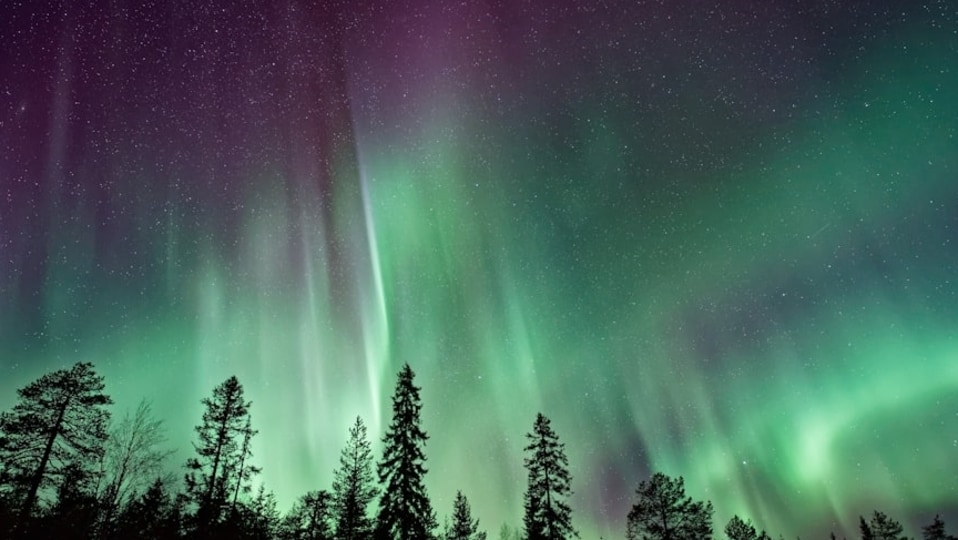
The storm also means that vibrant northern lights, or aurora borealis, might illuminate the night sky in various parts of the United States.
The much sought-after spectacle might be seen as far south as Oregon, Illinois, and potentially even deeper into mid-latitudes like Alabama and northern California on Saturday night.
US States Where Auroras May Be Visible
Alaska
Montana
North Dakota
Minnesota
Wisconsin
Michigan
South Dakota
Vermont
New Hampshire
Maine
Idaho
Washington
Oregon
New York
Massachusetts
Nebraska
Iowa
Wyoming
Illinois
Connecticut
California
When will the Aurora Borealis or northern lights be visible?
According to the predictions made by the scientists quoted on Space.com, the CME is expected to impact Earth in the early hours of June 1. So, enthusiasts are advised to keep an eye out for the spectacle as soon as the sky goes dark.
The CME could impact different places at different times. In the initial hours, it won't be visible everywhere at the same time.


