
 E-Paper


Is the Doomsday Clock real? Atomic scientists set it to closest point to catastrophe in history
The Doomsday Clock, established in 1947, was moved to 85 seconds to midnight, the closest it has ever been, due to insufficient progress on global threats.

 Prefer HTon Google


At the onset of the nuclear era, scientists created the Doomsday Clock as a symbolic indicator of how near humanity is to annihilating the planet.
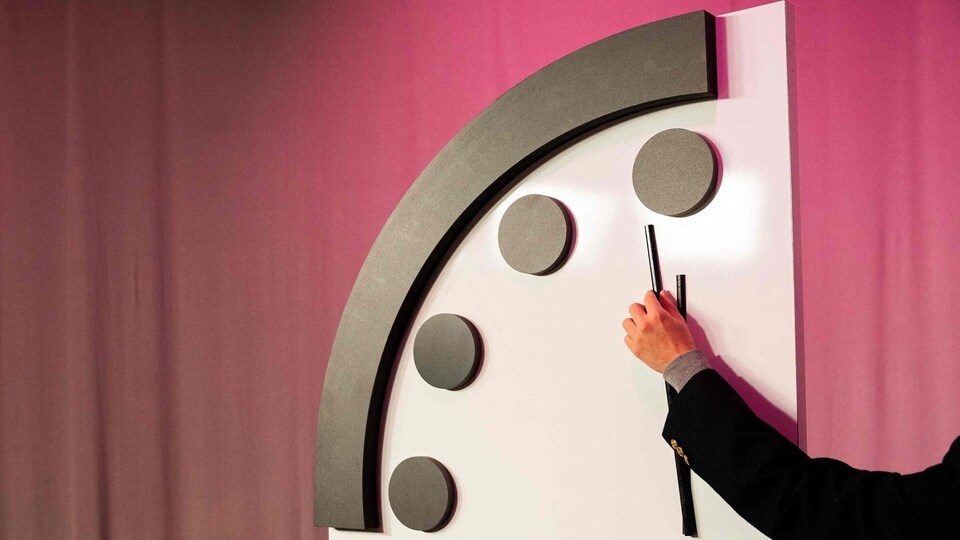
On Tuesday, nearly eighty years later, the clock was adjusted to 85 seconds to midnight — the closest it has ever been to that hour, as reported by the Bulletin of the Atomic Scientists, which created the clock in 1947.
Midnight signifies the moment when humanity will have rendered Earth uninhabitable.
Doomsday Clock: A look at past
Last year, the Bulletin positioned the clock at 89 seconds to midnight, marking the closest proximity the world had ever reached to that critical hour. Following adjustments to 90 seconds to midnight in 2023 and 2024, the scientists modified the time for 2025 due to a lack of adequate progress in addressing or regulating global issues such as nuclear threats, the climate emergency, biological dangers, and advancements in "disruptive technologies" like artificial intelligence.
The Bulletin's scientists also pointed to the proliferation of misinformation, disinformation, and conspiracy theories as additional existential risks to humanity.
‘This is our reality,’ says Bulletin President
Speaking about this year's change, Bulletin President and CEO Alexandra Bell stated: “Humanity has not made sufficient progress on the existential risks that endanger us all. The Doomsday Clock is a tool for communicating how close we are to destroying the world with technologies of our own making.”
“The risks we face from nuclear weapons, climate change and disruptive technologies are all growing. Every second counts and we are running out of time,” the CEO continued.
“It is a hard truth, but this is our reality,” Bell added.
Last year, scientists from the Bulletin cautioned that nations must alter their approach towards fostering international collaboration and addressing the most pressing existential threats, stated Dr. Daniel Holz, the chair of the Bulletin’s science and security board, during a news briefing on Tuesday.
“Conflicts intensified in 2025 with multiple military operations involving nuclear-armed states. The last remaining treaty governing nuclear weapons stockpiles between the US and Russia will soon expire on February 4. For the first time in over half a century, there will be nothing preventing a runaway nuclear arms race.”
What is the Doomsday Clock? Is it real?
A collective of researchers involved in the Manhattan Project, which was the codename for the atomic bomb's development during World War II, founded the Bulletin of the Atomic Scientists as a nonprofit organization in 1945.
Initially, the organization aimed to assess nuclear threats; however, in 2007, the Bulletin opted to incorporate the climate crisis into its evaluations.
According to the Bulletin, the clock is not intended to provide a definitive measurement of existential threats but is designed to stimulate discussions regarding challenging scientific issues and the crises facing our planet. Some experts who were not part of the clock's establishment have raised concerns about its effectiveness.
"It is an imperfect metaphor," stated Dr. Michael Mann, a Presidential Distinguished Professor in the Earth and Environmental Science department at the University of Pennsylvania, during an interview with CNN in 2022. He emphasized that the clock's representation encompasses various types of risks, each with distinct characteristics and occurring over different timescales.
Eryn MacDonald, a senior analyst with the Union of Concerned Scientists' Global Security Program, told CNN in 2022 that the Bulletin has made deliberate choices each year regarding how to capture public attention concerning existential threats and the necessary actions to address them.


