
 E-Paper



‘Reject violence, hate’: What Bangladesh interim govt said on Osman Hadi’s death
Osman Hadi died late on Thursday, days after he was injured in an assassination attempt.

 Prefer HTon Google


Bangladesh’s interim government on Friday appealed for calm and urged people to refrain from violence as police and paramilitary forces were deployed across Dhaka and other cities following overnight protests over the death of youth leader Sharif Osman Hadi.
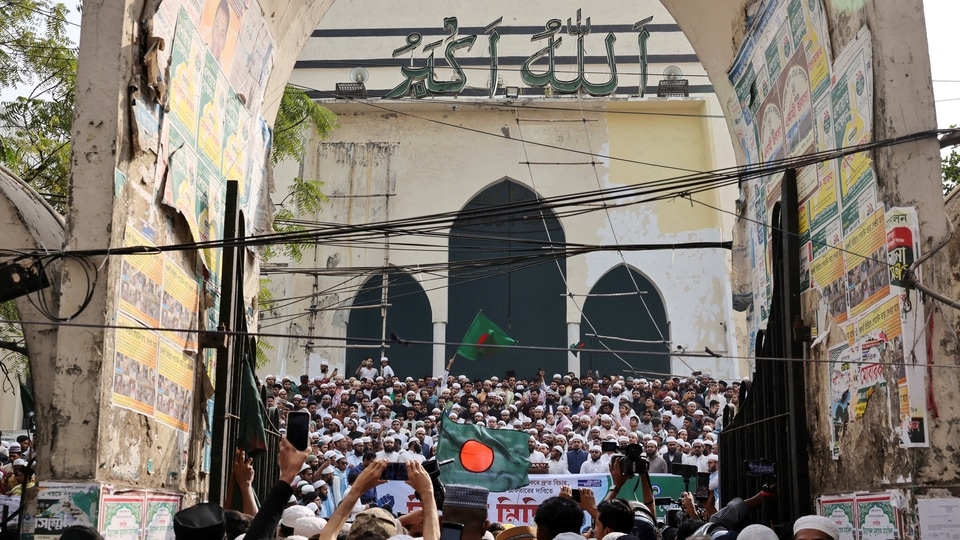
Hadi died late on Thursday, days after he was injured in an assassination attempt.
Thousands even gathered outside Baitul Mukarram after Friday prayers and staged a protest demanding justice following the death of Osman Hadi, according to a report by PTI.
In a statement issued from Dhaka on December 19, the interim government said it was calling on citizens to remain vigilant against violence and condemned attempts to destabilise the country.
“The government is calling on all citizens of Bangladesh to remain firmly vigilant against all forms of violence perpetrated by a few isolated extremist groups.
“We strongly and unequivocally condemn all acts of violence, intimidation, arson, and destruction of life and property,” the statement said.
Hadi, a candidate in the scheduled February 12 general elections, died at a Singapore hospital while undergoing treatment after battling for his life for six days.
He was shot in the head last week by masked gunmen as he began his election campaign in central Dhaka’s Bijoynagar area.
Also Read | Media offices torched, cities on edge: What is happening in Bangladesh after Osman Hadi's death?
What did Bangladesh's interim govt say?
The government said the country was at a critical juncture and warned against efforts to derail the democratic process.
“At this critical time in our country's history, we are moving through a historic democratic transformation. We cannot and will not allow this progress to be disrupted in any way by a few who capitalize on chaos and ignore the path to peace," it said.
“The upcoming elections and referendums are not just political exercises; they are a serious national commitment. This commitment is inextricably linked to the dream for which Shahid Sharif Osman Hadi sacrificed his life. Honoring his sacrifice and memory requires restraint, responsibility, and an unwavering commitment to rejecting hatred,” it stated.
Addressing recent attacks on media personnel, the interim government expressed solidarity with journalists and condemned violence against minorities.
“Attacks on journalists mean attacks on the truth. We assure you of full justice. We deeply condemn the lynching of a Hindu man in Mymensingh. Such violence has no place in the new Bangladesh. No one involved in this brutal crime will be spared. In this critical moment, we call on every citizen to show due respect to martyr Hadi by rejecting and resisting violence, incitement, and hatred,” the statement added.
What is happening?
Sharif Osman Hadi, 32, the youth leader who died, was a spokesperson for Inquilab Mancha, also known as the Platform for Revolution, and had taken part in the protests that led to the ouster of Sheikh Hasina, according to a Reuters report.
He was shot in the head by masked assailants in Dhaka last Friday while launching his election campaign.
Reports of violent protests and vandalism emerged soon after news of Hadi’s death broke.
Demonstrations were marked by emotionally charged slogans invoking Hadi’s name, with protesters vowing to continue their movement and demanding swift justice.
Several areas remained tense, prompting the deployment of additional police and paramilitary forces to prevent further violence.
Offices of prominent Bangladeshi newspapers, including Prothom Alo and The Daily Star, were set ablaze by an angry mob while staff members were still inside.
The interim administration has declared Saturday a day of state mourning in honour of Hadi, with national flags to be flown at half-mast and special prayers planned across the country.


