Sign in

Former chief of Maoist army elected Nepal’s vice-president

Nanda Bahadur Pun, former chief commander of Nepal’s People’s Liberation Army, the military wing of Maoists who fought a 10 year civil war, was on Saturday elected the country’s second vice president.

Updated on: Oct 31, 2015, 17:38:44 IST
Hindustan Times | By , Kathmandu
Share
Share via
  • facebook
  • twitter
  • linkedin
  • whatsapp
Copy link
  • copy link

Nanda Bahadur Pun, former chief commander of Nepal’s People’s Liberation Army, the military wing of Maoists who fought a 10 year civil war, was on Saturday elected the country’s second vice president.

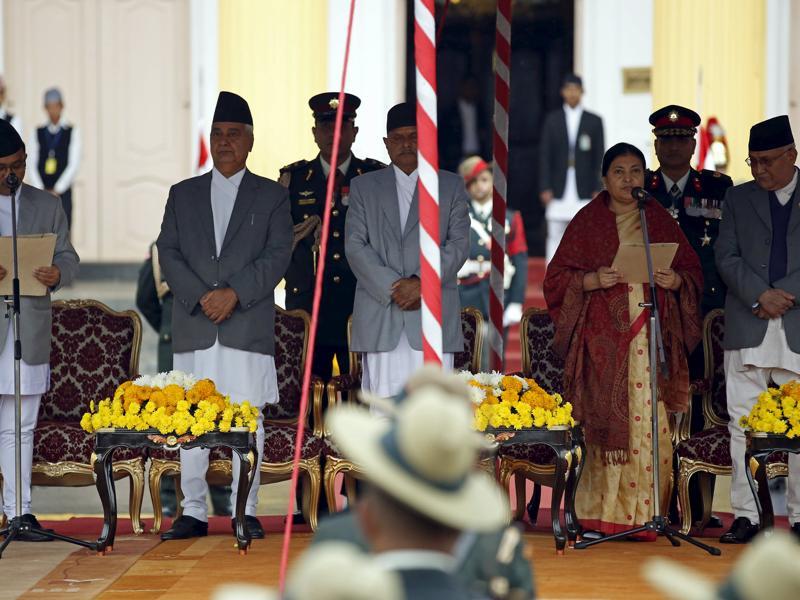
Chief Justice Kalyan Shrestha (L) administers the oath of office to Nepal's newly elected President Bidhya Bhandari (4th L) in the presence of former President Ram Baran Yadav (3rd L), former vice president Parmanand Jha (2nd L) and Prime Minister Khadga Prasad Sharma Oli, also known as KP Oli (R), at the presidential building "Shital Niwas" in Kathmandu, Nepal October 29, 2015. Nanda Bahadur Pun, former chief commander of Nepal’s People’s Liberation Army, the military wing of Maoists who fought a 10 year civil war, was on Saturday elected the country’s second vice president. (REUTERS Photo)

The 50-year-old who had support of the ruling coalition, which includes his party, Unified Communist Party of Nepal (Maoist), defeated Nepali Congress candidate Amiya Kumar Yadav.

Pun secured support of 325 parliamentarians to beat 69-year-old Yadav, who got 212 votes, by a margin of113 votes. Lawmakers from Madhesi parties protesting against the new constitution abstained from voting.

“Since Nanda Bahadur Pun has secured majority votes, I declare him elected to the post of vice president. I congratulate him on his win and convey best wishes for his tenure,” speaker Onsari Gharti Magar announced.

The Maoist leader more popular as Comrade Pasang who hasn’t held any official post till date despite his party being in power twice in the last seven years, will replace Parmanand Jha.

Pun’s election comes three days after Nepal’s parliaments elected Bidhya Bhandari as the country’s first woman president. The elections are being held as per provisions of the new constitution adopted last month.

The fourth among seven siblings born to Ramsur Pun and his wife Mansara at Rangsi in Rolpa district---considered the cradle of Maoist revolution in Nepal----Pun joined the communist movement while still in school.

He soon joined the Communist Party of Nepal (Unity Centre) and later became the first district president of Young Communist League (YCL)—the armed youth wing of the party later transformed to Ladaku Dal.

Pun was part of the attack on a police post at Holeri in September 1996, which started the civil war. When Ladaku Dal was named PLA in 2001, he was made in charge of the first battalion.

A master strategist, Pun is responsible for planning most of the attacks the PLA undertook on police and army during the 1996-2006 civil war, which claimed over 16,000 lives.

He took part in most of the major attacks in western Nepal. Pun was named chief commander of PLA in 2008, two years after a peace deal ended the civil war and brought Maoists to the political mainstream.
  • Utpal Parashar
    ABOUT THE AUTHOR
    Utpal Parashar

    A seasoned senior journalist, I have nearly three decades of experience across print, digital, and online platforms, covering political transitions, insurgencies, environmental issues, and development stories in India and Nepal. I am skilled in breaking news, leading editorial teams and launch of newspaper editions. I am adept at leveraging digital trends and social media to expand global reach, with a strong ethical foundation and a reputation for impactful journalism. An alumnus of Asian College of Journalism, I joined Hindustan Times in New Delhi as a trainee reporter in May 1997. Over the years, I have been posted in Dehradun, Kathmandu (Nepal) and Guwahati. Currently, as Senior Assistant Editor at Hindustan Times, I lead a team reporting on India’s northeastern states. My work involves in-depth analysis, and engaging multimedia storytelling across formats, including text, photo, video, and interactive content. I am skilled in producing timely, shareable content, leveraging digital platforms and social media to engage global audiences. Throughout my career with the Hindustan Times, I have led diverse editorial teams, designed capacity-building activities, and supported reporters in developing strong story ideas, ethical reporting practices, digital skills, and fact-checking techniques. As Senior Assistant Editor for Northeast India, I have been responsible for guiding correspondents through complex political, humanitarian, and community-level stories using multimedia formats. Earlier, as Foreign Correspondent in Nepal, I produced extensive reporting during Nepal’s democratic transition and the 2015 earthquake and its aftermath.Read More

Get the latest World News, breaking headlines and global updates from the US, UK, Pakistan, Bangladesh, Russia and other countries. Follow major international events on Hindustan Times.