E-Paper



Nepal’s adoption of new constitution marred by violent protests
Nepal adopted its new constitution for becoming a secular, federal republic on Sunday amid violent protests by thousands of Indian-origin Madeshi people opposed to the charter.


Nepal adopted its new constitution for becoming a secular, federal republic on Sunday amid violent protests by thousands of Indian-origin Madeshi people opposed to the charter.
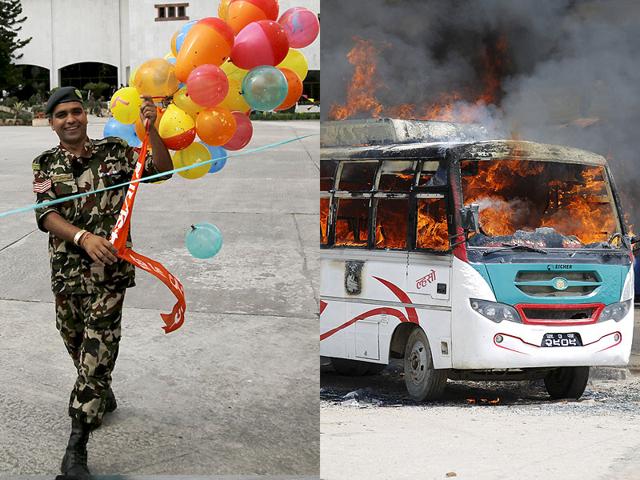
President Ram Baran Yadav formally promulgated the Constitution at a special ceremony held in the constituent assembly building, even as police fired at protesters, killing one of them in the Birganj area close to the Indian border.
“I offer my congratulations and best wishes to all Nepali brothers and sisters on this special occasion. We hope the Constitution will lead to lasting peace, stability and fast-paced development,” he said amid loud thumping of desks by lawmakers.
With this the interim constitution, in operation since 2007, will cease to exist and the constituent assembly will start functioning as a full-fledged Parliament. A new government is also expected in the coming weeks.
The new charter will divide the Himalayan nation into seven federal provinces but this is opposed by Madeshi and Tharu communities in the Terai region who fear they will be marginalised in Parliament. More than 40 people have been killed in clashes in the past one month.
Despite a call by the government to celebrate the occasion, curfew was imposed in several areas in the southern plains bordering India as protests against the statute continued.
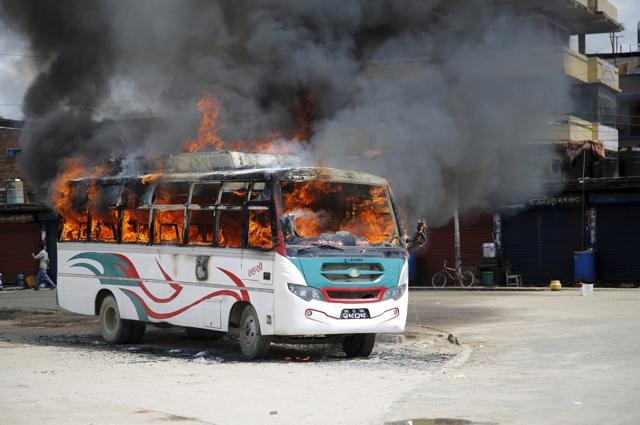
Police opened fire in Birganj, killing one and injuring nearly a dozen others, after thousands of protesters defied the curfew and protested violently.
India expresses concern
The unrest troubled New Delhi, which rushed foreign secretary S Jaishankar on Friday as PM Narendra Modi’s special envoy.
Shortly after the new constitution was promulgated, India extended its best wishes to the people of Nepal, but also expressed concern at continued violence in border areas.
In a statement issued by the Indian embassy in Kathmandu, India hoped that issues of contention get resolved through dialogue in an “atmosphere free from violence and intimidation”.
“We are concerned that the situation in several parts of the country bordering India continues to be violent,” the statement said.
Also read: How India was both right and wrong on Nepal
China welcomed the new constitution saying that as a “friendly neighbour” it hoped for increased stability and growth.
Democracy, federalism, secularism
Nepal has had six constitutions and interim statutes since 1948, but this is the first time such a comprehensive document has been prepared by an elected constituent assembly.
The latest process began in 2008 after a civil war which claimed over 16,000 lives, but the first assembly was dissolved in 2012 due to differences among parties. The second assembly was elected in 2013.
The April earthquake, which claimed 9,000 lives, forced squabbling parties to come together and speed up the constitution-drafting process. Parties from Madhes, however, quit the constituent assembly in protest.
Endorsed by an overwhelming majority, Nepal’s new constitution espouses multi-party democracy, federalism, secularism, human rights, press freedom and independence of judiciary.