
 E-Paper



All aboard the ‘Earthship’: Living in a plush bungalow without power, water supply
A journalist spends a night in an ‘earthship’ to find how a house with modern amenities and luxuries can have a zero ecological footprint

 Prefer HTon Google


At first thought, the idea of living in a self-sustaining house without grid power connection or piped water supply in the freezing cold seems like an outlandish idea. How would one survive in the chill of New Mexico in the middle of December without a heating system?
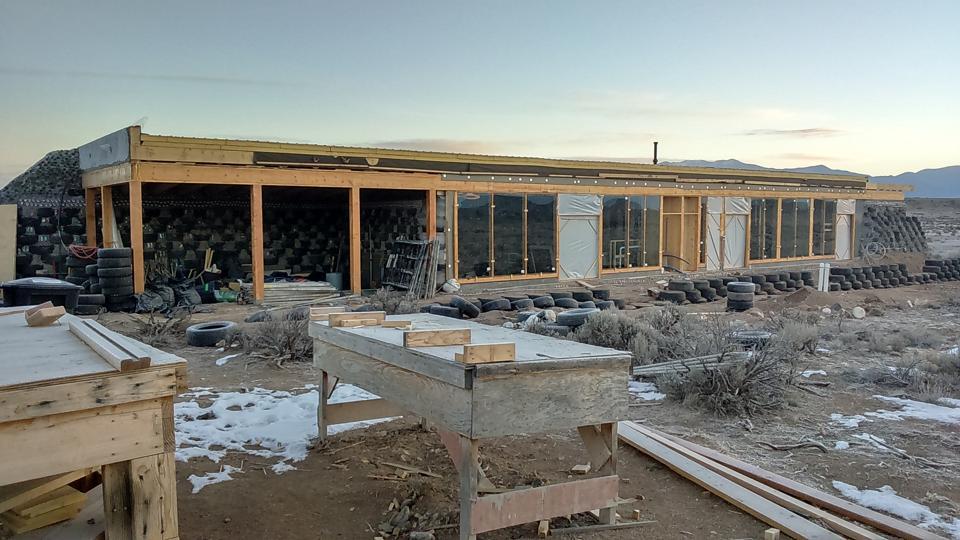
But a couple of days in an earthship – a plush bungalow built with recycled goods --- will make anyone believe that it possible to survive without resource-guzzling amenities that are ravaging the planet.
From inside, the home with several bedrooms and a kitchen garden looks like any other modern house in the United States. But, the difference is how the house is built to conserve key limited resources for survival --- power and water --- without one having to make huge adjustments in one’s daily life.
The use of waste --- tyres, cans and bottles --- with concrete and mud reduces the construction cost considerably with a two bed room earthship priced at around US $ 500 and the bigger one at US $ 5,000 dollars. Once that is done, the living cost is almost zero.
Renewable Power
The power to run the home is generated from six solar panels on top of the home and a small wind mill and is stored in lithium batteries that can fit into a suitcase with a meter to gauge energy levels in the batteries.
The batteries would show zero power only if there is no sun or wind for week or more. “Not without power may happen once in few years and that is an exception,” says 33-year-old Ryan Halpin, who quit a high-flying job in Denver to live in an earthship three years ago. He has not encountered a “power-less” day so far.
As electricity is needed only to power lighting, its requirement is minimal. The passive solar house built by using energy conserving waste material naturally cools in summers and heats up in winters, thereby making it a non-fossil fuel home.
The sun-facing window panes heat the home during the day. The heat remains trapped as the home is insulated from three sides. The air tunnels below the ground and above roof help in maintaining the temperature.
“The homes are designed with thermal mass construction and natural cross ventilation to regulate indoor temperature,” said Rohan Guyot-Sutherland, an education coordinator with earthship, adding that you can live inside in a sweat-shirt while the outside temperature is freezing.
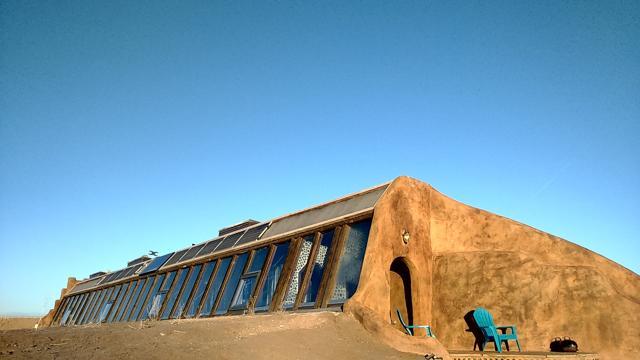
He was surely not bluffing as a team of six Indian journalists including this correspondent stayed in an earthship for a night, while the temperature outside was minus 12 degree Celsius following a snow storm. None complained it was cold inside. But one has to be cautious as keeping the main doors open can cool the home quickly and replenishing natural heating may take several hours.
Optimal water use
Sutherland said that the rain and snow that fall on the house get filtered into huge water tanks concealed behind the back-wall of the earthship. “As water from sky is cleanest, it is fit for use in the kitchen. For drinking, the water is filtered,” he said. And that is the reason kitchen has two taps --- one for human consumption and other for washing utensils.
The water from the kitchen called grey water is used for toilets after passing them through a series of native plant species that absorbs toxins or pathogens. “The bathroom may be slightly smelly because of the water,” cautioned Halpin as we entered to inspect the home. But, the odour was bearable.
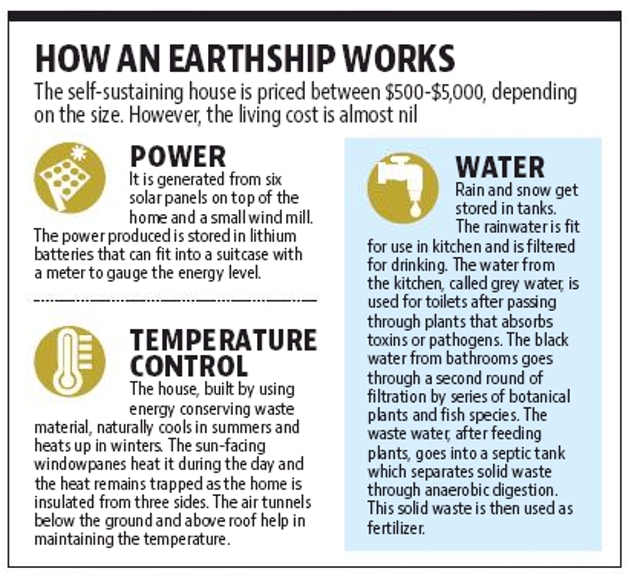
The black water from bathrooms goes through a second round of filtration by series of botanical plants and fish species. “We take native species found in rivers and water bodies for natural filtration as their efficiency is better,” Sutherland explained.
The waste water after feeding plants goes into a septic tank which through anaerobic digestion separates solid waste. This solid waste is then used as fertilizer.
“In the end we make optimal use of water and no waste is generated,” he said. Plus one also gets fruits and vegetables from the plants, which Sutherland said are “non-toxic”.
No takers
While the concept looks great it has not found many takers in and outside the United States. The first earthship was conceptualised in the 1970s by a young architect called Micheal Reynolds, now 71, who wanted to build a home that would rely on natural resources and independent of grid. He wanted to build a home feasible for a person having no specialised construction skill.
Almost 45 years later, there are only 100 earthships across the world with half of them being in the shadow of the Rocky Mountains --- runs across 4,800 kms from Canada to New Mexico in southwest --- in Toas.
Halpin accepted that there were some challenges while living in the house. One has to watch for water and power levels because the home does not have an unlimited supply as a conventional home. If there is no sun for a week there can be a power cut and electronic filter has to be checked regularly to ensure clean drinking water.
To survive, he said, the mantra was simple; “You help the house and the house helps you in return”.


