
 E-Paper



Chandigarh: Judicial infra not luxury but a pillar of justice delivery, says CJI
Calling on Punjab, Haryana and the Chandigarh administration to strengthen judicial infrastructure, the CJI said court complexes must be equipped with adequate courtrooms and essential amenities

 Prefer HTon Google


Chief Justice of India Justice Surya Kant on Saturday said judicial infrastructure is not a luxury but a fundamental requirement for an efficient justice delivery system.
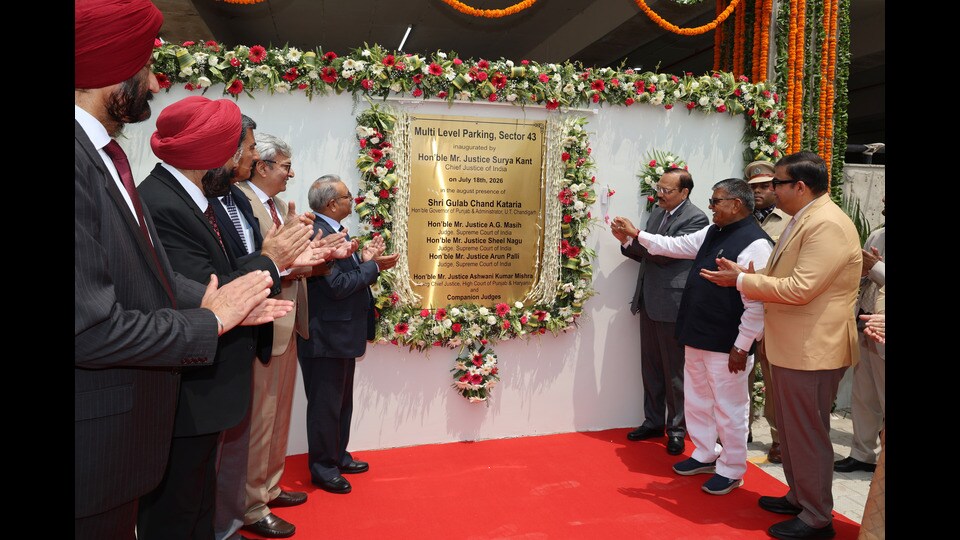
Speaking after inaugurating the ₹65 crore multi-level parking facility at the Chandigarh district courts complex in Sector 43, built over 4.5 acres with a capacity of 1,174 cars for advocates, litigants, judges, court staff, police personnel and the public, he said even basic facilities such as organised parking have a direct bearing on the functioning of courts.
Calling on Punjab, Haryana and the Chandigarh administration to strengthen judicial infrastructure, the CJI said court complexes must be equipped with adequate courtrooms and essential amenities to support both legal professionals and litigants.
Using apex court data as a benchmark, CJI Kant noted that annual filings in the Supreme Court (SC) surged from approximately 75,000 in 2024, with projections expected to cross 82,000-83,000 annually. While the Centre recently expanded the SC’s sanctioned bench strength to cope with the influx, a corresponding structural response is urgently required within the lower and district judiciaries.
More judges, no courtrooms
Addressing the systemic bottlenecks that choke the lower courts, the CJI clarified that while increasing posts and expediting recruitments are necessary, doing so without expanding physical infrastructure is counterproductive.
“We talk about appointing more judicial officers to tackle the backlog, but we do not have the judicial infrastructure to accommodate them,” he said. “If there is no physical courtroom available, what is the point of appointing a judicial officer?”
The CJI further explained that case pendency is heavily tied to non-negotiable statutory mandates including issuing notices, submitting replies, framing issues, granting opportunities for evidence, and recording documents. Because these vital procedural steps cannot be rushed or completed in a single day, a robust infrastructure remains the primary variable required to handle the high volume of cases efficiently.
Impact of urban challenges legal professionals
CJI Kant, who has previously practiced as an advocate in Chandigarh, observed that modern vehicular growth has completely outpaced the city’s original layout. Due to the exceptionally high rate of vehicle ownership among the city’s advocates, court complexes have faced chronic congestion, turning daily parking into a major logistical hurdle.
He argued that these daily environmental stressors directly hinder the delivery of justice by fracturing the concentration of legal professionals. “If a lawyer who has to argue a critical case or draft an urgent brief in the morning is entirely stressed out over where to park their car, their professional concentration is broken,” he observed, emphasizing that facilities like the newly inaugurated multi-level structure are baseline operational necessities rather than luxury upgrades.
Re-model judicial spaces
CJI Kant concluded his address with a direct call to the Chandigarh administration and the state governments of Punjab and Haryana to re-evaluate the design and management of judicial spaces, advocating that district and high courts be structured with the same systematic utility and essential amenities as a hospital.
Because litigants frequently arrive at court in a state of personal distress, subjecting them to a chaotic environment lacking parking, proper seating, or clean drinking water actively erodes public trust in the judicial system. To combat this, he urged the administration to immediately address similar parking and chamber shortages at the Punjab and Haryana high court.


