E-Paper



Number Theory: The importance of pilgrims in tourism economy
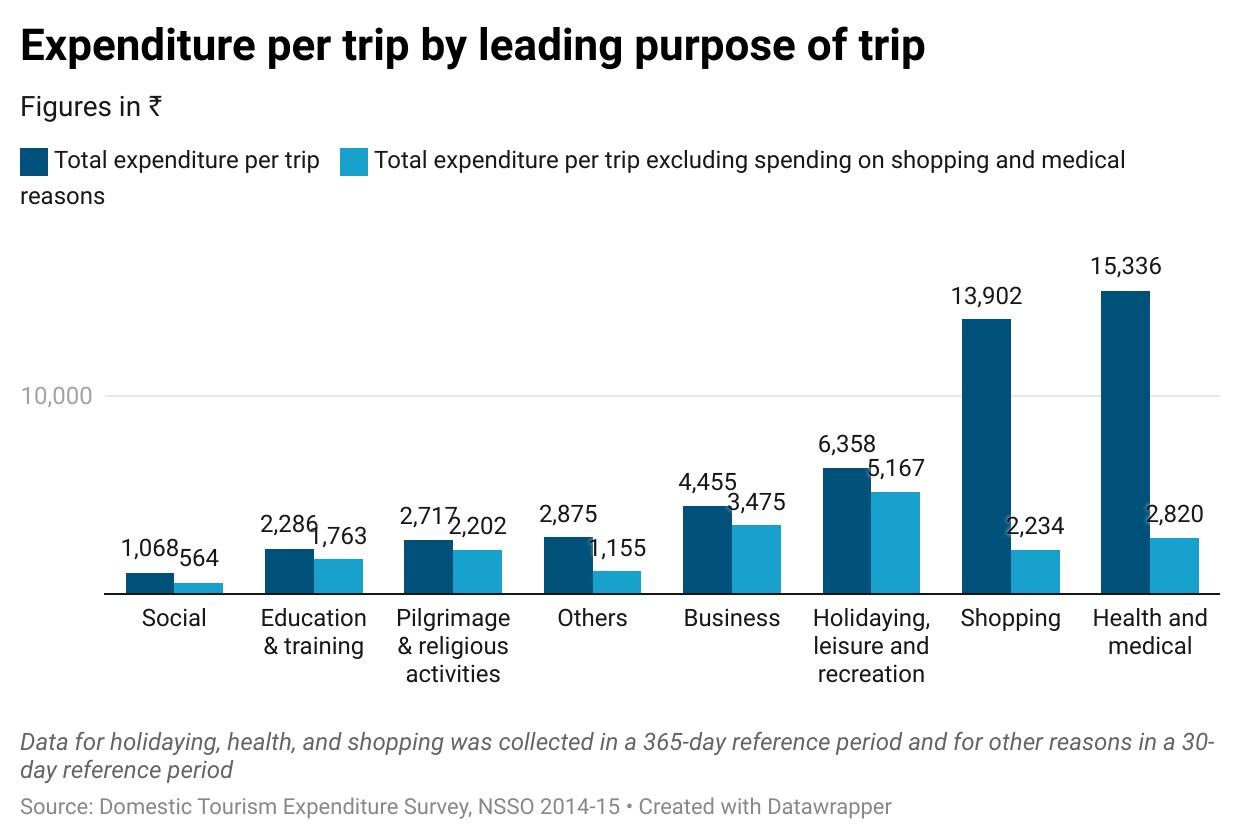
According to the NSSO survey, the average religious or pilgrimage trip generated a bill of ₹2,717 in 2014-15. This is the third-lowest bill
Updated on: Jan 21, 2024, 13:29:12 IST

 Prefer HTon Google
Share via


Copy link

The first part of this two-part data journalism series looked at the importance of religious tourists among domestic tourists in India. The second part will try and answer a related question. How important is spending by religious tourists in the domestic tourism economy in India? Here is what an analysis of unit-level data from a 2014-15 survey on domestic tourism by the National Sample Survey Office (NSSO) shows.
 Spending on religious trips is among the lowestAccording to the NSSO survey, the average religious or pilgrimage trip generated a bill of ₹2,717 in 2014-15. This is the third-lowest bill among the seven distinct types of trips recorded in the survey. To be sure, the most expensive trips -- they are health and medical, and shopping -- see a spike in overall spending because of the inclusion of money spent on medical treatment or shopping rather than travelling per se. However, even if one were to exclude the spending on these activities, religious trips continue to be in the lower bracket of trips by average spending. The data also shows that average spending on trips made for holidays is more than double what is spent on religious trips. Also, as can be seen from the average spending on these trips, these numbers are not representative of what the rich would spend on any kind of domestic trip. This needs to be read with the context that the NSSO data is more useful in giving a ballpark estimate about the relative importance of different kinds of domestic trips rather than the market for niche segments in the tourism economy such as star hotels.
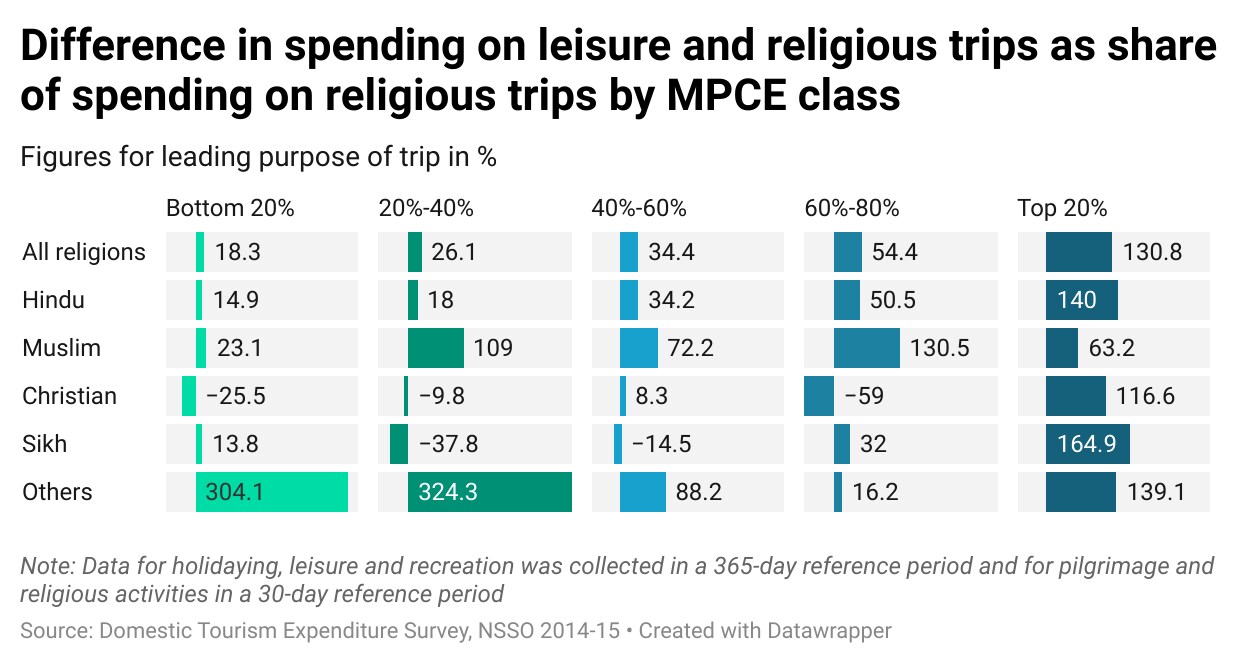
- The gap between religious and holiday spending increases with rise in incomesThis is an important insight into the economy of domestic tourism in India. The data shows that richer households are more likely to spend more money when they go on trips for holidays or leisure than religious tourism. The difference in average spending per leisure trip versus a religious trip is just 18% for the poorest 20%. This difference rises progressively to 26%, 34%, 54% and 131% for each quintile ending in the richest 20% bracket. To be sure, this overall trend is more a reflection of the growing gap between holiday and religious travel spending among Hindus than every religious group.
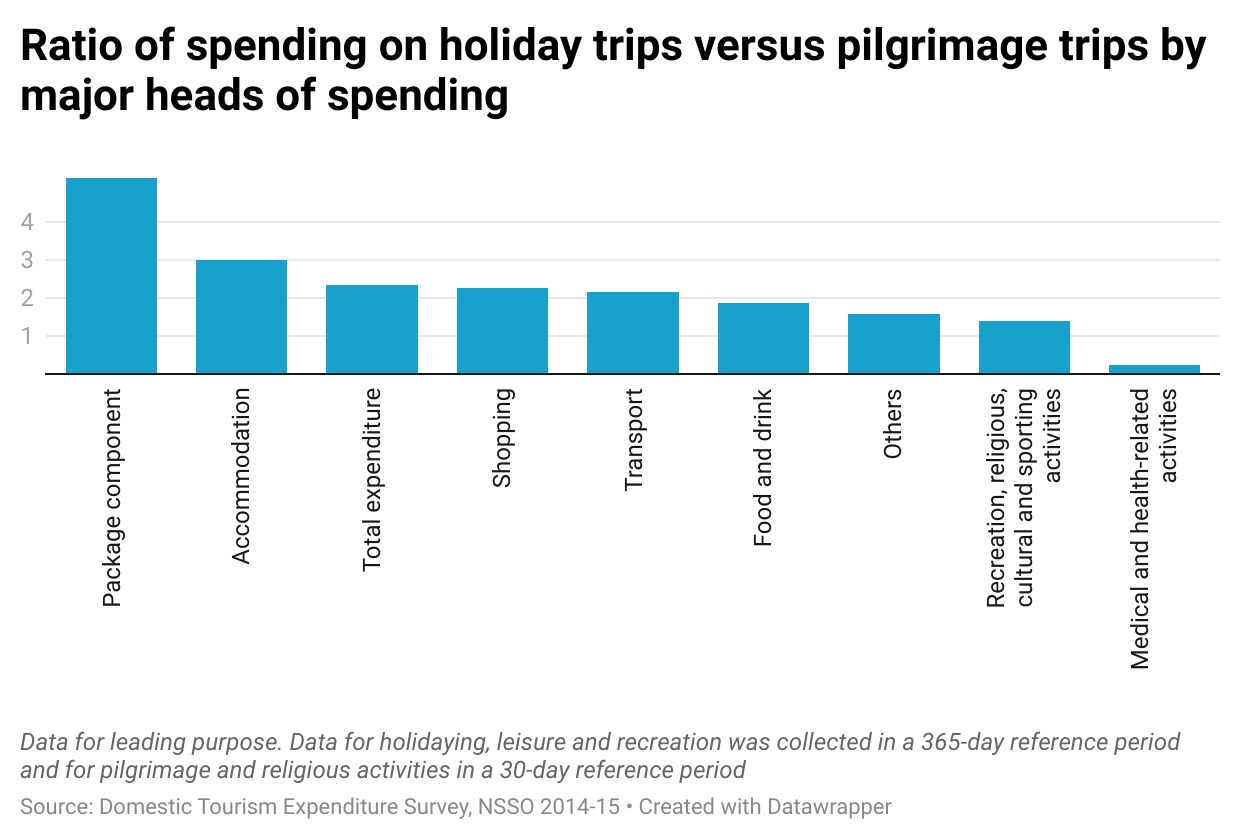
- What explains the spending gap between holiday and religious travel?This is an interesting question to ask to understand India’s tourism economy. Average spending on holiday travel was 2.3 times the expenditure on religious travel. NSSO data gives a break-up of spending during domestic travel into various heads which can give us an idea about where people are over or underspending during various kinds of trips. While holiday trips saw a higher expenditure on every head compared to religious trips, the biggest proportional gap between holiday and religious travel is seen in what is described as the “package component” of the spending. This includes spending on a package of services availed during the trip through somebody like a tour operator. The fact that the biggest proportional gap between holiday and religious tourism exists in the “package component” suggests that religious tourism is more of a self-driven activity than a business where services are sought from persons or firms engaged in the tourism economy. This is one thing which could change with the government’s attempts to sell Ayodhya as not just an act of faith but also an opportunity for India’s tourism economy.