E-Paper



Overall rainfall, reservoir levels, sowing normal despite break phase in monsoon
Although the cumulative rainfall continues to be in the normal range, there have been periods of prolonged dry patches

 Prefer HTon Google


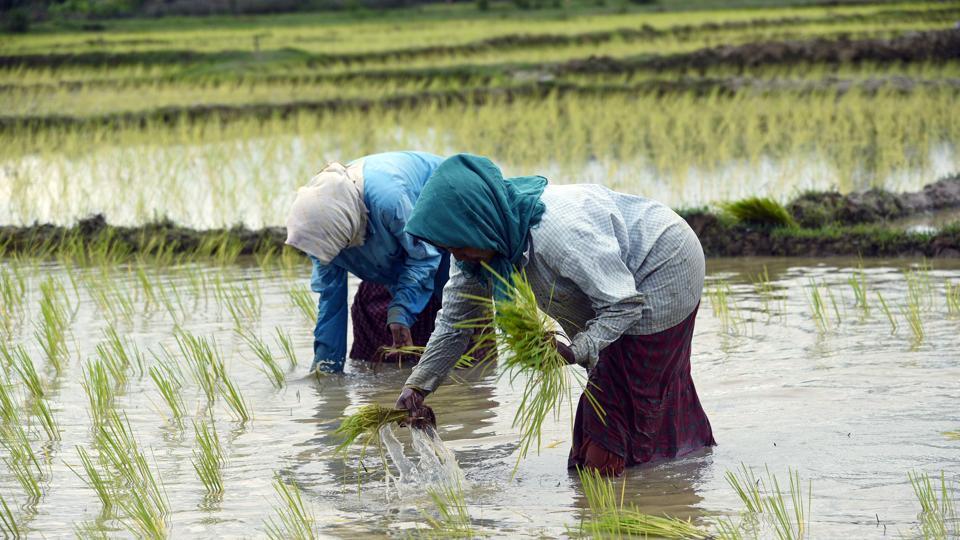
Unless things change drastically, India is on course to having a normal monsoon, which will recharge country’s main water reservoirs just enough, and ensure that the most important crops for the kharif season see normal sowing. This is good news for agricultural production and food prices. However, two major areas of concern remain: intermittent dry patches this monsoon season that could adversely affect crop-yields; and regions which continue to suffer from deficient rains or floods despite the national average rainfall being in the normal zone.
Cumulative rainfall continues to be in normal range
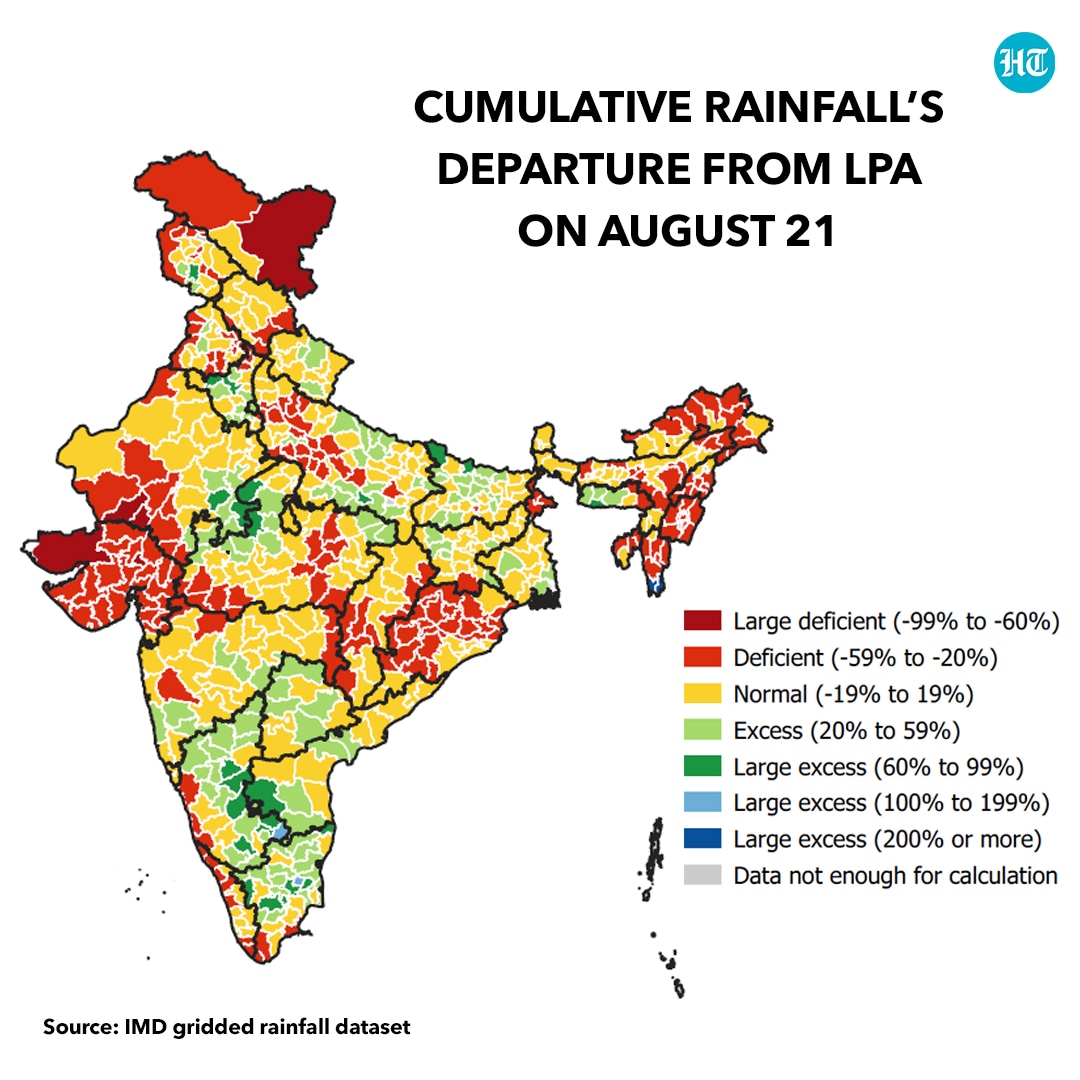
The June-September period is considered as the monsoon in India. Cumulative monsoon rainfall as of 8:30 AM on August 21 was 5.07% less than the Long Period Average or LPA, according to the gridded rainfall dataset of the India Meteorological Department (IMD). A 5% deficit from LPA is considered to be in the normal range. IMD defines the average of rainfall in the 1961 to 2010 period as the LPA for that interval. It considers less than 20% deviation on either side of the LPA as normal; a surplus of 20% or more as excess; and a deficit of 20% or more as deficient.
Although the cumulative rainfall continues to be in the normal range, there have been periods of prolonged dry patches. There was a 47% surplus in cumulative rainfall before a dry patch from June 21 to July 11 -- when daily rainfall was less than the LPA on all days -- created a deficit of 3% in cumulative rain. After a period of recovery that led to a 2% surplus on August 1, another 16-day dry patch from August 2 to August 17 created the current 5% deficit.
Past week’s recovery limited to few areas
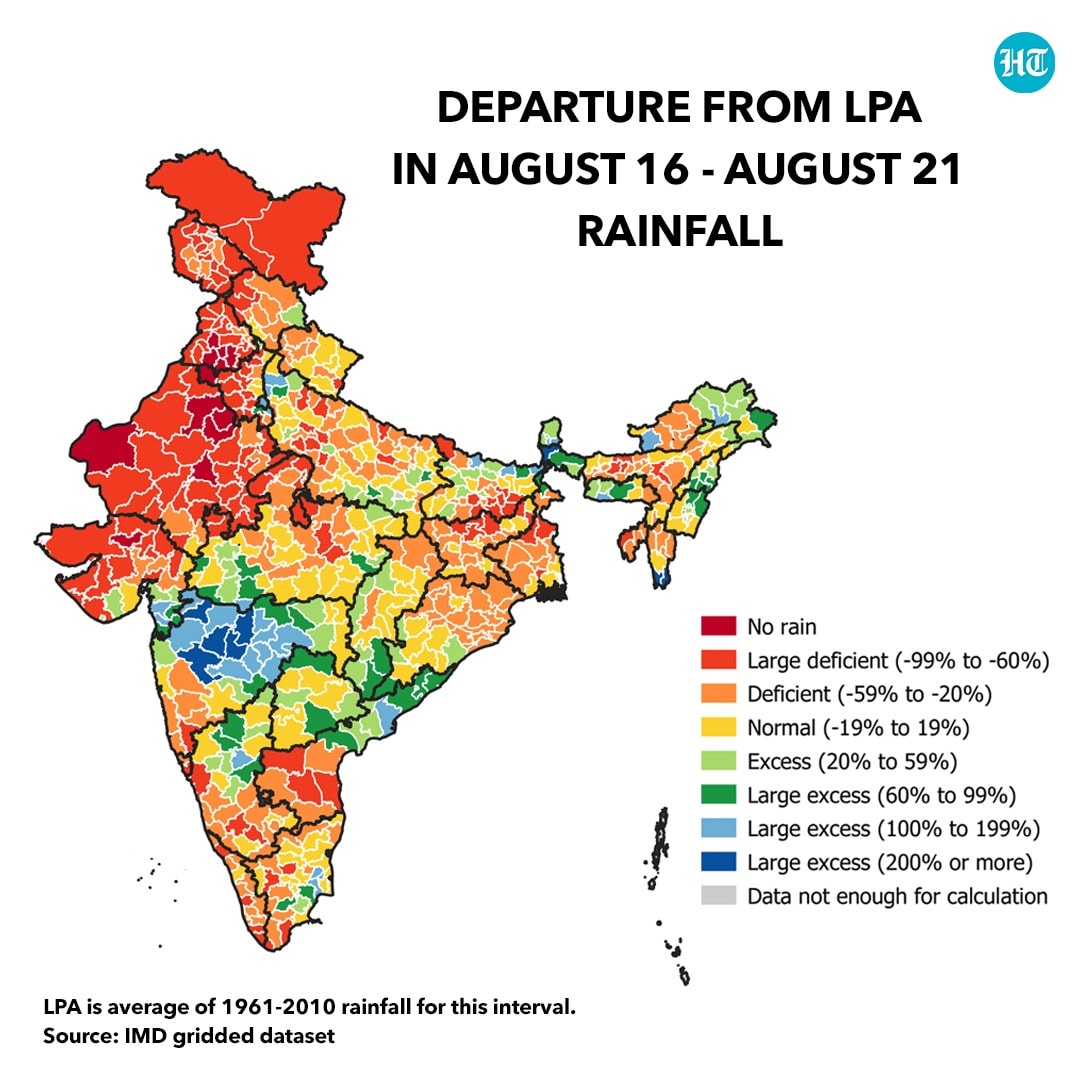
Both the June-July dry patch and this month’s dry patch had been caused by a “break phase” of monsoon. This is a feature of the monsoon that causes heavy rains along the foothills of the Himalayas but leaves a major part of the country dry. There has been some recovery from that phase last week. Daily rainfall from August 18 to August 20 was more than the LPA. However, this recovery was limited to Delhi, districts in Western Maharashtra, Chhattisgarh, Andhra Pradesh, West Bengal, and the north-east. Most of north-western India was dry last week.
Almost one-third of India’s districts are still rainfall deficient this year
An analysis by districts shows that last week’s recovery in rainfall has not done much to fix deficient rainfall in about a third of India’s districts. Of the 614 Census (2011) districts (with Delhi’s districts merged as one) for which this analysis is possible, 332 received deficient rainfall last week (August 16-August 21), 139 received normal rainfall, and only 143 received excess rainfall. As a result, the number of deficient districts in cumulative rainfall on August 21 was the same as on August 15: 194. The number of districts with normal rainfall increased from 269 to 278 and those with excess rainfall decreased from 151 to 142.
Reservoir levels normal, but regional differences remain
The storage in 130 main reservoirs of the country was only 1% below the last 10 years’ average on August 19 (latest available data), according to the Central Water Commission (CWC). While this is good news, the 1% deficit is not as good as the 21% surplus on July 29. Regional differences similarly continue to exist. 10 of 20 states for which this data is available have a deficit compared to the last 10 years’ average. Nagaland, Himachal, Punjab and Gujarat have a deficit of 30% or higher. On the other hand, Andhra Pradesh and Telangana have a surplus of over 100%.
Sowing levels normal, but yields might suffer
Overall, 97.28% of the area sown normally in the kharif season has been covered by August 20 (latest available data). This is only 2.15 percentage points lower than area covered in the same period last year. Rice and arhar – the main cereal and pulse – and sugarcane are even closer to or have surpassed last year’s sowing. Some impact of the break in monsoon on sowing can be seen in the coverage of cotton and oilseeds, where sowing is lower than last year’s levels although over 90% of it is complete. “However, given the erratic monsoon rainfall this season, crop yields could suffer, reducing the overall farm output for the year,” said an August 16 research note by Rahul Bajoria, Chief India Economist at Barclays India.
Retail inflation data released on August 12 showed that while food prices overall had moderated in July, year-on-year prices of oils and fats category increased by over 30% for the third-consecutive month. Since India is import-dependent for edible oils, good domestic production of oilseeds could control inflation.