
 E-Paper



It’s not fair to blame Punjab’s farmers for Delhi’s red pollution map
On Friday, two days into the worst smog the city has witnessed in 17 years, the particulate matter in Faridabad was a even higher than in south Delhi, while Gurgaon and Noida were at par with the Capital, showing that pollution is not just a Delhi problem any longer.

 Prefer HTon Google


Saturday morning in New Delhi felt like a day from the dark and smoggy winter of 1998. But even that year, which prompted the Supreme Court to introduce CNG engines for public transport and phase out old commercial vehicles, the conditions had been much better than they are now. Though the nitrogen oxide that hurts the eyes is almost at the same level, average particulate matter is more than double of what it had been then.
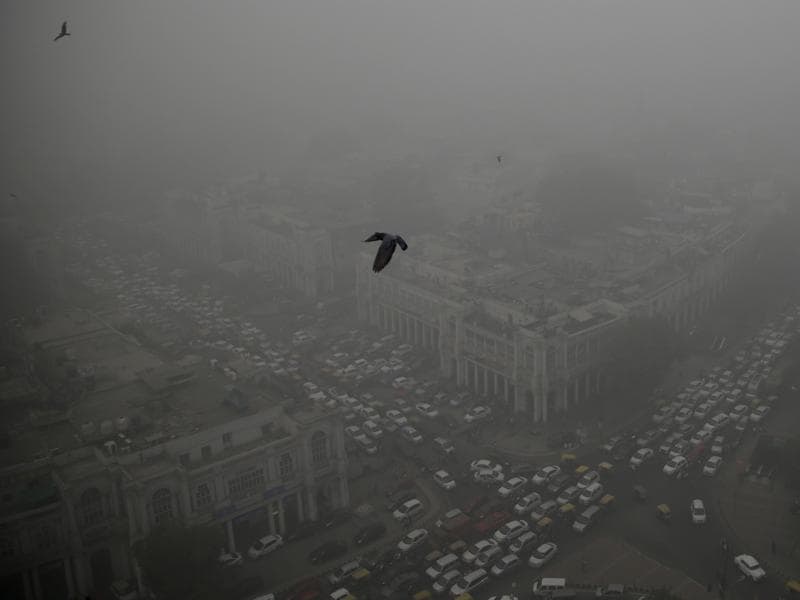
Delhi has reached this sorry state due to a lack of political will and the unwillingness of its residents to change their lifestyle. The per capita registration of high-emission vehicles in the city is the highest in India, according to data from the road transport ministry. Transport officials say that more than half of Delhi’s middle-class homes have two or more cars -- a sign of their growing affluence.
This has led to the vehicle population to treble since 2007 -- when the first signs of the re-emergence of pollution rise had became visible – and average traffic speeds on congested stretches have dropped to 50 per cent of what they were in 2000.
One can no longer look at Delhi and its adjacent towns as separate units since the green corridors that divided them have vanished. As per the Census Commissioner’s estimate for 2015, the population in the new concrete conglomerate of Delhi, Gurgaon, Faridabad, Sonepat, Noida and Ghaziabad has almost doubled to 28 million in the last 15 years. The majority of this population growth has happened in the areas that surround Delhi.
On Friday, two days into the worst smog the city has witnessed in 17 years, the particulate matter in Faridabad was even higher than in south Delhi, while Gurgaon and Noida were at par with the Capital, showing that pollution is not just a Delhi problem any longer.
But even today, politicians are abdicating their responsibility by blaming stubble burning alone for the ongoing crisis. This is not just counter-productive, it is also an over-simplification. Had the stubble burning in Punjab been the only cause for Delhi’s bad air, pollution in other cities falling between Delhi and Punjab would have been alarmingly high as well.
Rohtak, north-west of Delhi in Haryana, serves as an interesting case study. Winds bringing smoke from Punjab farms should spike Rohtak’s pollution levels. On Saturday, the particulate matter in the fast-growing township, which has an IIM and an AIIMS, was less than 100 micrograms per cubic metre. About 50 kms away, the PM10 level in Delhi’s Punjab Bagh locality on Rohtak Road was nearly 1,200.
Here is how the air deteriorates between the two places. Three big industrial zones, Nangloi, Bawana and Mundka, release huge pollutants. Delhi’s inner and outer rings roads add heavy vehicular traffic to the mix. And cramped colonies around the industrial zones not only lead to traffic congestion but also stop the foul air from escaping.
“The wind speed in the last few days has dropped and there has been a dip in temperature. All this has contributed to pollutants getting trapped at a breathing level,” says Gufrain Beg of the Indian Institute of Tropical Metrology.
While stubble burning may be a big contributor, source appropriation studies by the Central Pollution Control Board and IIT Kanpur in 2015 showed that over 80 per cent of air pollution in Delhi was because of sources within the city and its immediate neighbourhood.
Blaming stubble burning alone for the rise in Delhi’s air pollution serves as a convenient tool because it shifts the blame on people not accountable to the residents of Delhi. It helps Delhi Chief Minister Arvind Kejriwal and the city’s administrative head Najeeb Jung evade questions about their failure to take adequate measures. While they shrug their shoulders, Delhi’s pollution map is all red and the lungs of millions of Delhites are turning black.
Read more - Air so dirty you can smell, taste: Delhi grapples with toxic pollution


