
 E-Paper



Protests over Modi visit an excuse. Hefazat-e-Islam’s real aim to radicalise Bangladesh: Officials
The rise of anti-India Islamist force Hefazat-e-Islam in Bangladesh has contributed to the radicalisation of the region and is turning out to be a security threat to the Sheikh Hasina government

 Prefer HTon Google


The violent protests in Bangladesh over Prime Minister Narendra Modi’s visit last week was the first major action by Islamist hardline group Hefazat-e-Islam after Junaid Babu Nagari took over the radical group in November last year and had been trying to make his mark, people familiar with the matter said. Babu Nagari, a Hadith scholar who studied in Pakistan’s Jamia Uloom-e-Islamia for four years, elevated himself as the group’s chief at the end of a bitter power struggle that peaked after the death of its amir Shah Ahmed Shafi in September last year.
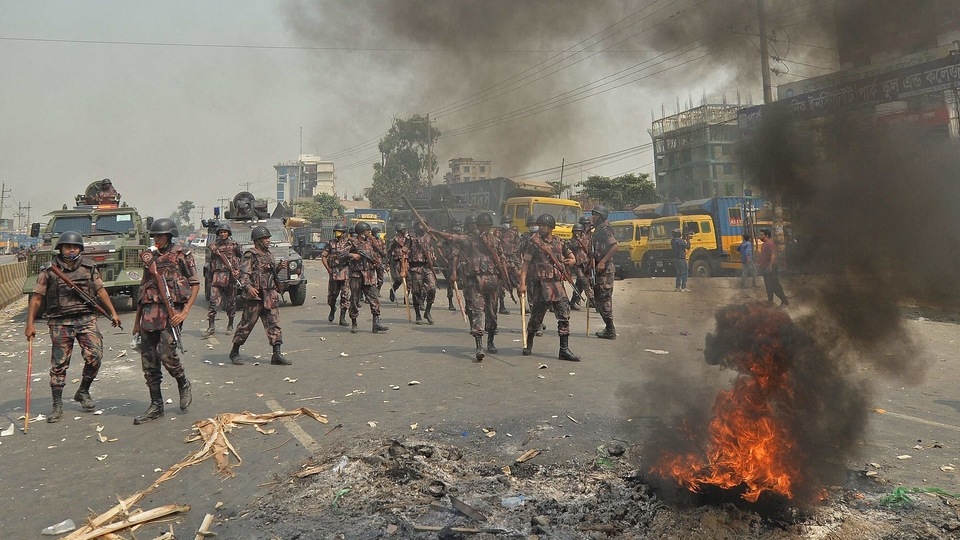
At least 13 people are confirmed to have died in the protests and scores are injured after security forces cracked down on demonstrators across Bangladesh over the past week. The protests had started on Friday from a prominent mosque in the capital city of Dhaka before spreading rapidly.
Over the three days, supporters of Hefazat-e-Islam clashed with the police and later, pro-government protesters at multiple locations blocked highways, burnt vehicles and attacked a passenger train. Five people died on Friday, the day PM Modi landed in Dhaka, another six the following day and two more on Sunday during the nationwide general strike called by the group.
The radical group has given a nationwide strike call on April 2 to protest the police crackdown in what, an Indian official said, was a continuing effort to radicalise Bangladeshi society by its potent mix of religion and power politics.
To be sure, there were calls for protests against PM Modi’s trip well before he landed. The spread of violence, however, took the authorities by surprise.
Indian officials who have been tracking activities of Hefazat-e-Islam, which translates as Protection of Islam and claims to be a non-political front, said the organisation first came to notice of the authorities for protesting the 2009 policy for equal inheritance rights to women. The organisation rose to prominence in 2013 when it sent students from its nationwide network of madrasas to Dhaka to counter the “Shahbagh movement” of students demanding the death penalty for all war criminals of 1971. The Hefazat-e-Islam placed a list of 13 demands including punishment for atheist bloggers and changes to textbooks.
There, however, has been a marked difference after the change of guard in November. Unlike its founder Shah Ahmed Shafi who was often perceived to be soft on the ruling Awami League, Hefazat-e-Islam under Junaid Babu Nagari has the tacit support of the Khaleda Zia’s Bangladesh Nationalist Party and fundamentalist groups such as the Jamaat-e-Islami.
For instance, the BNP did not formally extend support for the general strike called on Sunday but pointedly asserted that the call for the strike was logical.
Diplomats in New Delhi and Dhaka suggest that the links between the Hefazat-e-Islam and the BNP could become more visible with Babu Nagari’s elevation as he seeks to turn the notorious group into a political force.
Senior Bangladeshi journalist Mahfuz Anam seemed to agree. In a recent commentary, he said the real reason for the protests against PM Modi’s visit was to signal that Hefazat-e-Islam under its new leadership was not the same party that Shah Ahmed Shafi had led.
Anam, the editor of Bangladesh’s largest English-language newspaper, The Daily Star, also blamed the Sheikh Hasina government for practising a policy of appeasement which, he said, had made the Hefazat-e-Islam stronger and more determined to challenge the fundamental character of the country.
Indian officials said they had spotted efforts by Islamic fundamentalist forces to unite for further Islamisation of the society. The Hefazat, under its new leadership, is attempting to emerge as the leader of these fundamentalist groups.


