Analysts credit the Aam Aadmi Party’s (AAP) return to power by a landslide to the goodwill generated by the Arvind Kejriwal-led government’s work on education and health care; its generous subsidies for utilities; and its sops including free public transport for women.
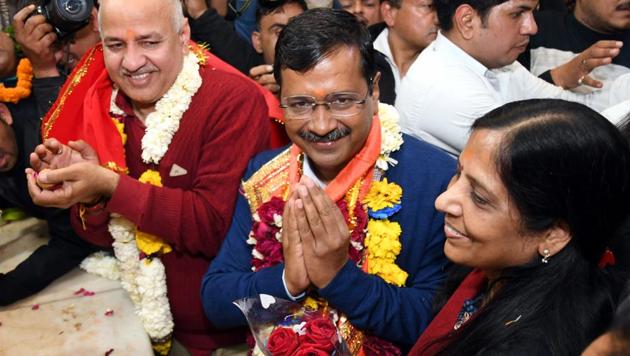
Addressing AAP workers and supporters at the party’s office after the results were declared, CM Kejriwal said, “This victory is not mine. It is the victory of all those households who have started getting 24-hour and free electricity. It is a victory of those families whose children have started getting a good education. It is of those who started getting good treatment in our hospitals.”
Kejriwal made at least a dozen announcements in the run-up to the elections, specifically between June 2019 and the start of campaigning, among other things making bus rides free for women; raising auto- and taxi-fares; land launching a free public WiFi service.
Importantly, analysts point out that many of the subsidies and schemes, while aimed at the power, were not meant exclusively for them, thereby reducing utility bills for almost everyone.
The AAP government launched a power subsidy scheme soon after it came to power in 2015, but radically changed it six months ago by making electricity free for those consuming either up to 200 units or having a bill of up to ₹800 a month. For those consuming between 201 and 400 units, Kejriwal revised the discount to ₹800 per household. Under the old scheme only households using less than 400 units were eligible for a subsidy — a flat 50%. The new scheme would benefit around 4.2 million households, the AAP government said at the time of the relaunch.
{{/usCountry}}The AAP government launched a power subsidy scheme soon after it came to power in 2015, but radically changed it six months ago by making electricity free for those consuming either up to 200 units or having a bill of up to ₹800 a month. For those consuming between 201 and 400 units, Kejriwal revised the discount to ₹800 per household. Under the old scheme only households using less than 400 units were eligible for a subsidy — a flat 50%. The new scheme would benefit around 4.2 million households, the AAP government said at the time of the relaunch.
{{/usCountry}}“The announcement was timed in such a way that maximum households in Delhi could avail the free and subsidised power schemes in the winter months of December, November and January. So, just before the elections, we heard people from across sections talk about getting either zero or heavily subsidised bills,” said Pramod Deo, a former chairperson of the Central Electricity Regulatory Commission.
Launched in 2015, the AAP’s water-subsidy scheme benefits around 1.5 million households according to government data. According to experts, it seeks to encourage water conservation, and also increase the coverage of the water metering system. After the scheme was introduced, the number of unmetered connections in Delhi dropped from about 390,000 to 180,000 between 2015-16 and 2016-17, data from the annual economic survey for 2017-18 showed. At the same time, the number of metered connections increased by nearly 400,000 from 1.92 million to 2.32 million.
This was one of AAP’s focus areas, and also primary talking points in the campaign. From building over 8,000 classrooms to starting lessons in happiness and entrepreneurship at government schools, from bearing the cost of Central Board of Secondary Education (CBSE) registrations for classes 10 and 12 students this year to offering free coaching for students from underprivileged backgrounds the AAP government made several moves on the education front.
Experts said education had never figured as prominently in an election campaign as it did in this election.
“There has not been any state or national election where education has been discussed like it was this time. It is because of this strategy of the AAP that rival parties like the BJP and Congress had to come up with additional and better promises in this sector,” said Sanjay Kumar, director of the Centre for the Study of Developing Societies.
Health care was a key issue in the elections, with the AAP speaking of its mohalla (neighbourhood) clinics and upcoming hospitals, and the BJP bringing up the non-implementation of its flagship national health insurance scheme, Ayushman Bharat, in the national capital.
The AAP government promised to set up 1,000 mohalla clinics to provide free consultation, medicines, and 212 tests during the last election. So far, it has set up 450 mohalla clinics. “The AAP government’s mohalla clinics have brought access to health care right inside the slums. It has strengthened primary health care. It is low cost and extremely effective,” said former Union health secretary K Sujatha Rao.
The AAP government started the Delhi Arogya Kosh scheme, which reimburses private hospitals for providing beneficiaries around 1,200 medical and surgical procedures and expensive radiological tests.
The BJP has been targeting the government for not implementing the Centre’s Ayushman Bharat insurance scheme. The AAP government, in response, has said the scheme will not benefit a majority of Delhiites.
“The scheme in Delhi is universal and also has no cap. I think it is working well. Why then would the government want to implement the central scheme and share credit with the other government?” said Rao.
The slew of announcements regarding transport began with Kejriwal promising free rides to women in buses and the Delhi Metro in June last year. In four months, the AAP government fulfilled the promise of free rides for women in all Delhi Transport Corporation and cluster buses. The plan to make the Delhi Metro free for women could not be executed for lack of the Central government’s approval. To ensure women’s safety in public transport, the AAP government deployed marshals in every bus.
In 2018, AAP finally secured the clearance to install CCTV cameras in all residential and market areas. Several residents’ welfare associations have welcomed the move, saying it has helped them feel more secure. “My car was stolen from the colony itself. These cameras, installed by the government at our colony gates, were used by the Delhi Police, after which the culprits were nabbed in 15 days. The footage showed the registration number of the vehicle in which the thieves arrived,” said 60-year old Raman Chawla, a businessman and a resident of BK Dutt Colony.