E-Paper



Bhopal has highest number of disabled people, Indore second
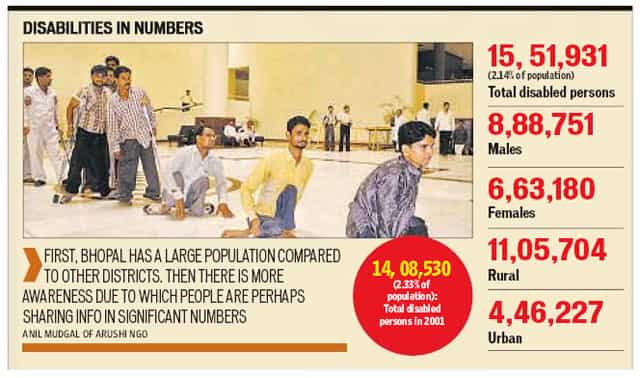
Bhopal has the highest number of disabled people in Madhya Pradesh, according to Census 2011. Of the total 15.5 lakh disabled population in MP, 84,502 live in Bhopal. Indore comes second with 78,761 disabled people.


Bhopal has the highest number of disabled people in Madhya Pradesh, according to Census 2011. Of the total 15.5 lakh disabled population in MP, 84,502 live in Bhopal. Indore comes second with 78,761 disabled people.

Among the eight categories of disabilities listed in the census, Bhopal district tops the list in five categories — seeing, hearing, speech, mental retardation and ‘other disability’.
As for the other three categories, Indore tops in mental illness, Rewa in ‘multiple disability’, while Satna top the list in movement related disability.
The census figures show that the percentage of disabled people in movement (26.08%) and multiple disabilities (8.21%) categories is higher in MP compared to the national average in the two categories, which is 20.28% and 7.89% respectively. In rest of the categories, it is lower than the national level.
After Bhopal and Indore, the maximum number of disabled people is in Jabalpur (59,074), Rewa (57,889) and Sagar (52,576). Alirajpur district, with 10,869 disabled people, has the lowest number of disabled people in the state, followed by Datia (12,379), Harda (12,568), Burhanpur (13,032) and Sheopur (13,435).
It was for the first time the census collected information about eight types of disabilities. In Census 2001, information was collected about only five types of disabilities.
Anil Mudgal from Arushi NGO, which works for the cause of disable people in the state for more than two decades, said that there were various reasons for Bhopal topping the list in most categories.
“First, Bhopal district has a large population (over 23.6 lakh) compared to other districts. Then there is more awareness here due to which people are perhaps sharing information here in significant numbers compared to other more backward areas,” he said.
Mudgal, however, pointed out that most important issue in the state was that all disabled people were not coming forward to get themselves registered in the government surveys due to the social stigma attached to such disclosures.
“In the state government’s own data on disabled collected through Sparsh Abhiyan, the number of disabled people in the state is 8.25 lakh, while the latest census showed there were over 15 lakh. And from my experience I can say, the actual number must be higher than 15 lakh. The need of the hour is more awareness drives, education and new schemes so that people come forward and share information on various disabilities.”