
 E-Paper



Disappearing butterflies: Blame uneven rainfall, insecticides
When was the last time you saw a kaleidoscope of butterflies around you? What about swarms of common grass yellow that used to be a common sight five-six years back?


When was the last time you saw a kaleidoscope of butterflies around you? What about swarms of common grass yellow that used to be a common sight five-six years back?
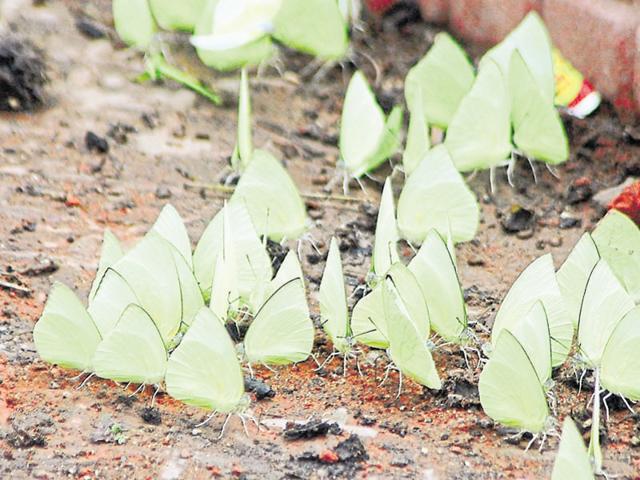
Little do we realise that with the passage of time, this colourful creation has distanced itself from humans. HT spoke to nature experts on the phenomenon of disappearing butterflies.
“Butterfly depletion is being seen in and around Bhopal from the past two-three years. They can be spotted in groups in dense forests but in cities, it is impossible. You can hardly see one or two. When I was the director of Van Vihar in 1999, we created a butterfly garden which is almost deserted now,” says Jagdish Chandra, a retired forest service officer and nature expert.
According to him, excessive usage of insecticides and pesticides stopped the butterfly larvae from growing. “Small shrubs and plants with flowers are their habitats and they are destroyed because of pollution and insecticides.”
A report of World Wildlife Fund, 2013 mentioned that butterflies like the monarch have been decreasing in population across the world due to climatic changes. Abnormal rainfall, extreme summers and winters contribute too.
The report also suggests that herbicides and pesticides used excessively on plants have reduced their population. “The WWF classifies butterflies as only ‘nearly-threatened.’ Their habitats are degraded driven by commercial development and lack of awareness,” says Mohammad Khaliq, a conservationist. “Everyone is aware of the uneven rainfall this time and this will affect the population further. Much of the larvae are being destroyed because of excessive rainfall.”
Dr Sangeeta Rajgir of Bhopal Birds Organisation has been working on significant species of butterflies.
She says, “There are broadly two categories of plants on which butterflies thrive. Breeding plants and feeding plants. In urban areas, we don’t have enough space to cultivate these plants, because most of them are wild or of not much use. We need to understand this that if we do not let plants flourish, forget that butterflies will come fluttering in your homes. Also, try and create some garden space in the backyard or frontyard of your houses.”
While there are several protection programmes and conservation acts for endangered species like tigers and lions, there is no proper protection programme for lower species in the ecosystem.
Chandra says, “If there is no grass, there is no ecosystem. I call small species ‘below poverty line species’. Butterflies, birds, grasshoppers, insects come under this category and little do we understand that all of them are responsible for a balanced environment.”
According to Chandra, there should be a mandatory course on environment in schools. “Kids should be taken out to green areas where they can connect with the environment. They will experience nature before it is too late and before we leave our future generations with just pictures of butterflies instead of a colourful world.”


