
 E-Paper



Tribal kids in MP learn gender equality through graffiti art
Mumbai-based artists Shruti Naik and Sidd Sap, a sought-after graffiti painter, were drawn to a nondescript village in Madhya Pradesh’s Panna district after a German woman’s Facebook post revealed a deep-seated gender bias there.


Mumbai-based artists Shruti Naik and Sidd Sap, a sought-after graffiti painter, were drawn to a nondescript village in Madhya Pradesh’s Panna district after a German woman’s Facebook post revealed a deep-seated gender bias there.
A few weeks ago, Ulrike Reinhard’s wrote how a young boy allegedly touched her inappropriately and when she confronted him, the brat’s reply was even more appalling. “I can do this because I am a man,” he had allegedly said.
Known collectively as NME Graffiti, the duo decided to demolish the gender demon at the tribal village of Janwaar with a splash of colour and a theme — Art For Equality. They landed in this impoverished Bundelkhand region on September 28, with their backpacks, stencils, pencils, paintbrushes and a lot of colour.
“As artists, we always keep looking for new canvasses and this place is perfect for us,” Shruti said. “This village has a huge canvas in many ways … there is a grave need to change the people’s mindset. For them, this isn’t an issue but a way of living. It encourages us to show our concerns through the medium of art,” she said.
Their first task was to make the kids familiar with the theme, method and possibilities of painting. Then they spread out to Panna and started painting at public and private places.
“It didn’t take five minutes for children to break the ice. The moment they got to know that we are here to paint everyone was enthusiastic,” Sid said. “All the kids here are like a big family. They share everything and really take care of each other. Seeing them help each other gives a sense that they understand the equality thing.”
Shruti and Sidd could draw from their experience in Mumbai’s Dharavi slums — where NME Graffiti conducted a similar exercise — to get along with the tribal kids at their Madhya Pradesh workshop.
“We helped the children draw outlines of the images first and then let them paint colours of their choice. The result is turning out to be beautiful,” Shruti said.
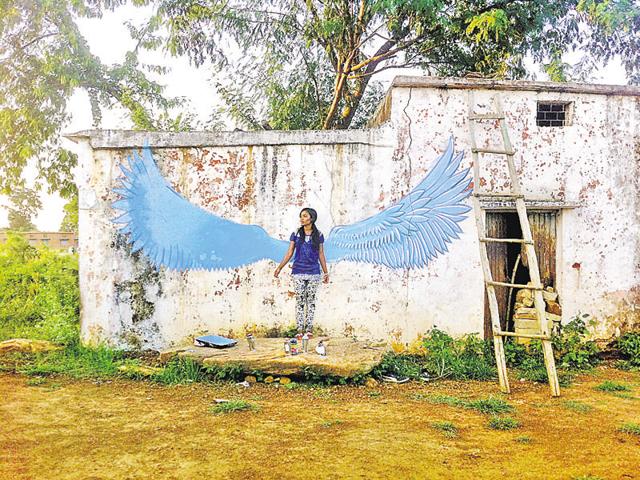
Like in all graffiti, symbolism plays an important part of the expression. That now shows at Janwaar — the giant wings of a blue bird spread wide on a poke-marked white wall of an outhouse; entwined geometric triangles on a concrete platform encircling a huge tree. The work catches public attention.
Graffiti has been the common people’s most potent weapon to voice their opinion or protest, Sid explained. “We wish to use this weapon once more, like many before us, to uplift our society and light the lamp that will dispel the dark depths ignorance.”


