
 E-Paper



Amrita Mahale: “We are all unknowable in some ways”
On ecology and development, algorithms and erasure, caste and class, and her second novel, Real Life that insists women have the right to their own choices

 Prefer HTon Google


Mansi carries the weight of adult responsibilities from childhood. How does this forced acceleration of maturity become both her strength and her blindness as an adult? What does she see clearly that others miss, and what does she fail to recognize about herself?
When I began seeing reels and posts (and even a New York Times article) about the ‘Eldest Daughter Syndrome’ last year, I immediately thought of Mansi. Girls in Indian families are forced to assume responsibility at a young age – they are expected to care for younger siblings, help the mother with chores, be on their best behaviour around the family elders – and they have ‘maturity’ thrust upon them. But in most cases, and certainly in Mansi’s case, this maturity is essentially just forbearance and emotional endurance (in less polite words, a deep tolerance for bullshit), and not moral clarity. After Tara disappears, Mansi is forced to examine her own beliefs about how women “should” live and behave, and the role this may have played in her friend’s fate. When she finally applies this gaze to her own life, it becomes clear to her that her family has controlled her and undermined her over the years, and she is compelled to take decisive steps to change that.
Your characters navigate caste with a kind of performative awkwardness — they know the right words but hesitate at the deeper reckonings. As a writer, how do you calibrate that hesitation? When do you let them off the hook, and when do you force them to confront their own complicity?
This is a tough one. I can say that I tried to stay close to each character’s consciousness. Sometimes this meant letting the awkwardness sit there, because their silence and inaction revealed the limits of what the characters were willing to confront. At other moments, I wanted to push them to a place where the discomfort breaks through — where they could no longer hide their complicity behind the right words. I struck a balance that felt right for what I was trying to say through the book, but I also wonder if I could have leaned in a little more into exposing their complicity.
The men in Real Life make devastating choices, yet you resist painting them as clear-cut villains. What interests you more — the moment someone becomes irredeemable, or the gray space before that point? What do we lose when we rush to categorize people as simply good or evil?
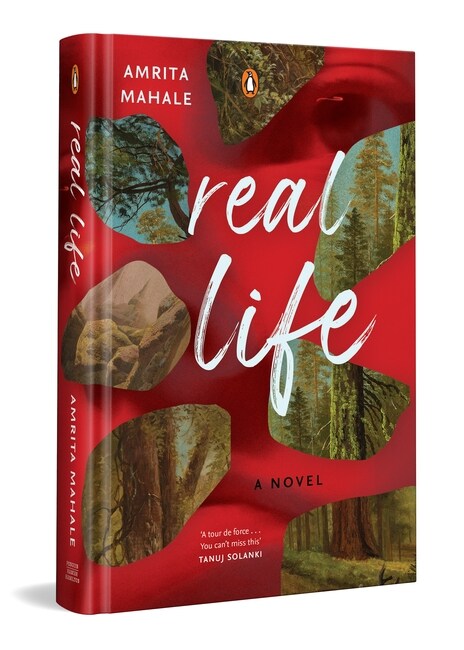
The two men who appear in Tara and Mansi’s lives, Bhaskar and Sid, are not intended to be villains. Bhaskar is a lonely and wounded man, and it is his loneliness that curdles into obsession. Some of the things that happen to Bhaskar are very unfair. He is humiliated and rejected on multiple occasions, but instead of dealing with his feelings, he directs his rage outwards at the women in his orbit. Each time, he believes he’s the only one who’s been wronged, which helps him justify his actions to himself. Sid is a loving and supportive partner in some ways, but does not want to challenge a social order that suits him just fine, even if it is grossly unfair to the woman he claims to love. And each time she challenges it, he is quick to put her down.
In fact, both Bhaskar and Sid are shaped by a world that teaches men they’re owed certain things — attention, affection, control — and when they don’t get these things, they turn caustic, bitter, even violent. This mindset of victimhood and entitlement is crucial to how misogyny operates and propagates, especially in online spaces today. I was more interested in exploring these dynamics than in labelling these men as chauvinists. However, at no point did I want to excuse or justify their actions. None of my characters are good or evil, it is their actions that are kind, brave, vengeful, irresponsible or plain stupid. I don’t want to write parables. Exploring the human mind and the human condition is what draws me to writing fiction.
Your characters argue passionately about development versus ecology, tradition versus progress, yet you seem to withhold judgment. Is this neutrality a writerly strategy, or do you genuinely believe these tensions can’t be resolved?
What I love about writing fiction is that it gives me the opportunity to explore multiple perspectives. In real life, I hold nuanced views about these topics, and some may see in these views contradictory strands. The arguments between the characters are debates I have had with myself. In some of these debates, I have come away with a clear opinion, and in others I have not been able to resolve all tensions.
Through Bhaskar, you explore the uncanny valley between artificial and human intelligence. What made AI feel essential to this particular story about disappearance and surveillance?
Apart from my writing, I also have a career in the development sector, more specifically in tech and AI for public health. Some of the big ideas and questions in Bhaskar’s section had been on my mind for a long time: techno-solutionism, the problem of bias in AI models, the ethics of using personal or copyrighted data to train language models.
Real Life is a novel about what it means to want a life that feels real; in a world that’s constantly trying to reshape women. And AI, of course, complicates the question of what is real (and what is seen as valuable). It is also a novel about the ways in which women disappear from the world. Disappearance today isn’t just physical — it’s also about who is rendered visible or invisible in the technologies and systems that increasingly govern our lives. Women, and especially women on the margins, are often absent from the data that trains algorithms, or they are misrepresented in the outputs. This is a different form of erasure than someone vanishing from a mysterious valley, but technology shapes how we are seen and understood, and what choices are made available to us in the real world, so it is no less dangerous.
Mansi and Tara’s friendship is far from the supportive sisterhood we often see in fiction. What drew you to explore female friendship as a site of tension rather than comfort? What truths about women’s relationships do we avoid when we insist on purely solidarity?
I see their friendship as messy and uneven. Female friendships hold intimacy, joy and deep loyalty, they are a place for women to be themselves. Female friendships can also be intense and complicated, like the one in the book. Mansi and Tara are very different people. They are both aware of the ways in which the other can be stubborn, dismissive, and even unseeing, so they keep parts of themselves hidden from the other. It is almost trite to say that one cannot know another person completely. We are all unknowable in some ways, aren’t we? What is more powerful to me is the lengths we go to understand those whom we love. This journey is more important, and interesting to me, than the (elusive and unattainable) destination of perfect understanding. Perhaps it was easier to explore this in a friendship that has some tension in it, and hence the friendship is how it is.
Your female characters claim their agency even when it leads them into danger or moral ambiguity. There’s something almost defiant about their right to be wrong. What does it mean for women to insist on making their own mistakes rather than being protected from them?
There is a long history of women being told that protection is love — that safety is the highest gift we can be given. But this safety comes at the cost of autonomy. To me, it feels vital that my characters (all people, really) are allowed their full range of choices, even the slightly reckless or morally ambiguous ones. Mansi and Tara are both flawed characters and they make plenty of mistakes, some with more serious consequences than others. I think a lot about the idea of agency, as an individual, as a woman in a patriarchal society, and as a public health professional who works in the field of women’s health. Agency is an individual’s capacity to act and shape their own life, and this intrinsically includes the capacity (and freedom) to err and to learn from those errors – this is central to the idea of independent action and self-determination. Claiming the right to be wrong is a way of insisting on equal personhood.
Aaditya Pandey is an independent writer.


