
 E-Paper



Book to screen: One Battle After Another
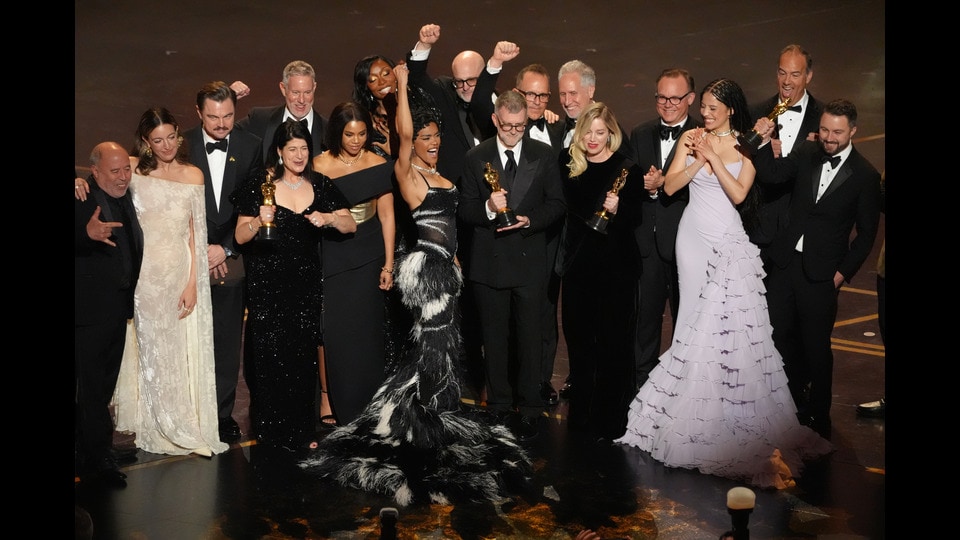
The film, that just won six awards at the Oscars, isn’t as radical as its source text, Thomas Pynchon’s Vineland

 Prefer HTon Google


For a film that addresses revolution and adopts a fairly radical outlook towards it — even condoning violence as a means of migrant liberation — Paul Thomas Anderson’s One Battle After Another, loosely adapted from Thomas Pynchon’s postmodern satire Vineland (1990), doesn’t engage much with the many contentious issues it raises. Revolution, in Anderson’s film, isn’t a living, breathing organism deeply embedded in the film’s texture but a ghost lurking in the shadows, summoned only to further the plot. Vineland is not only more radical in its critique of fascism, but also explores, via allegory, the many facets of revolution.

In Vineland, Frenisi Gates, a radical filmmaker, betrays her counterculture allies to honour her loyalty towards Brock Vond, a pro-government, fascist prosecutor. Gates emerges as the allegorical figure of a deeply flawed revolutionary, one whose loyalty rests on thin ice and would readily shift allegiances in a moment of crisis. Zoyd Wheeler, former hippie and washed-up radical is the embodiment of a hypocritical revolutionary who, for his livelihood, relies on the benevolence of the very government he protests against. These characters are placeholders for real-world political beliefs — flawed, hypocritical, sometimes morally reprehensible.
In Anderson’s world, these dichotomies aren’t fleshed out entirely. Leonardo DiCaprio’s Bob Ferguson doesn’t have to enact stunts to receive disability cheques from the government, unlike his textual counterpart. We don’t get a macroscopic look at the reasons Teyana Taylor’s Prefidia betrays the members of French 75 while Frenisi’s disloyalty is rooted in her psychosexual attraction towards men in uniform: “a helpless turn towards images of authority”. Besides the erasure of important context that establishes these complex characters, the film doesn’t take world building very seriously.

The mechanics of a revolutionary group: the fractures among the members, the solidarity and the changing dynamics are all alluded to but never fully addressed. Unlike Pynchon, who uses humour as a tool to sharpen his knife — one that cuts through fascism, rips it open, and displays its ugliness — Anderson’s use of humour seems to undercut the seriousness of the revolution itself. French 75 seems less like a formidable resistance movement with gravitas and more like a bunch of nincompoops arguing over code speak. The stoner-comedy elements feel oddly out of place, failing to blend with a film that otherwise grapples with weighty themes.
In Anderson’s world, the revolutionaries are full of swagger. Think Junglepussy strutting in high heels as she robs a bank with a gun, declaring “See my face, I am what Black power looks like”. The critic in me wondered: what is their endgame besides liberating detention centers and bombing pro-choice senators? 24fps in Pynchon’s Vineland used film as a political weapon to expose the government’s corruption and abuse of power. What is a suitable equivalent for French 75? Are these very badass-looking, swaggy revolutionaries working towards a larger goal or are they entirely focused on short-term wins?
Pynchon divided his critique of the US regime into two distinct timelines. The first is the 1960s or the Nixon years marked by the mushrooming of hippie groups who were vehemently opposed to the Vietnam war and to fascism. The second timeline, the 1980s, are the Reagan years marked by Reaganomics, tax cuts, and the regime’s anti-communist stance. By contrasting the two decades, Pynchon interrogates the extent to which the world has changed or stayed the same — washed up radicals from the 1960s have reluctantly accepted Reagan’s right-wing politics.

Anderson doesn’t make the timeline explicit but the hints are all there. When Willa Ferguson attends a college event, Walk The Moon’s Shut Up And Dance plays, signalling the film is set towards the fag end of President Obama’s second term and the beginning of Trump’s presidency in 2016. If the viewer were to make an educated guess, the earlier timeline might just be the Bush years — the 2000s. Unlike Pynchon, Anderson does not scrutinize how much — or how little — American society has changed between two right-wing regimes, a lapse that dilutes the film’s impact, as it becomes difficult to precisely situate it within its cultural and political milieu.
Pynchon’s excellent and effective expose of the ubiquity of television — how it is used to control the masses — doesn’t have much of a fitting parallel in Anderson’s film, even though Gil Scott-Heron’s Black liberation anthem The Revolution Will Not Be Televised finds multiple mentions. Pynchon’s world is richer, more layered. It is inhabited by Thanatoids — a ghostly tribe of vengeful spirits stuck between life and death. We see a fictional, countercultural nation of hippies — People’s Republic of Rock and Roll — seceded from the United States.
And yet, for all its evasions and omissions, the film is not entirely devoid of political conviction. The director meticulously tackles the transgenerational nature of revolutionary ideals. “We tried to change the world but failed. Maybe you will not,” writes Prefidia in a letter to her daughter, Willa. With an optimistic ending, Anderson plants the hope that the new generation might learn from the failures of its predecessors and become more formidable dissenters as regimes grow increasingly draconian. Anderson is not merely interested in revolution but the aftermath — the unresolved trauma, guilt and the legacy left behind by problematic revolutionaries.
Anderson takes certain liberties that deepen the film, opening it up to debate and adding to the narrative’s complexity. One such deviation from the source material is the conversation between Lockjaw and Willa (Chase Infiniti), in which she casts aspersions on his sexuality. It catches the viewer by surprise since it has no antecedent in the book. Another addition is Benicio Del Toro’s Sergio helping immigrant children escape through the tunnel during a raid. These small additions give the film a distinct flavour, revealing where the director’s sensibilities lie.

In an interview, Anderson said: “Realistically, for me, Vineland was going to be hard to adapt. Instead, I stole the parts that really resonated with me and started putting all these ideas together. With [Pynchon’s] blessing”.
To call One Battle After Another a fitting adaptation of Pynchon’s postmodern novel would be an exaggeration but Anderson does succeed in bringing to life the film’s central conflict, even if in a slightly diluted way, and that must be acknowledged.
Deepansh Duggal writes on art and culture. He tweets at Deepansh75.


