
 E-Paper



Excerpt: Don’t Trust Your Gut by Seth Stephens-Davidowitz
According to the author, a former Google data scientist, more than gut instinct, it’s the right data that leads to success in careers and on dating sites. This excerpt, which looks at how prolific artists also tend to produce more masterpieces, applies those “Picasso dynamics” to dating

 Prefer HTon Google


PICASSO’S RULE: PUT MORE WORK OUT THERE TO LET LUCK FIND YOU

In a now-legendary study, Dean Simonton, distinguished professor of psychology at the University of California, Davis, found a fascinating connection. Artists who produce more work tend to have more hits. Simonton found that the relationship between quantity of art produced and greatness, measured in various ways, exists in a variety of fields.
Many of the most famous artists of all time, those with the most pieces considered masterpieces, created a shocking amount of work to get their hits.
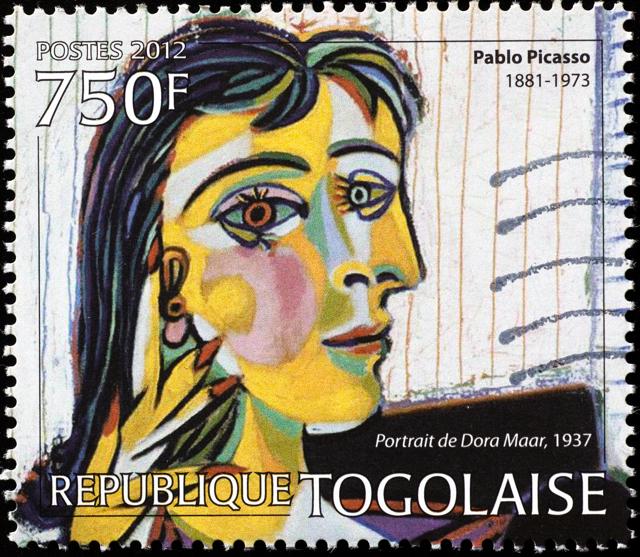
As Adam Grant has noted in his wonderful book Originals, Shakespeare wrote 37 plays in a two-decade period, Beethoven wrote more than 600 pieces, and Bob Dylan has written more than 500 songs. But perhaps no artist was more prolific than Pablo Picasso. Picasso released more than 1,800 paintings and 12,000 drawings, only a tiny number of which are well-known.
Why is prolific output such a predictor of artistic success?
There are likely many reasons for this correlation. One reason: extremely talented artists may find it easier to both produce a lot of work and produce great work.
Dylan in his prime could write so many hits he sometimes forgot which ones he wrote.
One day, Dylan and his good friend Joan Baez were in a car when the radio played a song being performed by Baez. Dylan did not recognize the song, Love Is Just a 4 Letter Word, but liked what he heard.
“That’s a great song,” Dylan commented.
“You wrote it,” Baez responded.
Another reason for the relationship between quantity and artistic reputation: artists who have early success may have more help producing more work.
But there is an additional important reason for the connection between being prolific and success: artists who produce a lot have more chances to get lucky.
Think about it this way. The success of a particular piece of art can be a lottery ticket, with unpredictable events sometimes leading to outsized success. If you have more lottery tickets than other artists, you have more opportunities to capitalize on one of these lucky breaks.
Putting lots of work out there as an artist can be particularly important since artists are sometimes unable to predict when they have produced a masterpiece. One study that pored over letters written by Beethoven documented at least eight times in which Beethoven disliked a piece he had created, only for the world to deem it a masterpiece.
When Woody Allen finished editing his movie Manhattan, he was so displeased by what he saw that he asked United Artists not to release it. He even offered to make a different film for no fee to avoid the embarrassment of having Manhattan shown to the world. United Artists overruled Allen’s verdict and put the film out there in the world, where it was immediately judged a masterpiece.
Upon completing his third album, Born to Run, Bruce Springsteen hated it.
“I thought it was the worst piece of garbage I’d ever heard,” Springsteen has said. Springsteen considered not releasing the album and had to be convinced to release it by his producer, Jon Landau.
The album — which included the title track as well as Thunder Road, Jungleland, and Tenth Avenue FreezeOut, was a hit. It landed Springsteen on the covers of Time and Newsweek, was called by Rolling Stone “magnificent,” and was eventually rated among the greatest rock-and-roll albums of all time.
Thankfully, Beethoven, Allen, and Springsteen put the work out in the world despite their reservations. But many artists who never reached the same level of acclaim don’t do that. They pre-reject themselves.
Of course, if artists could perfectly judge which of their pieces would be well received, it would be perfectly fine for them to be exceedingly selective in what they release. But artists cannot do this. Therefore, they must avoid the temptation to limit how many times the world is exposed to their art. By putting more work out there, they can let the world sometimes surprise them by giving them a hit.
Does the value of quantity extend beyond art?
Indeed, Simonton has found a similar relationship in science — scientists who put the most papers out there are most likely to win major prizes. Scholars have found a relationship between quantity and good results in other domains as well.
PICASSO DYNAMICS IN DATING
In Chapter 1, we discussed the overwhelming evidence that certain people are more desired in dating.
You may recall one of the “no-duh” findings from that chapter: beautiful people are more likely to get responses to their messages; and people are less likely to get responses when they message beautiful people...
Again, no huge surprise there. Beauty matters, the data says, in dating.
But in that chapter we didn’t focus much on the actual response rates. Now let’s look at those numbers closely.
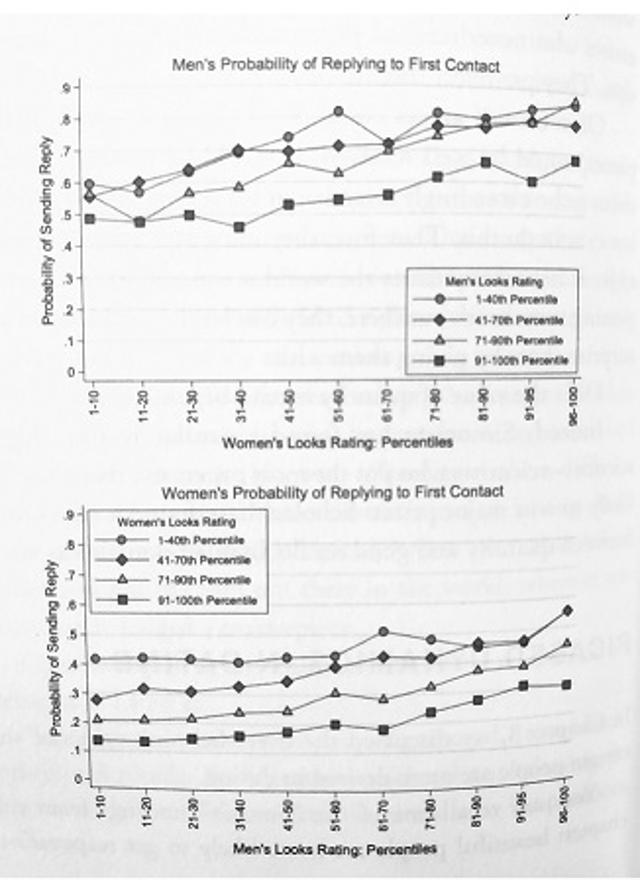
Note what happens when one of the least attractive males (someone in the 1st to 10th percentile of looks) reaches out to one of the most attractive women (someone in the 91st to 100th percentile of looks).
Before seeing this data, what would you have guessed the reply rate to such men would have been? I would have guessed it would be very low. Perhaps 1 percent? Maybe 2 percent? Three percent at its very best? We are, after all, talking about men in the bottom decile of appearance asking out women in the top decile of appearance. We’re talking about a 1 asking out a 10. Talk about out of your league!
In fact, men in this situation get a reply about 14 percent of the time. For women asking men out who are far more conventionally attractive, the numbers are even better. A woman in the 1st to 10th percentile of looks has about a 29 percent chance of hearing back from a man in the 91st to 100th percentile of beauty. Now, of course, not all replies lead to dates, but some of them will.
And the surprisingly-not-all-that-bad odds for people reaching well out of their proverbial league have been confirmed in other studies. Elizabeth E Bruch and MEJ Newman, using different methods and data from a different dating site, found the following: When the least desirable men on the site messaged the most desirable women on the site, the response rate was roughly 15 percent. When the least desirable women messaged the most desirable men, the response rate was about 35 percent.
And these not-as-bad-as-one-might-have-thought numbers have a profound implication for the optimal dating strategy: ask out a lot of people.
Think about it this way. Suppose a man is one of the least desirable men, as ranked by Bruch and Newman, on an online dating site. He dreams of having a date with one of the most desirable women on the site. Recall from Chapter 1 that this is not necessarily a good idea for achieving long-term relationship happiness, since highly desired qualities tend not to lead to lasting relationship success. But ignore that for a moment.

He wants to date an extremely beautiful woman but knows that he is not conventionally attractive. Each time he asks such a woman out, the data tells us, he has a better chance of being turned down than being accepted.
But, since the long shot isn’t as bad as he might have suspected, if he asks a number of these highly desirable people out, his chances of hearing “yes” get surprisingly high surprisingly quickly.
Here’s how the math works itself out, using the estimate from Bruch and Newman that the least desirable men have a 15 percent chance of getting a reply from the most desirable women.
If a man in this situation asked one such person out, he would have a 15 percent chance of hearing back. If he asked 4 such people out, he’d have a 48 percent chance. If he asked 10 out, he’d have an 80 percent chance. And if he asked 30 out, he’d have a — wait for it — 99 percent chance of hearing back from at least one of them.
Also, the numbers would be far higher for one of the least desirable women going after the most desirable men, since the data says they are even more likely to hear back. This may be one reason another study determined that heterosexual women significantly increase their odds of pairing up with a more desirable male if they initiate more contact with males.
In dating, if you take many shots, you have many chances to get lucky. Just as Picasso putting lots of art into the world allows the world to approve some of those pieces, a dater who puts more asks out there in the romantic world allows more potential partners to approve them.
And in dating, just as in art, it is important not to pre-reject yourself. You may recall the stories showing that many artists are unable to judge the quality of their own art. Beethoven thought many of his greatest pieces sucked; Woody Allen thought he would embarrass himself by releasing Manhattan; and Springsteen thought Born to Run was “garbage.” The great artists put work out there anyway, despite their concerns that it won’t be well received. They then get more chances for the world to give them surprisingly good news.
In dating, how many of us get stuck in our own heads, thinking that we have no chance with a man or woman we want to date? How many of us don’t ask the guy or girl out because we think they are out of our league? How many of us think that we are “garbage” or that we risk embarrassing ourselves by asking certain people out?
The math says that being driven by such insecurity is clearly a mistake. The odds when you ask out people who may, on paper, seem more desirable than you may be long — but they are miles away from impossible.
…
Chris McKinlay also learned the power in dating of increasing the chances for other people to pick you and make you romantically lucky. McKinlay, whom Wired describes as a “math genius” who “hacked OkCupid to find true love,” increased his chances to get a lucky match not by asking more people out. Instead, he came up with a clever hack to get his profile in front of more people.
McKinlay noted that women were notified anytime a man visited their profile. So, among many data-driven innovations, McKinlay wrote a bot that allowed him to visit the profiles of huge numbers of potential matches—more than he could visit manually.
Just by increasing the quantity of women who saw his profile, he could dramatically increase the number of women who were interested in him. Shortly after he began his strategy, he was getting some 400 visits per day and 20 messages per day.
This led to numerous dates, including a date with Christine Tien Wang—his 88th first date. A little over one year later, they were engaged.
Dating is a numbers game, and McKinlay hacked the system to up his numbers.
PICASSO DYNAMICS IN JOB APPLICATIONS
Even just being prolific in how many jobs you apply to can massively improve your career. A recent study surveyed hundreds of scientists about the particulars of their job search: every place they applied to, every interview they got, and every offer they received. They found that, for every offer a scientist receives, the average scientist applies to 15 schools.
Further, the scientists who conducted the study found evidence that the scientists who were in their sample may not be applying to enough jobs. It turns out that the more jobs a scientist applied to, the more interviews they tended to receive. And scientists who received offers tended to have sent out more applications.

Think how shocking this is. Scientists work 60-hour weeks trying to do everything possible to improve their candidacy to fulfill their dream of an academic job. But many of these same scientists do not spend the extra dozens of hours it would take to widen the pool of schools they apply to, even though evidence suggests this could improve their odds of a job.
An academic job is, to a certain degree, a lottery. And the lottery winner is likely to be the person who spends a few extra hours accumulating more lottery tickets. More quantity of applications means more chances of a quality outcome — a job.
DATA-DRIVEN DECISION MAKERS CAN DO THINGS — LIKE TRAVEL widely and put themselves out there more — that increase the odds that they are chosen for success. Or, as I like to say it, fortune favors the data-driven decision maker.
…


