
 E-Paper



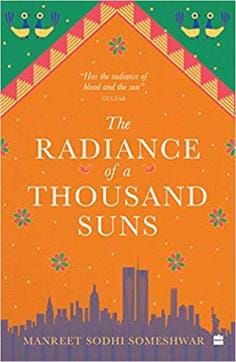
Excerpt: The Radiance of a Thousand Suns by Manreet Sodhi Someshwar
Memory and history, Oppenheimer and the humble jamun, the past and the present all coalesce in this excerpt from The Radiance of a Thousand Suns.


‘You know Tristan, right?’ Mehar asked as she shook jalapeño pretzel pieces into a bowl, a snack for Leyla and herself as they did their homework in Mehar’s room. ‘He calls us the Curry Girls. What does curry even mean?’
Ah! Niki was surprised it hadn’t come up before – a racial epithet. But then, Mehar’s school was rather international with students from Latin America, Asia, Europe and, the US, of course.
‘Curry,’ Niki said, ‘is the English attempt to describe Indian food. Which makes Tristan the curry boy, really.’
‘Tell me more.’
‘Well, the English came to India and discovered spices, rather the peculiar alchemy of spices in dishes that varied as much as the topography of India. Tamarind and jaggery in the south, onion and tomato in the north, mustard in the east, sweet yogurt in the west and endless permutations of gravy from Peshawar to Periyar. The English, nostrils leaking, tongues aflame, discombobulated by the perpetual heat, roiling over the polysyllabic names, did what they could with the multiplicity of India: they reduced it to a single constant. Hence, curry.’
‘Dis-com-what?’
‘Discombobulate. To confuse.’
‘Hmm. Curry sounds like tari, no?’ Mehar said, referring to the gravy dishes of their meals.
‘Yes. It could be a corruption of that as well.’
Leyla had walked up and was listening to them. Niki saw her look around the living room, her eyes resting on the centrepiece: Nooran’s bagh embroidery framed and hung on the wall. She popped a Snyder piece into her mouth and nodded. ‘Oh my god, Tristan is such an ass.
Call him Tristan tikka masala.’
‘Why?’ Niki asked.
‘Tristan is so behind on his slurs,’ Leyla said. ‘He might think he’s being clever, but he probably wolfs down chicken tikka masala every night – that too from the corner takeaway!’ She’d grown up in England; she would know.
‘Tristan tikka masala!’ Mehar shrieked with laughter.
‘So, what did you do at school today?’ Niki asked.
‘Oh, the usual.’ Mehar shrugged.
‘Tell me about one thing, please.’
‘Well, in social studies, we read about Little Boy.’
‘Little boy?’
‘Uh-huh. And Fat Man.’ She watched her mother intently.
‘Ah! The atom bombs over Hiroshima and Nagasaki.’
‘Real slow, Amma – admit it!’ Mehar teased.
‘Perhaps. But do you know who is called the father of the atom bomb?’
Mehar twisted her mouth. ‘He has a long name, and yes,’ she snapped her fingers, ‘it was called the Manhattan Project.’ She angled her head: score.
‘Right. J. Robert Oppenheimer. That the name you were looking for?’
The girls nodded.
‘And do you know,’ Niki asked as she retrieved the pressure pan, ‘what Oppenheimer had to say when he stood in a control room and saw the explosion of the first atom bomb they tested in a desert in New Mexico?’
‘Pumped his fist, I guess?’ Leyla said.
‘Perhaps,’ Niki said, ‘though I think the scientists were rather overawed by what they saw.’
‘Why?’ Mehar asked, popping a pretzel piece in her mouth.
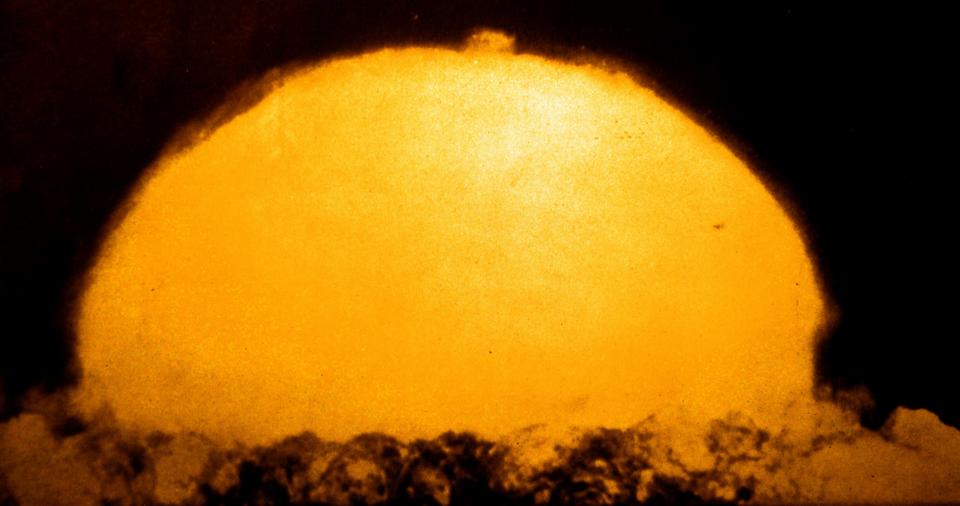
‘This was the atom bomb, remember. It destroyed entire cities and ended the Second World War. Apparently, Oppenheimer was so struck by the blinding light that he quoted from the Bhagavad Gita, recalling the radiance of a thousand suns, the splendour of the mighty one.’
‘Hmmm...’ Mehar said, chewing slowly. ‘Mighty one?’
‘From the scene where Krishna shows Arjuna his godly form, the destroyer of time, the one who shattered entire worlds?’
Mehar nodded. ‘Seeing which Arjuna said “Roger that!” and rejoined the battle.’
‘Something like that,’ Niki laughed. The girls went back to Mehar’s room, and she got busy with preparations for dinner: soaking black lentils in a pan with minced ginger, garlic and half a teaspoon each of red chilli powder, ground turmeric and salt. The book was her Manhattan Project: she was in a race against time and Jyot’s story was the critical fissile material needed for delivery.
At dinner, Mehar pointed to the framed bagh embroidery. ‘It does look ugly, you know.’
Niki was stung but she held her tongue and glared instead.
‘Well, Leyla is right – it looks unfinished...’
‘Do you find it ugly?’
Mehar studied her dinner.
‘You know the story behind Nooran’s bagh.’ When Mehar didn’t answer, Niki said in a quiet voice, ‘Words can hurt, mean words especially so.’
*
Niki’s cheeks were freezing, even as her jaw seemed to have locked itself. The rainwater in the puddles from yesterday had become the black ice of today as she jogged in Central Park. Pin oak leaves were impaled on a fence by the wind and an austere artistry had replaced the profusion of summer. A tree of twigs, bare and brown, dotted with wondrously red cherries. A squirrel, scooting up a tree trunk. A swirling eddy of dry leaves like a curtain of confetti she must part to go through.
How could she make Mehar connect with her past? Their relocation could not become a dislocation, her roots upended and flailing in the exposed air. She thought of her friend Aruna, who had come to the US after getting married. Aruna was sanguine:
‘Home is where our feet take us,’ she always said. It reminded Niki of Dadima’s mang tikka, the pendant framed for posterity on Roop’s forehead as a bride.
The ornament had journeyed from Peshawar to Lahore to Amritsar to Mumbai, to Hong Kong, and now it was in Manhattan.
If it could tell its story, where would it say its home was? In the cradle of the north-western frontier of Pakistan, infamous now as the site of the US war on terror, where three mountain ranges – the Himalayas, Hindukush and Karakoram – had come together to birth its precious stones? In the by-lanes of Lahore, where it first came to rest on the graceful forehead of the first woman to possess it? In the bag in which it was ensconced during the inky flight across Ravi? In the two-room brick house in Amritsar, where it was guarded fiercely against the temptation to pawn it for cash? In the locker of a steel almirah in a quiet bungalow in leafy Chandigarh, where it nestled with other jewels that were collected for a granddaughter’s trousseau?
In the peripatetic bag of the itinerant expat woman, who had taken it to most of the financial centres of the world? Eventually with Mehar, whose home would be god alone knew where. Wherever her feet took her...
From the corner of her eye, Niki saw a child gather pine cones and pour them into a woman’s gloved hands, which reminded Niki of gathering jamun with Nooran every monsoon of her childhood.
Once, while returning from the neighbourhood park, they had met a tall man with whom Nooran had chatted for a bit. Something about the exchange had made Niki jealous.
When they had been back in the kitchen, she had asked, ‘Who was that man?’
‘My man,’ Nooran had answered.
‘His name?’
‘Allah Ditta.’
‘God given? You mean God gave him to you?’
‘No, I gave him to myself,’ Nooran had laughed. ‘That’s his name.’
Niki had frowned. ‘What kind of name is that?’
Nooran had grinned. ‘His mother didn’t want to announce in public that having given birth, she felt like a God. That is why she called him Allah Ditta, when we all know who gave him to the world.’
Nooran snorted. ‘A woman only has to say the most incredible things with a straight face, and the world swallows it wholesale.’
Niki had laughed, not sure if she got it entirely though. ‘If you had a child, Nooran, you’d call it Nooran Ditta?’
‘If I had a child,’ Nooran had said, rolling the pin as she flattened a ball of dough, ‘I would call it Niki, so I could spank it any time.’ She slapped the disc of dough in her palms and plonked it on the griddle. From behind her, Niki had clasped her arms around Nooran.
The satin of her kameez was scratchy, she had smelled of sweat and flour, and Niki had been happy to rest against Nooran’s ample behind. Twin treats had followed: a hot dish of choori and a dessert of pulpy jamun.
As she reached her apartment, Niki shook herself out of her memory. Once inside, she sank on the low chair by the door, her chest heaving with quiet sobs. Tears rolled down her cheeks. She saw one fall to the wooden floor, staining it. Head in her hands, Niki felt both under- and overwhelmed. A black figure blurred into view. It stepped closer before sitting on its haunches right beneath her line of vision, emerald green eyes studying her intently. With one hand
Niki stroked Jade, with the other, she wiped her face. As Nooran and Old Man Bullah would have said, ‘People say their lentils won’t soften, and I have seen stones dissolve often.’
‘Am-ma!’ Mehar stopped as she caught Niki wiping her eyes.
‘What happened?’
‘Nothing.’
‘No, tell me,’ Mehar crouched beside Jade, looking up at her.
‘I ... was remembering Nooran.’
Mehar crossed her legs, took Jade in her lap and sat down. ‘What about Nooran?’
‘Oh, nothing.’
‘Go on, you have so many stories about Nooran – tell us one.’
Niki recounted how she would go with Nooran to the park each monsoon to look for juicy jamuns scattered at the base of the jamun tree, pick the good ones, pile them in the dupatta that Nooran would spread out like a net, rinse them at home, sprinkle them with salt and pop into her mouth one by delicious one, the tangy taste yielding to sweetness and a tongue dyed deep purple. ‘Jamun is better than any strawberry, blackberry or other berry,’ Niki concluded.
‘And what about mangoes?’ Mehar asked, aware of her mother’s fondness for it.
‘After mangoes, jamuns are the finest fruit of the Indian summer.’
‘And Nooran’s dupatta?’
‘Dadima gave her a fresh one when jamun season ended, and the stained dupatta became a head wrap for when Nooran dusted the house!’
Niki paused. Nooran was Niki’s mother as much as Dadima was.
When a mewling motherless infant was delivered to Jinder Nalwa, Nooran had swaddled the baby in soft mulmul as Dadima had dipped her finger in honey and touched the infant’s tongue. She had suckled on Dadima’s finger as Nooran’s capable hands cradled her.
How did Niki know this? It was her favourite story of the trove of stories they had nurtured her on. The umbilical cord that Nooran had always talked about pulsed not only with oxygen-carrying blood but life-giving stories also. Everything that Niki knew had come from the conversations that filled her home.
Even on the day that Niki had lost Nooran, she knew she could always find her way back to her for they were intimately connected through that umbilical cord. Like dust motes that become apparent in the air in the chink of light breaking through a parted curtain, Nooran’s stories would remain in the ether of her life, to be plucked and re-plucked when needed. What could sum up the woman whom she had always called by her first name, who had cared for her as a mother but treated her as a friend-sister-daughter, whose laugh was heartier than any man’s, who was truer than the blazing sun, whose snort could cut through her bullshit, who would cradle her to her bosom and cure all her heartaches?
‘What, Amma? What are you thinking?’
‘Nooran,’ Niki smiled.
‘What about Nooran?’
‘That she had the radiance of a thousand suns.’
‘Little Boy or Fat Man?’
‘Her Own Woman. Nooran was her own woman,’ and Niki reached out and embraced her daughter. As long as there were stories to tell, there was a way to connect.


