
 E-Paper



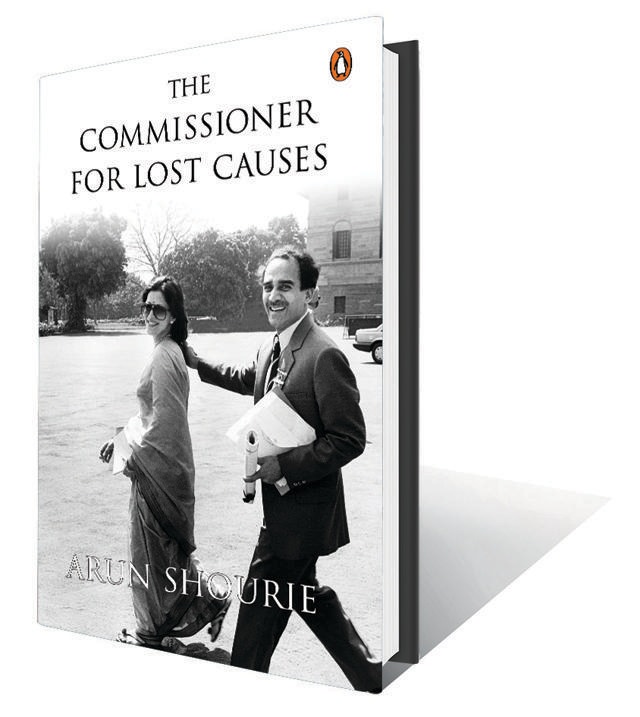
Excerpt: The Commissioner For Lost Causes by Arun Shourie
This first exclusive excerpt from Arun Shourie’s memoir revisits one of the biggest stories of the 1980s – that of Kamla, who was purchased by a journalist in an attempt to expose the exploitation of tribal women in central India

 Prefer HTon Google


Ashwini Sarin was a daring young reporter in our Delhi team. He would go into the field and document the facts — from the excesses of authorities during the Emergency in the name of family planning to irregularities in disposing of old defence vehicles. To substantiate conditions in which prisoners were being kept in Tihar jail, he had himself arrested for “drunken behaviour”, and got himself into the jail. While he was inside, he collected information about the conditions, of course, but, more important, about the free flow of drugs there. He wrote about this trade when he came out, to great acclaim from readers.
While covering elections in the Dholpur-Morena area, Ashwini had learnt that trade in women was widespread at the junction of Madhya Pradesh, Rajasthan and UP. From time to time, social workers used to draw attention to this evil practice, and officialdom used to deny it. Ashwini told me that he was prepared to go to the area, actually purchase a woman, and bring her to Delhi.
We kept the project from everyone — at home and in the office…
Of course, we had no doubt that purchasing a woman was a serious matter… I wrote to five eminent persons — starting with the then Chief Justice of India, Justice YV Chandrachud, and Justice PN Bhagwati… I explained what Ashwini was about to do, and the reason he was going to do it. The reason was plain and simple: instead of taking steps to eliminate an inhuman practice, the Madhya Pradesh Government was just covering it up with lies. We were going to expose the facts in a way that would render them undeniable. This would put pressure on the Government to at last take steps to educate the poor tribal people to stop visiting this terrible fate on their sisters and daughters.
Ashwini began visiting the area to get to know the lay of the land, to forge contacts, to win the confidence of the local people. For winning confidence, he made himself out to be several characters, including a Thakur from Punjab on the lookout for a girl... This subterfuge continued for almost eight to nine months… Ashwini went to the area 10 times… At immense risk to himself, Ashwini established direct contacts with persons who were in the business of buying and selling women. After intense and diligent work, he struck a deal at the Morena Circuit House, and purchased the lady, Kamla. She was delivered to him at the Delhi railway station. Ashwini’s account began with sentences that were to be echoed for long:
Yesterday I bought a short-statured skinny woman belonging to a village near Shivpuri in Madhya Pradesh for 2,300 rupees. Even I find it hard to believe that I have returned to the capital this morning after buying the middle-aged woman for half the price one pays for a buffalo in the Punjab.
I visited the area ten times to win the confidence of the sellers but in the end it was as if I were just buying a pair of shoes. . .
…We thought it best that after Ashwini’s initial story, Kamla should be met by and be interviewed by a lady. Coomi Kapoor, our Chief Reporter in Delhi at the time, went to meet her. During the conversation, Kamla often referred to herself in the third person… From time to time, Kamla lapsed into incoherence; she did not seem to be in full possession of her faculties. Even making allowances for the effect of what she had been through during the preceding day — having been sold, being brought to a large, unknown city — Coomi judged her responses to be erratic. “She has been used and abandoned again and again,” Coomi wrote. “No wonder she is now on the edge of madness.”
At times, far from being distressed, Kamla expressed a measure of pride at the fact that the price for her had been pegged so high. Kamla’s reactions also established another distressing fact. So widespread must the trade in women have been that, at times, Kamla thought her fate to be the normal one: Ashwini’s wife told reporters that Kamla asked her how much Ashwini had paid for her, Uma; that as Ashwini had already paid for her, Kamla, why could the two of them not stay together with him. On meeting her, and listening to her rambling, sometimes contradictory, sometimes somewhat incoherent responses, Coomi concluded that Kamla was “in urgent need of psychiatric care”.
The story created a sensation.
Ashwini… became a household word in every city where the Express was published. On the other side, governments flew into a rage. They had been shown up doing nothing about an abhorrent practice. The local police at Dholpur let it be known that they would be filing a case against Ashwini for trafficking in women. To forestall that, we filed a writ in the Supreme Court requesting the Court to give directions on steps governments must take to curb the trade, and about where Kamla should be housed.
To our great relief, an Arya Samaj institution that maintained a home for orphans and destitute women, the Arya Anaathalaya, agreed to provide her shelter. She was taken there. But… a posse of Delhi policemen swooped down to the Arya Samaj shelter to take possession of Kamla… Colleagues rushed to the Chief Justice of the Supreme Court... Late in the evening, Justice Bhagwati directed that Kamla be returned to the orphanage, and should not be shifted “till further orders”.
The dispatch filed that evening after all this rushing around concluded: “Kamla, removed from the Home around 5 pm, came back at 7.30 pm, visibly dazed and upset: “Am I a monkey to be pushed around like this? You have not been kind to Kamla,” she said. “Have you?”’
... Ashwini, Coomi and I filed a writ in the Supreme Court. Justice Bhagwati and Justice A Vardarajan admitted the petition. They directed that Kamla not be shifted; that AIIMS immediately depute a psychiatrist to assess the kind of help that Kamla needed; that governments should not initiate any action based on the subject matter of the writ against anyone among the three of us without prior permission of the Court. And they issued notice to the governments of Madhya Pradesh, UP, Rajasthan and the Centre to explain what steps were being taken to suppress trafficking in women.
The Madhya Pradesh government, which had done nothing to curb this cruel trade, now directed the Commissioner of the Morena Division to inquire into the matter and file a report within 10 days… the Government wouldn’t make the findings public. We had an outstanding correspondent in the state, NK Singh. He got hold of the report...
There was a flourishing trade in women centred in Morena and the surrounding areas, the Commissioner’s inquiries confirmed. Girls and women were brought from faraway places, bought and sold, and sent to centres like Delhi and Meerut… “The traffickers,” NK quoted the report to have recorded, “are influential in local politics and enjoy patronage of political and social bigwigs.”...
Ashwini’s story, and his daredevilry, became a household word. The famous playwright, Vijay Tendulkar, wrote a play with Kamla’s fate as its peg… The play became the basis for a movie, Kamla…
Ashwini’s spectacular effort had a tragic end, in more ways than one. Even as efforts to find Kamla a shelter were continuing, one day we learnt that the poor lady had “disappeared”. How could that be? Kamla was not of sound mind, and so she could not have escaped on her own into a city that she knew nothing about. More important, entry to the orphanage was strictly controlled. The building had only one entrance — a high gate that was always closed. And the police had been posted outside the gate. How could she have got out or jumped out? Efforts to trace her continued. In November that year, the Supreme Court directed the Police Commissioner of Delhi to make all efforts to locate her. She was never found. The most likely explanation? Persons buying and selling women who would have been exposed had removed her somehow...
Ashwini continued in the paper for a few years. Later I heard that he had left journalism all together, and taken to business. I had lost touch with him. To make sure that my memory was not deceiving me on some details, I got his number from an old colleague. Almost forty years would have passed since I had spoken with him. We were hardly a few minutes into the conversation that Ashwini was overwhelmed with tears. He said he had become “too emotional”, that he couldn’t talk at the moment, and would get back later. He put his wife, Uma, on the phone . . . Talk of bonds forged in those years...


