
 E-Paper



Interview: P Sainath, author, The Last Heroes - ‘This is a more emotional book”
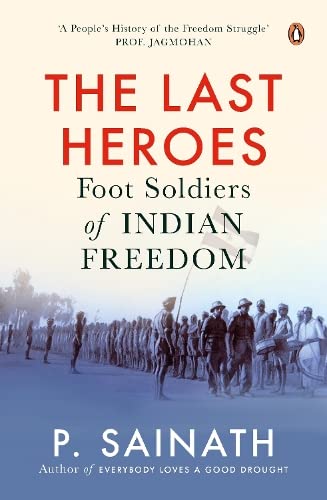
26 years after P Sainath wrote Everybody Loves a Good Drought, he’s back with The Last Heroes: Footsoldiers of Indian Freedom, one that Gopalkrishna Gandhi says “redefines biography writing”

 Prefer HTon Google


26 years after P Sainath wrote Everybody Loves a Good Drought, he’s back with The Last Heroes: Footsoldiers of Indian Freedom, one that Gopalkrishna Gandhi says “redefines biography writing”. The big names we are all familiar with make cameo and guest appearances. The heroes are relatively unknown. They come from across India and speak many languages. That diversity is mirrored in their individual struggles. With lathis, type-writers and tiffin-carriers, they took on the might of the Raj. Some made bombs, others stopped and looted trains, and a young woman used a slingshot with great precision. Stirring, sad, hopeful, revelatory and unexpectedly funny, The Last Heroes is truly the “Ordinary People’s History of the Freedom Struggle”, as Professor Jagmohan Singh calls it in the foreword. Here, Sainath speaks about the process, the people and the purpose of this unusual book.
It seems at one level as if on August 15th, 1947, every Indian was equally free and governed by the same set of laws. And yet some continue to struggle for the rights. Those struggles in fact essentialize the book. Isn’t it ironic that the fight is not over?
As Captain Bhau says in the first line in the book, “We fought for freedom and for independence. We attained independence.” And every one of them had their own take on the freedom struggle, where not just Oxbridge return elites were setting the agenda.
They were fighting for their rights as human beings, for the survival of their occupations. And their common goal was fighting the British. All of them came from the rural areas and their first battles were in the rural areas.
And those battles are not over, the denial of the rights to the Adivasis is still going on. I always say the Adivasis were the first to fight for freedom, the last to gain from it.
At the age of 95, Captain Bhau came out one day, in 2017, on the street in his own village. When I saw a Facebook post about it, I asked him, what were you doing out there? He said, then also we fought for farmers and labourers, now also we fight for farmers and labourers. For him, that was a battle unfinished.
R Nallakannu is a legend on the Kisan Front, N Sankariah on multiple fronts. They were fighting feudal forces, which had been propped up by the British. They are still fighting those semi-feudal forces, for farmers, labourers, and workers. This is who they were: you’re looking at a bunch of people who identified with the masses, were themselves part of the masses, and therefore the empathy and identification was near total.
Why have the struggles and sacrifices of the women who fought for our freedom been largely forgotten?
It was a question put to me very squarely by Lakshmi Panda back in 2007 that made me look at how we define freedom fighters. Like in most other things in society, our definitions exclude women and the marginalized. Now, if you look at the Swatantrata Sainik Samman Yojanya (SSSY), it tells you there are only seven ways someone can qualify. I’ve described it as the seven laws of bureaucratic suffering. One of them is a jail term. Lakshmi Panda asked me, “Because I never went to jail, because I trained with a rifle but never fired a bullet at anyone, does that mean I am not a freedom fighter? I only worked in INA forest camps that were targets of British bombing. Does that mean I made no contribution to the freedom struggle? At 13, I was cooking in the camp kitchens for all those who were going out and fighting, was I not part of that?”
She wasn’t obsessed with the pension. What she really wanted was the recognition that she played a role.
Now, Lakshmi Panda at least saw herself in that light. Bhabani Mahato, accepted the stereotypes on women by a male-dominated society. She said, “Why are you calling me freedom fighter? I don’t know. My husband was a freedom fighter. He went to jail for 13 months.”
We realised that she doesn’t think she did much and she also was coming at it from a very realistic standpoint, which was, “I was married at nine. Did you expect me to have great positions on Gandhi’s philosophy of Ahimsa Satyagraha? I was using a charkha at age five, six. Once I got married, I could not do it any more. I had to feed a large family.” And then we realised, she was also doing the incredibly arduous, laborious and risky task of feeding the fighters who were hiding in the forests after the Purulia police station was attacked, that too, at the height of the Bengal Famine.
Then there’s Mallu Swarajyam, an ace with the slingshot and the leader of all Dalams (armed squads). Tell me how easy is it today for a woman of 16 or 60 to be given that responsibility? Mallu wrested that responsibility and led all the Dalams in the Telangana Uprising, male, female, of her large region in Warangal.
Ketaki Parida, Hausabai Patil, Salihan – they all summoned up great courage. I keep asking myself - and I want readers to ask themselves - what would we have done in their situation? Yet, they are not going to be recognized as freedom fighters.
Shobharam Gehervar asks this question, which continues to and is conveniently used to divide people: “Why should I choose between Gandhi and Ambedkar? I can choose them both.” What’s your take on this?
I think that he has given us a very powerful comment on the futility of how the present day debates are structured. That is, are you with Gandhi or are you with Ambedkar?
And Shobaram said - what a beautiful phrase – “I was with both Gandhivad and krantivad.” [Gandhian path and revolutionary movement].
Now, how you do not give that man a place on the list of great freedom fighters is beyond me. The chapter called Directive Principles of State Policy captures totally the battles which we have not yet won.
As a journalist, you’ve covered some of the more difficult processes of our time, including the farm suicides. What was reporting for this book like?
Goosebumps and hair standing. As I speak to you about them, you can see it on my hand now. I grew up on these tales. My mother would tell me about her own father who spent years in British jails. This book was both: a labour of love and something very difficult to handle. In many ways, this is a far more emotional book than [my first one] Everybody Loves a Good Drought. It still tries for the fly on the wall thing, but then, I don’t believe the journalist is a zombie.
Here you can see it from the poem for Salihan. After meeting her, four grown men in that car, on our way home, were either in tears or close to tears. Looking at someone whose battles were part of our achievement of independence, whose courage in taking on British-Indian police with a lathi, when they had firearms, and just looking at her condition…
Meeting someone like Salihan was devastating. And I couldn’t write that story. I could only write a poem, almost a jingle. And I wrote it in the anger that we all felt on the way out of her village.
Then there’s Baji Mohammed who allowed us a glimpse of greatness of a kind which very few of us can aspire to. This man was beaten up in prison by the British, treated in the most cruel way, and then speaks about them and about it without bitterness. Almost half a century after that, he has his skull fractured by Sangh Parivar elements at Babri Masjid, when he was sitting among a group of Gandhians on a peaceful dharma. Yet, he speaks of that without the slightest bitterness.
Could you elaborate on the timing and audience of this book? You have said it comes when, in the political and public domain, the freedom struggle itself is being dated back by 800 years.
We have had ministers dating back the struggle for freedom to the Delhi Sultanate and the so-called Muslim invasions. The government of India has also put up a website: Azadi ka Amrit Mahotsav. It’s part of a big campaign. The first project was worth about 110 crores. But I could not find a single photo, article, video, statement or quote of a living freedom fighter.
The timing [of my book] was also for the 75th year of independence.
As for the audience, I wrote this book first and foremost for the people in it. We need their stories in order to better shape our own. Also, they have a right to have their stories told. There are two, three of them who died soon after – like Bhagat Singh Jhuggian. I met him twice. He asked: “You’ve done the story, no? When is the book coming?” It’s like he let go after he knew his story would be told. That’s what my friends in Punjab told me. That’s sad, but beautiful.
Secondly, the book is written for a generation that will never ever see, speak to, engage with, hear or listen to a genuine bona fide freedom fighter who gave them the country they now have. And that breaks my heart.


