
 E-Paper



JLF 2018: The connection between the Mughals and Rembrandt van Rijn
Artistic exchanges between India and Europe during the Mughal period weren’t just about culture but also about trade, negotiation and power. Stephanie Schrader of the J Paul Getty Museum spoke about the link between Indian and European art during a session at the Jaipur Literature Festival.


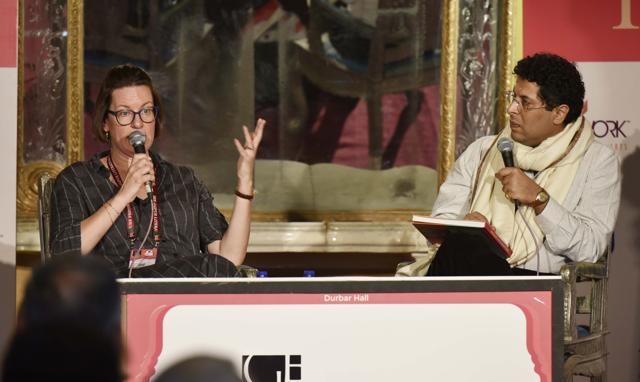
“They don’t look like Dutch merchants, do they?” asks art curator Stephanie Schrader, showing the audience sketches of two men wearing choghas, elaborate turbans with feathers, and ornaments. This is at a session aptly titled Rembrandt and Mughals featuring Delhi-based historian and art curator Naman P Ahuja and Stephanie Schrader of the J Paul Getty Museum, who spoke about the link between Indian and European art.

For Jaipur Literature Festival full coverage, click here
Schrader reveals that one of the challenges she faces is to make viewers believe the drawings were made by Rembrandt van Rijn. Here’s the back story: In the 17th century, merchants of the Dutch East India Company took Mughal drawings back to Netherlands, which were then replicated by the famous painter Rembrandt.
No one knows why the painter, who often focused on fantastical elements and portraiture, tried to draw the Mughals. “It’s something I’ve always been curious about. How did Rembrandt, who had never travelled out of Netherlands, know about India and the Mughals?” Schrader wondered.
Were the Dutch painter’s Mughal drawings simply a passing fantasy? “He’s all about drawing with wet brush, using light and shadow… and his painting don’t have too many details,”says Schrader who is a specialist in 16th-18th century Dutch art.
The Mughal drawings are different. “They are meticulous. He (Rembrandt) is attentive and he gets the details,” she says adding that perhaps Rembrandt was trying to learn a new form of art.
The artist made 23 Mughal drawings: eight of them of Mughal emperor Shah Jahan and a few of Jahangir and Akbar as well. The drawings were sketched on Japanese paper, a material that Rembrandt had never used before.
Symbolically, the drawings made in 1650s, were also an “inversion” of the master-pupil role, Schrader told the audience. The Dutch master used to run a training workshop for artists and his exploration into Mughal art after he had already gained recognition for the work showed that he was a “good student all his life”.
But, the drawings did not inspire sweeping changes in Rembrandt’s paintings. “There are not many. Some people have pointed out details in swords. But no turbans, or feathers have been seen,” Schrader said.
The panelists also pointed out that such artistic exchanges weren’t only about culture. Schrader said English diplomat Sir Thomas Roe had once given European paintings to Emperor Jahangir. An art enthusiast himself, the Mughal asked his artisans to replicate the portraits. Roe couldn’t differentiate between the original and the copies. “And that type of power relationship was a game Jahangir loved playing… So, we have to keep in mind trade, negotiation and power when we think of such exchanges,” Schrader said.
Two works summed up the ties that bind Europe and India: One by an unknown Mughal artist featuring Jahangir holding a portrait of Virgin Mary and another by Rembrandt, titled Jahangir Receiving an Officer. In both, Jahangir’s face was uncannily identical.
Follow @htlifeandstyle for more


