
 E-Paper



David Szalay: “Life isn’t solely a matter of individual will and agency”
The author of Flesh, which won the Booker Prize earlier this week, on how socio-economic factors and political events shape people

 Prefer HTon Google


You’ve mentioned that Flesh was not the intended title of the book initially; it was just a placeholder of sorts. What made you stick with it as the final title?
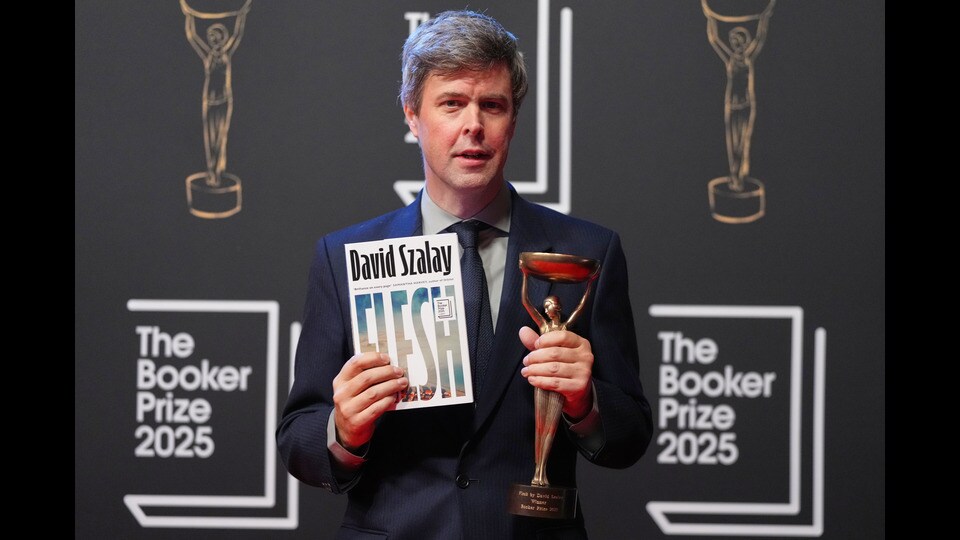
As you say, it was a working title, which I assumed would probably be replaced. In the end, [my editor and I] decided it was actually the best title for the book. The fact that it came to me instinctively as the working title probably indicated that. Initially, we felt it was a bit rough and made people uneasy — but we eventually decided that it was a good thing. It did seem a bit unliterary, but now I think that’s definitely a good thing. There were other options — something like “A Life” was briefly considered, but that felt weak. In German, it has a completely different title actually, chosen by my German publisher. I can’t remember the exact German, but it means something like “That Which Cannot Be Said”. It comes at the book from a different angle, but I think that’s a great title as well.
The novel seems to suggest that the body is both the one thing we truly own, and the one thing that betrays us most. Was that the paradox you wanted to examine — the body as both home and prison?
Absolutely, and that’s a very nice way of putting it actually. The body defines who we are in some sense, I mean, we are our body. But as you say, it also places limitations on us of various kinds, absolute limitations, really. The word prison might be a bit extreme (laughs) but yes, I think that was a driving idea in the background of the writing process. Definitely.

The title makes us think of skin, desire, decay, appetites — but it’s also strangely impersonal, as if you’ve stripped the human of individuality. Were you trying to write about the human animal, rather than “a man” as a social being?
Yes, very much so. The idea of human as an animal is quite prominent in the book in many ways. But it is also present with human society. I don’t think they’re two entirely separate things. I mean, the nature of human society and the way it’s built is a reflection of the animal nature of each individual human, to a certain extent. I see those two things as being very closely connected to each other. That close connection was also what I was trying to express in the book. You mentioned the impersonality; I think that there is some. I wouldn’t say the book is anti-individualistic, but there’s a sense that we’re all the same person.
With Flesh, did you start with the idea of writing “a novel about the body,” or did István come first as a character?
It’s hard to say exactly that it was one or the other. I did definitely start with the idea of writing about the body or at least life as a physical experience. But it was very important for me to approach it through a character who is compelling and sympathetic to the reader, since it was a novel. So those two things kind of grew up together.
The protagonist, István, is often passive, drifting through forces greater than him. How much did you struggle (or relish) the tension of writing a main character who is, in many ways, a “puppet” of his circumstances rather than someone who is fully in control?
I mean there wasn’t much struggle in terms of making the character and the novel work. That wasn’t the case. The sense of writing about a person whose life is shaped by things over which he has no control was an idea that was there from the beginning. I do think all of our lives are like that, to quite some extent. So, I wanted to write a book about that. There wasn’t a version of the book where István had more agency and then I had to suppress that.
The novel moves between multiple phases of István’s life — adolescence, military service, his rise in the elite circles, and so on. Did you have that mapped out from the start?
I had that rough arc in mind from the start, though obviously not in every detail. But I knew I wanted to write a book about his whole life, from his childhood to his old age. I actually had to cut a lot of chapters from the in-between phases of his life, so the flow changed but the basic outline was there — quite clearly in my mind — from the beginning.
Your prose in Flesh is tight and pared down, with so much unsaid. How do you balance that restraint with giving enough “hooks” so that the reader remains invested in the plot and characters?
I think the reason it could be pared down like that was partly because I had a clear sense of what I wanted to express with this book, which also meant that I had a quite a clear sense of what was necessary and what wasn’t. In terms of keeping the reader interested, for me it’s just following the principle of writing what interested me. You just hope that what interests you will also interest the reader. There wasn’t a very conscious process of deciding what to include and what to exclude.
Throughout István’s life, chance, power structures, socio-economic forces, and bodily fate seem to loom large. To what extent do you see Flesh as a novel about agency?
As we discussed before, it is very important to my conception of the book. The list of things you just said was very exact. It’s fully about the socio-economic factors, political events, and their effects on the limitations and desires of his own body. The book is about those forces as much as anything else and how lives are shaped by them. Life isn’t solely a matter of individual will and agency. To ignore the larger forces would be to paint a false picture. But at the same time, that doesn’t mean that the book supports the idea that we have absolutely no agency, and free will is an illusion. There are quite a few moments in the book which show how free will is actually shaped by those larger forces.
Money, status, power — they serve more than just backdrops, they actively shape István’s trajectory. How do you see the interplay between the physical and capital in this novel?
I think that the physical animal nature of people and the socio-economic structure of the society are very closely connected. They’re an expression of the other in some sense. I don’t know if there will be a world where that isn’t the case. So, the parts of the book that deal with social status and power and money are in a way continuation of the earlier parts of the book, where we explore the emotional and sexual power people have over each other.
Has writing this novel changed the way you perceive the interplay between these two factors?
As I’ve written the book, maybe it’s refined somehow. But since it’s a novel rather an essay or a work of intellectual abstraction means it can’t deal with the abstract of these ideas so much as in an imagined reality. I think I can now see more easily how those two factors work in real life. Well, at least an imaginary real life.
In an interview, you mentioned wanting to move away from the idea of a mind trapped inside a body, toward seeing humans as “bodies that think.” Flesh seems to embody that — the psychology feels implied through action and texture rather than interior monologue. Would you say you’re consciously writing against traditional psychological fiction?
I don’t know if I’m consciously writing against it. I obviously stand by what I said in that interview, but that’s just, I suppose, how I see things. It feels a lot more interesting to look at things from that perspective. It feels truer for me.
When you write characters like István — who live largely in the external world — does that feel like a rebellion against your own interior life as a writer?
(laughs) That’s a great question. I have to say… Yes!? I mean, I haven’t really thought about it like that. Being a writer largely involves sitting silently in a room and doing something which is invisible to an outsider. With this book, I was keen to write a story that was exterior and with characters who were viewed in terms of their actions rather than their thoughts.
What writers or books have influenced Flesh and your overarching work in general?
I always find this very difficult to answer, because there are always so many things, people, and works you draw from, consciously and subconsciously. There’s a book, which is not that well-known I think, which has had quite a profound impact on this novel. It’s called Ultraluminous by Katherine Faw. I happened to read it in the early stages of working on Flesh. The way it works, the way it operates, its presentation — it was quite impressive on me. It’s a novel which also doesn’t really have interiority. The interiority is implied. Apart from that one book, Michel Houellebecq, the French writer, has been very influential for my work. Virginia Woolf, not a name you’d expect, but she’s inspired me as a writer quite a lot as well.
Rutvik Bhandari is an independent writer. He lives in Pune. He is a reader and a content creator. You can find him talking about books on Instagram and YouTube (@themindlessmess).


