
 E-Paper



Neige Sinno: “Abusers are regular people”
At the Jaipur Literature Festival, the author of Sad Tiger and winner of the Prix Femina spoke about literary strategies to tell personal stories

 Prefer HTon Google


You begin Sad Tiger, translated from the French by Natasha Lehrer, by creating a portrait of an abuser, your stepfather. Why did you do that?
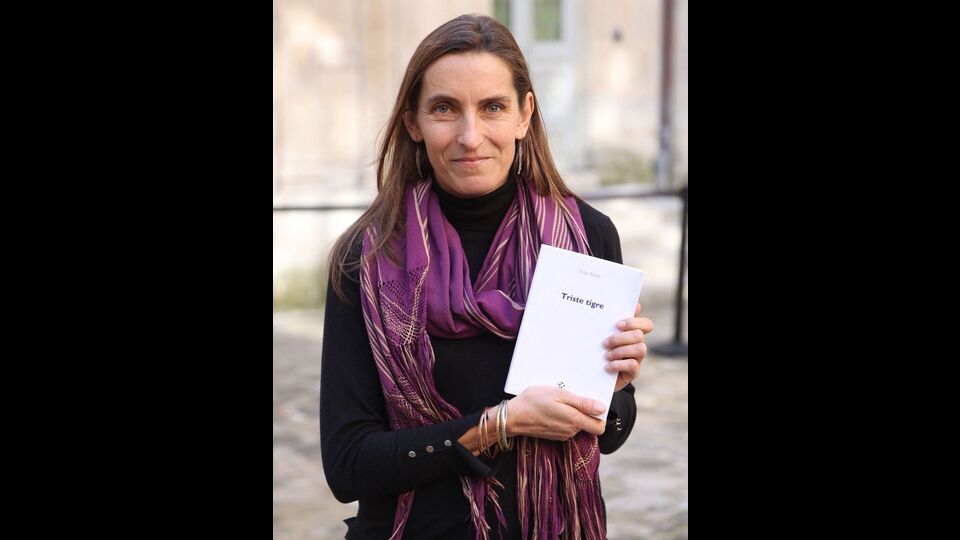
One of the reasons is the impact the trauma had on me. I was abused by a powerful figure, and I was forced to put myself in his shoes all the time. One of the strategies of his domination over me as a child, as a victim, was to make me consider him more important than me. I think it’s very common in people who’ve been victims to think a lot about the abuser.
And it’s also strange, the language we use. I’ve seen something I can call evil, but I don’t really know how and what to call this. I always wondered what happened to [my stepfather]? What was happening in his brain when he started doing this? How can that happen? Would I be able to become an abuser myself? I was thinking of all these questions.
When the book begins, the figure of the abuser in my head is big, and I’m trying to come to terms with this, and that’s why the title is Sad Tiger. Because this tiger, which is very ferocious in the beginning, is getting deconstructed as the story progresses.

I started with the promise of a portrait, but it was not going to be possible to sustain it, because I also realised that I wanted to take more space than him. It’s a strange narrative because there’s an undercurrent here. I’m trying to build this space for myself and for my voice, but also for the reader.
The narrative reason is that it’s provocative. Since I knew it was going to be difficult for me to write this book, I knew it’d be difficult for you to read this book as well, so why not start with the difficult stuff, say it on the first page, ‘You know what, we’re going to be in a room alone with this man.’
It was challenging, but this was my contract with the reader: to begin this way. To tell them that it’s going to be tough, I’m going to talk about rape, and we together are going to investigate something very dark and painful. It was like a trigger warning in a way which wasn’t a trigger warning at the same time because it’s a strange invitation. Of course, it’s a hypothesis; I’m not completely sure if I succeeded in doing that, but I do know that when I wrote those first pages, I knew, at last, the book started the way I wanted it to start.
The book’s epigraph quotes Vladimir Nabokov’s Lolita with the titular character being called a “small ghost”. With Lolita, Nabokov’s readers were divided because Humbert Humbert, a perpetrator, was telling the story, not Lolita. You do the opposite by creating this portrait of your stepfather.
I find manipulative prose interesting. I wanted the reader to be very conscious that I could manipulate them too. It’s a different contract of reading. I wanted readers to be careful. I was informing them, ‘Don’t follow me. You’ll feel uncomfortable.’ In a way, I also created a critical space for them.
Humbert Humbert, in his narration, is manipulative too. He argues that maybe Lolita seduced him, and all the time, he is hiding things from everyone, so I believe he obviously knew it was a crime. Like most perpetrators, he was finding excuses by [fabricating] a story, silencing the victim. It’s interesting to deconstruct a perpetrator, seeing how vulnerable a victim can be in relation to someone when they have good literary strategies to manipulate everyone. I thought I could do that too. So, instead of trying to convince people, I built this strategy, telling the reader, ‘I don’t want you to think this or that.’
Would you say you’re demonstrating the power of storytelling this way?
I think it’s a power to tell the story. Of course, it’s a different power than abuse.
It’s okay to be conscious that you’re in a dialogue with the reader, and I’m unsure if I completely succeeded in it. While reading the book, you’ll note that often the story becomes blurry; I’m confusing the reader. They can judge me because of it. But at times, I’m also stepping out of what I was intending to do for the story to become meta-literary. Perhaps you can say that I wasn’t choosing a particular kind of reader.
It’s a play. It’s a game. And like in a game or in a relationship, you need to develop trust. It’s paradoxical in my book because I’m trying to build trust and at the same time, asking readers to be alert, too.
Your mother told you to look at the ‘good side’ of your stepfather. It’s eerily similar to the denial one can sense in the Alice Munro expose.
It’s complex, I know, and that’s what I’m trying to show: that it’s impossible to keep everything together, fully knowing the nature of the abuser.
There’s a man you know, who’s your friend, whom you think is a good person. It can be a colleague or your father or whoever, but when you learn he did something to someone, then how do these two personalities of the same person, these aspects, come together? Processing this can sometimes drive you crazy, which is what I think happened to my mother. What must she do with this information? Her denial demands an explanation. But, for her, my stepfather was just an ordinary person. He couldn’t have done this. So, maybe everything she had heard was a lie. Or the other way around, maybe my stepfather is a monster. If you look beyond the façade of a person, you tend to see that both extremes are wrong. The truth lies somewhere in between.
Abusers are regular people. They are among us. In our families. Inside our brains. It’s confusing, but I think they’re able to commit a crime because they’re able to project their goodness at the same time. And you know what, this is why even after 30 years, I tend to present these doubts because all this has been traumatic. You dissociate and put yourself in another person’s place all the time. But while writing this book, I was trying to find a middle ground.
We mustn’t forget that a child never consents. Imagine how much time and rumination are involved in acknowledging this bare fact. But after all these years of rumination, I wasn’t trying to find answers.
Which is why you’ve chosen this structure, the aesthetics of telling your story?
You’re right, it’s a construction. Fiction is construction, too. We’re never going to have direct access to the truth.
I think we’re starting to realise the damage Freudian theory has caused. I remember hearing in a conference when a PhD student explained that when Freud received all these testimonies of women who had shared flashes or memories of abuse, in the beginning, he believed that all this made sense, that these people were facing mental-health problems as a consequence of the trauma. Later, however, he said something to the effect that it’s impossible that there’s so much abuse, so perhaps these people are making things up because they have had an unconscious desire to have a relationship with their abusers. This damaged the way one considers reality. The truth is there’s a lot of abuse. People aren’t making it up. This is common sense. I don’t know much about India, but in the places I’ve lived, societal conditions aren’t made for children to be in a good, safe place.
To protect our children, we need to build a space for them to express themselves and hear them. They have dignity and should be respected, too. I believe we need to realise the structures of domination of adults over children.
But even if children expose their families, they’re made to experience shame while the perpetrators roam around shamelessly.
Absolutely. Towards the end of the book, I invoke this historian who’s been to Rwanda to interview perpetrators, and she notes that they do not have any bad dreams. I’m amazed. How can these people sleep at night? I think they’ve gone beyond the limits that make us human, or the way I understand being human.
You know, shame also maintains me in the subaltern position, but at the same time, it makes me responsible for my acts. It makes me conscious of being a member of a collective that carries too much shame. And I don’t deserve that shame. This shame should change sides. Annie Ernaux uses shame as a way or a place to extract the absolute truth, and she notes that she needs to explore this dark place to find the truth.
Saurabh Sharma is a Delhi-based writer and freelance journalist. They can be found on Instagram/X: @writerly_life.


