
 E-Paper



Report: 1st Ferozepur Heritage, Military and Literary Festival 2026
The event in the border town of Ferozepur in Punjab saw some lively sessions on local history, and on the ongoing war in West Asia

 Prefer HTon Google


The white colonial bungalows of Ferozepur cantonment gleam quietly in the late spring sunlight. The many monuments and plaques at the chowks and in the streets commemorating fallen soldiers send an involuntary shiver down the spine. As does the black and white photograph of Cfn MC Gopala Pillai, killed during the 1965 war with Pakistan, that hangs in your room in the EME Mess.
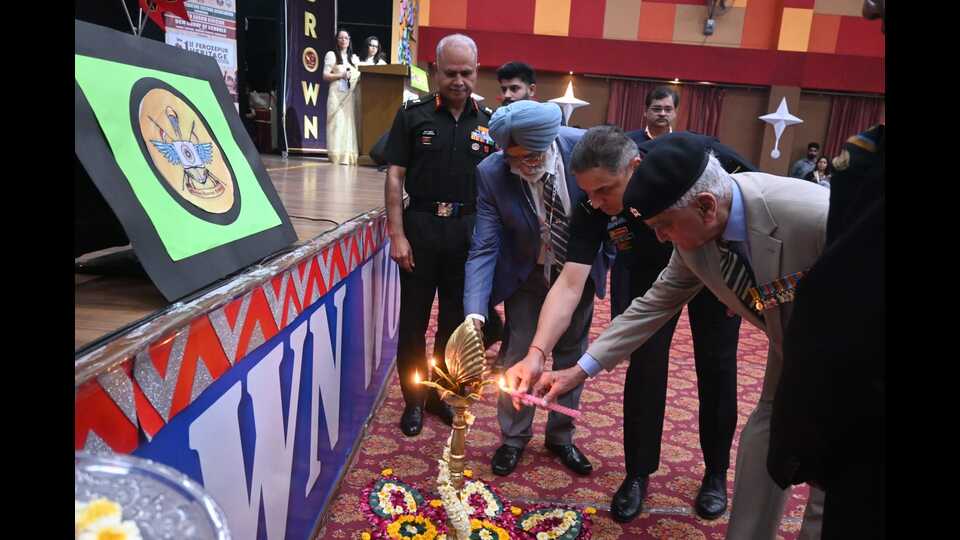
This town on the Sutlej with its Sikh Empire era fort and memorials of the Anglo Sikh Wars hosted the 1st Ferozepur Heritage, Military and Literary Festival held on 28 and 29 March 2026 at the Dass & Brown World School campus and the Sunder Singh Stadium.
There’s an edge-of-the-world feel to Ferozepur, once a distant suburb of Lahore, which is just 89km away. “Only in 1947 did Ferozepur become a heavily monitored border city,” said keynote speaker Lt Gen (Retd) TS Shergill, recalling childhood memories of mundan ceremonies and picnics on the banks of the Sutlej and tongas clip-clopping down the streets. “It’s true that Ferozepur is an area of shaheedi (martyrdom),” he adds alluding to the many battles that have been waged here including the Battles of Ferozeshah (December 21-22, 1845), Mudki (Dec 18, 1845) and Saragarhi (September 12, 1897), and the Battle of Hussainiwala in 1971.
Bullet marks still score the walls of the Kaisar-i-Hind bridge in Hussainiwala, about 10 km outside Ferozepur. Incidentally, the Hussainiwala railway station – up the road from the closed border check post with Pakistan and the National Martyrs Memorial where Bhagat Singh, Sukhdev and Rajguru were cremated – and now the last stop on the Northern Railway, sees trains chugging in just twice a year – on Shaheedi Diwas on March 23, which marks the day in 1931 when the three freedom fighters were executed, and on Baisakhi on April 13.
Befittingly, a festival session titled Ferozepur Gazetteer: Echoes of Yesterday, Pathways of Tomorrow moderated by communications skills professional Swati Rai stresses the importance of the place to Sikh, Punjabi and modern Indian history.
“What Gurgaon is to Delhi now, Ferozepur was to Lahore,” says Anirudh Gupta, CEO of the DCM Group that organized the event with the Military Literature Festival Association and the Indian Army’s Golden Arrow Division that’s stationed in town. “Punjab National Bank (PNB) opened its second branch here and Lala Lajpat Rai had an account there,” he adds.
Military historian Brigadier Jatinder Singh Arora (Retd) spoke about the land’s geographical history, the construction of its canals, and the early warring families who ruled the area before Ferozshah Tughlaq, the Sultan of Delhi, possibly founded the city. “Ferozepur is a gateway and also a defensive bulwark,” says Maj General Balwinder Singh (Retd).
The sessions, including one that focused on opportunities for women in the Indian armed forces that featured, among others, Col Sharmila and Lt Col Himanshi (Retd), and the military weapon and equipment display were well attended. The event also hosted a photo exhibition – featuring beady eyed paradise flycatchers in Tadoba, thoughtful iguanas in the Narmada valley and more – by Brig Bikram Singh (Retd).
The panel discussion on West Asia in Turmoil and Stakes for India was expectedly lively. “The presence of the PM in Israel two days before the war was a strategic mishap,” stated Maj Gen HV Singh (Retd), while General Sudhakar Jee (Retd) thundered about the challenges ahead: “50 percent of our energy requirement comes from the Straits of Hormuz; that’s 2.75 million barrels. There’s a requirement to diversify towards renewable energy. The impact (of the war) will be on agriculture, clothes, food and travel. India has $40 billion plus remittances from the Middle East. Huge mass-scale unemployment is waiting to happen. The GOI needs to invest in the navy and to invest heavily in surveillance systems too.”
“West Asia is likely to remain in turmoil for some time,” said Lt General JS Cheema (Retd) who added that the international state of flux that has resulted will probably see China reunifying with Taiwan sometime between December 2026 and April 2027, in time for the 100th anniversary of the People’s Liberation Army.
Everyone seemed to agree the US had blundered. “Iran has the third-largest oil reserve in the world. Iranians have been preparing for this war since the early 2000s. One day of conflict puts the US back by a year,” said Major General HV Singh. “Going to war is one thing; exiting on a high note is another,” said Lt Gen (Retd) Cheema. All of which recalled what Lt Gen (Retd) TS Shergill stated in his keynote speech addressed to an auditorium full of young military personnel: “These days, the conflicts that you see are a form of total war. You are used to it because you play video games and, in them, your object is to kill, kill, kill. Unfortunately, that is happening in life. Standoff weapons are being used; countries are being destroyed, women and children are being killed without remorse, and with savagery and brutality unmatched. This is because you do not hear the screams of the wounded, you do not smell the sweet-sour smell of blood, and you think it’s alright. I’m here to tell you it is not alright. Humanity must prevail.”
Few outside Punjab know about this town that slipped to the periphery when the Radcliffe Line was drawn. Perhaps that’s set to change with the Ferozepur Heritage, Military and Literary Festival turning the spotlight on an area that’s played a vital role in the subcontinent’s history.


