
 E-Paper



Report: A reading in honour of Gieve Patel
Six poets from in and around Mumbai read out selections from Patel’s work and their own as a tribute to the memory of the poet, painter and physician

 Prefer HTon Google


An art gallery can be a shape-shifter. Since late March 2025, the Jehangir Nicholson Gallery of Modern and Contemporary Art, Mumbai, has been morphing into many shapes that coexist to a single end. In one of these, it was an exhibition of paintings, embroidered fabric, and three-dimensional artworks, collectively titled A Show of Hands, curated by Ranjit Hoskote, to honour the memory of the departed multidisciplinary artist Gieve Patel, making the art gallery also a memorial and arts mela.
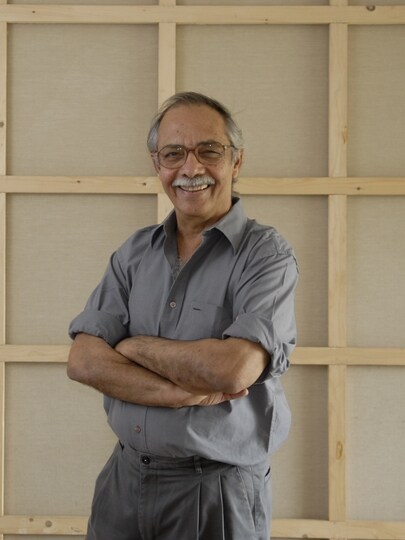
On the evening of May 24, six poets from Mumbai and around read poems to honour the memory of Patel, who was also a major Indian poet. This reading was brought together by the curator, who also joined in. The reading, as Hoskote explained, would uphold a core value which was discernible in the life and art of Patel – support for polyphony. These values, as the audience noticed, also reflected in the choice of poems read out, giving the reading its significance as the expression of an idea and culture of India as a place of many voices and peoples.
Patel’s renowned On Killing A Tree, published in 1966, was read out by Priya Sarukkai Chabria. An excerpt:
The bleeding bark will heal
And from close to the ground
Will rise curled green twigs,
Miniature boughs
Which if unchecked will expand again
To former size.
No,
The root is to be pulled out -’
The much-republished poem, which many explain only in the context of environmental degradation, was aptly included in this reading prefaced with, also, the context of communal violence and genocide. It was a segue from what the convenor/curator pointed out in his introductory address.
The introductory address to the audience, which also referred to Gaza as “the ambient tragedy of our times”, set the frame, in a manner of speaking, for the proceedings. Hoskote said: “At a time when we are being encouraged to subject ourselves and subordinate ourselves to dominant, domineering narratives in this country and in other countries […] at such a time, I think polyphony becomes not just an expressive possibility, it becomes a political movement. So, it’s in that spirit that we would dedicate this reading to this historical moment.”
Patel had written in various ways about his lived experience of being in a minority, whether religious, political or cultural, in India. In his writings, his sense of humour was possibly moulded by his heritage and also perhaps by his experiences as a practising doctor who witnessed his patients undergoing all of life’s rites of passage. Another of his poems was recited, namely The Ambiguous Fate of Gieve Patel, He Being Neither Muslim nor Hindu in India. This poem was brought out in all its poignant and ironical effect in Mustansir Dalvi’s reading.
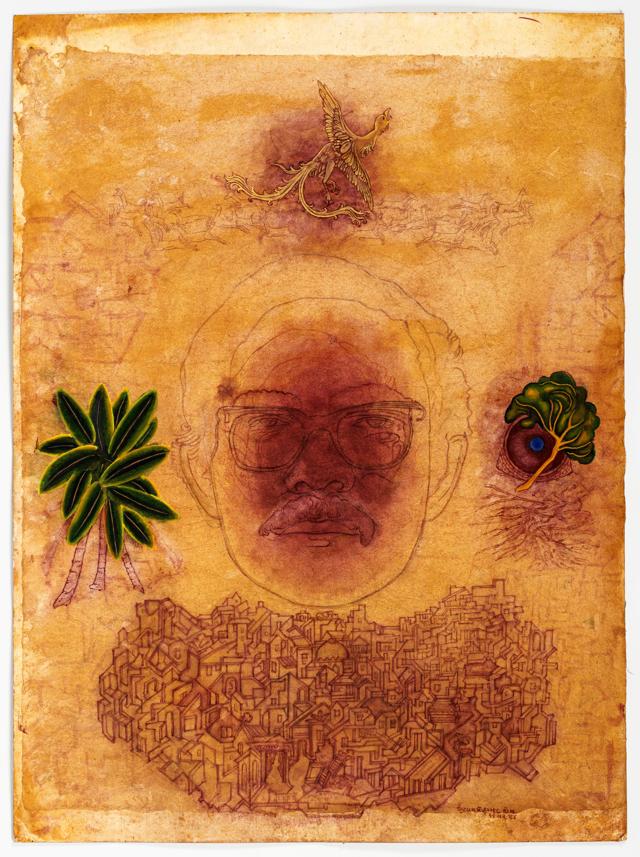
Dalvi, who years ago tweeted his translation of it into Marathi, said, “This is as universal a poem as can be, because if you are sitting here, in one sense you are a minority. You don’t have to be a very small minority in a nation where there are so many minorities. We all are (held to be) the lesser beings in some form or the other, when it comes to this larger picture that is moving us all very inexorably towards homogenity”.
The participating poets, in all their individuality, read out their own poems, too. Among the poetic preoccupations and effects that stood out vividly was Sarukkai Chabria’s evocative and declamatory foray into mythical and archetypal themes; Dalvi’s characteristic wordplay, social critique, and melancholic humour; Hoskote’s signature world evoking fables with royalty, travellers, warfare, migrations, birds on wing and birds in cages; Thakore’s bittersweet poem-diaries from encounters with art and artists; Sampurna Chattarji’s quiet conjuring up of trains of thought and rail journeys; Anjali Purohit’s paeans to friends and community.
Each of the reading poets came from different backgrounds and various religions, or none. And each in their way has plural practices: Hoskote researches and writes about culture, curates art shows and translates sacred and secular poetry. Sarukkai Chabria is an editor, anthologist and translator, and also writes speculative fiction. Mustansir Dalvi taught at an architecture college, helps document Art Deco structures, writes columns for newspapers and websites, and has translated from Urdu and Marathi into English; and English into Marathi. Anjali Purohit has curated arts festivals and other gatherings, besides translating from Marathi. Anand Thakore ran a publishing house and is a trained Hindustani classical vocalist. Sampurna Chattarji has edited literary journals and anthologies, has produced and edited journalistic writing, children’s fiction, and translated from the Bengali into English. Polyphonic, confluential and multi-faceted as you like.
Among those present among the audience, I recognised cultural theorist and curator Nancy Adajania, academic and writer Kaiwan Mehta, writer, film historian, curator and teacher Suresh Chabria, painter/physician, and one of the exhibiting artists, Sudhir Patwardhan, photographer Ritesh Uttamchandani and poet Dion D’Souza.
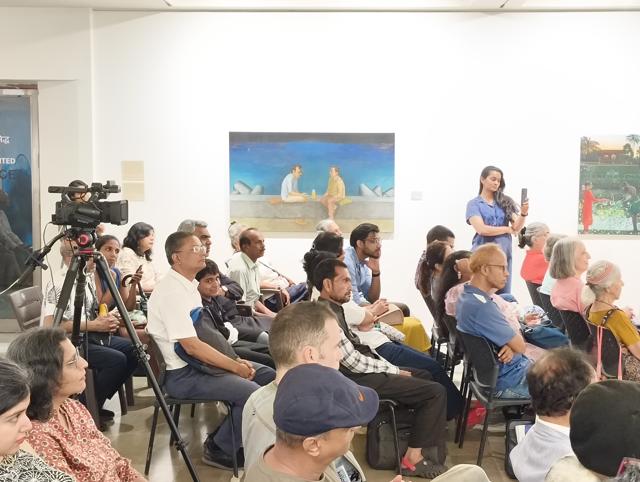
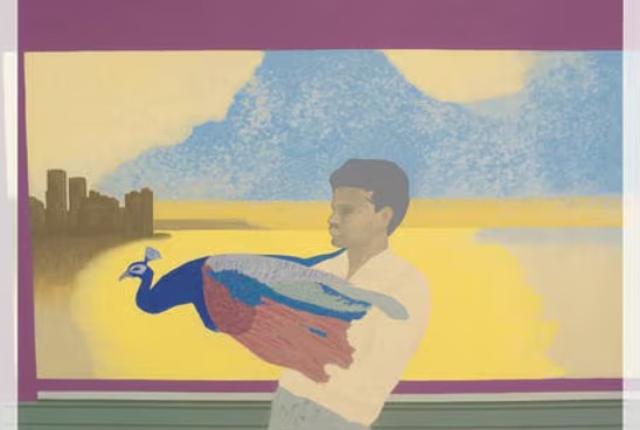
This evening, the reading poets stood against the backdrop of Patel’s famous painting (on loan for viewing from the owner), Peacock at Nariman Point. Around them were innovative works from various artists – as per the curatorial note, Aditi Singh, Anju Dodiya, Atul Dodiya, Areez Katki, Biraaj Dodiya, Gulammohammed Sheikh, Jitish Kallat, Mahesh Baliga, Nilima Sheikh, Ranbir Kaleka, Ratheesh T, Sudhir Patwardhan and Sujith SN. Each of these, said the curatorial note, “formed Gieve’s close circle of friends and colleagues, as well as artists who engaged with his ideas and his art from other points of vantage, or in whose work he had a close and sustained interest”.
Suhit Bombaywala’s factual and fictive writing appears in India and abroad. He tweets @suhitbombaywala.


