
 E-Paper



The stubborn scarcity of female breadwinners


 Prefer HTon Google


Women now account for three-fifths of American university graduates and just over half of college-educated workers.
TAYLOR SWIFT has accumulated many identities over her career: singer-songwriter, performer, pop mogul, millennial icon, cat lover. Her marriage this month to Travis Kelce, an American-football player, added wife to the list. It also gave her another, less traditional role: family breadwinner. Mr Kelce earns around $50m a year from his NFL salary, endorsements and podcasting. Yet in 2025 he contributed only perhaps a fifth of the Swift-Kelce household income.
Women now account for three-fifths of American university graduates and just over half of college-educated workers. But in most households, men remain the primary earners. In 2024, among dual-income couples, just 30% of American wives earned more than their husbands. Part of this imbalance reflects differences in occupations, working hours and pay. But a growing body of research suggests it also reflects the preferences of couples themselves.
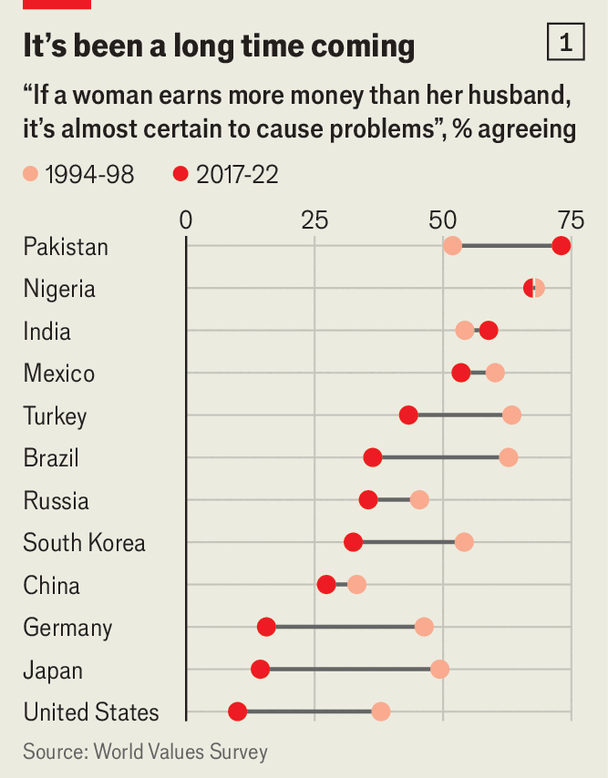
On paper, support for female breadwinners is strong in America. When Americans were asked in 2022 whether the fact a woman earned more money than her husband was “almost certain to cause problems”, only 10% said yes. The comparable figure was 16% in Germany and 27% in China (see chart).
In practice, many couples seem uncomfortable with the arrangement. In 2015 Marianne Bertrand, an economist at the University of Chicago’s Booth School of Business, and co-authors found that wives’ share of household income does not follow a smooth distribution. Instead, it drops sharply at the point where wives begin to outearn their husbands. Wives, in other words, are more likely to report earning slightly less than their husbands than slightly more. A recent study from France estimates that couples in which women earn around three-quarters of household income are also around 30% more likely to split up than couples in which both partners earn similar amounts.
Dr Bertrand and her colleagues argued that this pattern in part reflects a desire among the men and women in a couple to conform to gender norms, even if it means earning less income. In the decade since her paper was published, several economists have challenged its findings, arguing that the “cliff” in wives’ share of earnings is a statistical anomaly generated by couples who earn the same amount: because they work in the same family business, for example, or in similar occupations.
To analyse this disagreement The Economist compiled 17 years of data on young, working couples from the American Community Survey. We find that, more than a decade later, women’s share of household income continues to exhibit the pattern observed by Dr Bertrand, with a sharp break at the 50% threshold (see chart). The discontinuity remains even after excluding self-employed couples or spouses working in the same industry or occupation.
Why does couples’ behaviour not seem to match the attitudes found in surveys? One reason is that breaking with the breadwinner norm comes with psychological costs. Recent studies of American, Swedish and Australian couples all find that husbands who are outearned by their wives report poorer mental health.
Building on work by Joanna Syrda, an economist at the University of Bath, The Economist examined the relationship between breadwinner status and men’s mental health using data from America’s Panel Study of Income Dynamics. We found that men whose wives and partners are the primary earners are roughly one and a half times as likely to report “serious psychological distress”, even after controlling for age, education and household income. Among husbands whose wives earn at least 70% of household income, the risk is around two and a half times as high. One might expect the breadwinner norm to be weakening. But when we split our sample into two periods (2001-11 and 2013-23) the relationship remained virtually unchanged.
The costs are not borne by husbands alone. Research shows that breadwinning wives tend to report lower satisfaction with their relationships. Part of the explanation may be that high-earning wives are often responsible for much of the work at home. Research tends to find that even working women take on a disproportionate share of household duties. “Family work is still predominantly falling on women’s shoulders, no matter whether they are the breadwinner or not,” says Dr Heggeness. However, this would not explain why men, too, seem unhappy with being the lower earner.
Many traditional rules governing dating and marriage have faded—few couples today insist on marrying before having sex or moving in together. But other customs have proved more long-lasting, from men proposing marriage to wives taking their husbands’ names. Tabloids report that Ms Swift plans to legally adopt Mr Kelce’s surname while continuing to perform as Taylor Swift. Her bigger pay cheques look likely to remain unusual.


