
 E-Paper



Review: Giants by Huthuka Sumi
A coming-of-age story imbued with magical realism that captures the essence of the Naga people through their storytelling traditions

 Prefer HTon Google


Huthuka Sumi is the latest addition to the growing group of voices from Nagaland. For a long time, the place was written about by British anthropologists, American missionaries and political officers who mostly offered academic work which didn’t capture the essence of the people or the land. Nagaland has a rich oral storytelling history that has only recently, since the 1970s, been transposed to print in English by indigenous voices.

The author and poet Easterine Kire believes her work, as an insider presenting historical narratives of the state, challenges colonial voices. Nzanmongi Jasmine Patton describes her writing as an effort to preserve the oral storytelling tradition and folklore now mostly lost on Naga youth. Sumi’s voice joins this lineage as he uses magical realism to create a coming-of-age story that captures the essence of the Naga people through their storytelling traditions.
The prologue presents a dreamy picture of a land on the cusp of change with the Old Ones preparing for a long sleep while the white men arrive in their half pants and holding guns. Sumi has created the lore but it is clear that these tales carry within them the lives of those who sat around kitchen hearths sharing stories. Their lives were directed by the wisdom passed down through tales focusing on the harmony within different aspects of nature – the forests, mountains and rivers – and the villagers. But change is looming. Villagers see flying metals and hear the bombings in the nearby village of Kohima, which bore the brunt of the war between the British and Imperial Japan in 1944.
Colonisation was beginning to take root in the fictional land of Ayito-phu. “Children who had previously accompanied their parents to the jhum fields or made mischief all over the village now had to discipline themselves into sitting in the same place for hours — a thing the students hadn’t quite learned to tackle. After all, the school was hardly more than a year old.”
Kato, a mute 12-year-old, is bullied by his classmates and shamed by members of his extended family. By the age of three, he had learned to be ashamed of his muteness. Still, his loyal friend Apu stays by his side, filling him with fascinating stories. Kato also shares a special bond with his mother, who tells him about the myths, legends, and fables of their people.
Of all the tales he hears, Kato is intrigued by the myth of Timi-ala, the forest giants who looked after humans. He often wishes to be taken away by those giants. His wish is fulfilled when one night, a forest giant, Kene, comes looking for someone who will chronicle his stories of the Old Ones. Kato is baffled by the idea – how can a mute be a storyteller? And so begins the journey of a child who looks at the world differently, finds stories, and learns that having a voice has nothing to do with speaking.
Sumi utilises Kato’s disability, his muteness, as a catalyst to storytelling. Sometimes, people tell him their experiences for reasons they don’t understand. It’s likely because, in a village, word travels fast but cannot pass through a mute boy. His muteness becomes equivalent to the listener’s trust; he becomes the keeper of stories. This muteness could also be symbolic of the initial absence of Naga voices in mainstream Indian literature. For a people without a script, Kato finding his voice could then be perceived as Nagaland making its presence felt within the domain of Indian literature in English. By creating this story with elements of folklore, oral traditions and magic, the author has reclaimed the narrative lost in historical-cultural erasure. Giants then becomes a starting point for readers to be more curious about the state instead of being content to look at its beauty through the fog of exoticism that generally envelops northeast India.
Sadly, despite some well fleshed out sequences highlighting Kato’s sensitivity towards his surroundings, the story’s tragic moments don’t leave much of an emotional impact. Also, the idea of the importance of storytelling as a way to connect to one’s roots is repeated too often. And yet, the portrayal of the villagers’ scepticism towards all things modern, their hesitancy to participate in a war that’s not theirs, and their collective denial successfully highlights their connection to the land and community, creates a warm picture.
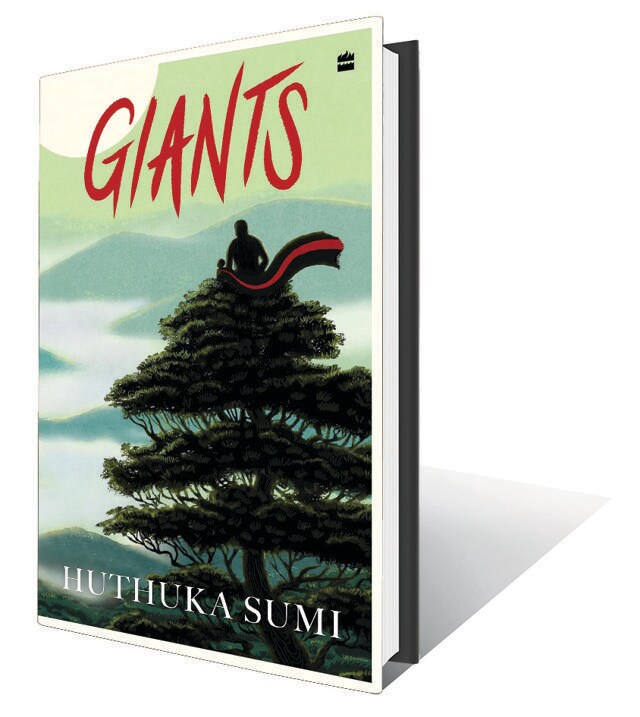
The cover illustration by Canato Jimo, a picture-book maker from Nagaland, aligns perfectly with the story. The page illustrations too are cleverly done and work as a mist in which the Timi-ala appears, allowing the reader to know that something magical is about to happen. Huthuka Sumi has managed to turn the essence of Nagaland into literary memory through a story that normalises disability — a feat indeed!
Akankshya Abismruta is an independent writer.


