
 E-Paper



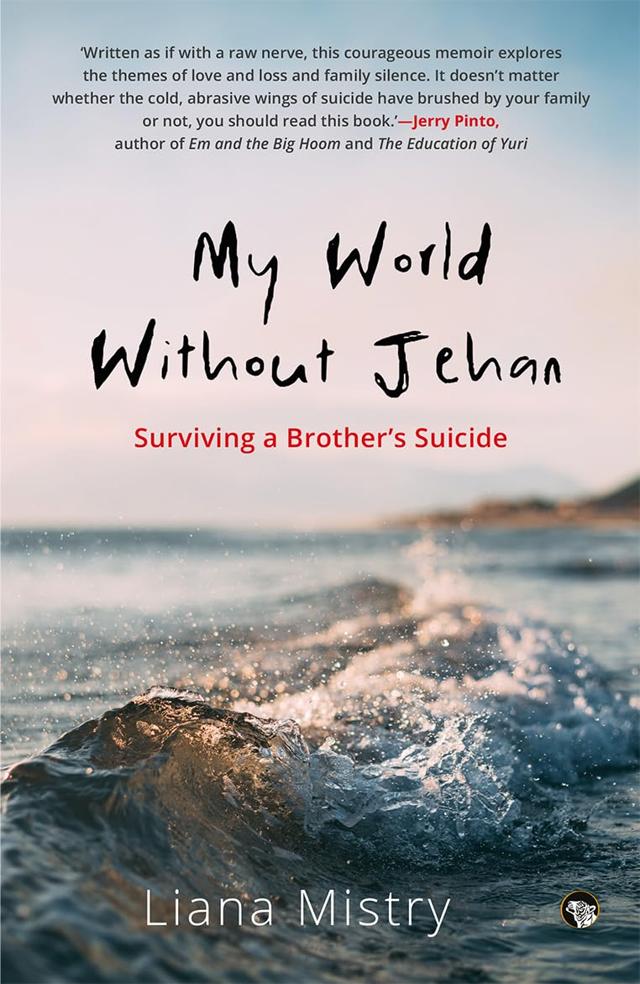
Review: My World Without Jehan by Liana Mistry
Told with great depth of feeling and a wry wit, this is the story of an unconventional Parsi family marred by a terrible tragedy

 Prefer HTon Google


In today’s globalised world, death and suicide are reduced to a statistic, a number that is used when we want to make an educated point. But My World Without Jehan shows what happens when you zoom into that one life, that one family, that one event and see how their world is completely shattered. Death and suicide no longer remain impersonal.

This is the moving story of an unconventional Parsi family and the tragic circumstances which culminate in the author’s brother taking his own life. In gripping detail, Liana Mistry lays bare the aftermath of this tragedy and the impact it has on the lives of each family member.
That the true value of life cannot be reduced to a number is perhaps Mistry’s greatest accomplishment through this work. And though “Liana Mistry” is a pseudonym, the author possesses a voice that is honest, vulnerable and unflinching in its raw honesty. This is the voice of a seasoned storyteller. Her handling of mental health challenges is delicate yet gentle. She avoids generalising, diagnosing, and judgement and uses plausible hypotheses and educated guesses as a rationale for both behaviour and emotion.
It is the 1960s and the author’s mother, Honey, leaves her husband Euruch and their children, Fali, Jehan and Liana in their small town in Gujarat to pursue her PhD in the US. Though a trailblazing move for its time, it sets off a sequence of events whose repercussions stay with the Mistry family for the rest of their lives. A year later, Honey rushes back to India, PhD abandoned, to take care of Jehan, her middle child, who has stopped eating, lost enormous amounts of weight, and slipped into withdrawal and depression. At the age of four, Liana is uprooted along with Jehan as their parents move to a small seaside town in south India. It is another move that deeply affects each family member differently while adding strain to their collective ties. Honey gives up her financial freedom and her job as a professor to play wife to Euruch’s blossoming career. Fali, the oldest brother refuses to shift cities and moves into his father’s cousin’s home, going straight from being spoilt kingpin to one of three other boys. In the author’s words, “A kid who had never lifted a finger in his life, bolstered by fulsome praise from all sides, and suddenly bereft of his own family, was now going to be living in a strange new environment, admittedly in the same town he loves and called home, but far from his mother.” While this shift left Fali to adapt to a new home, it left Jehan and the author to fend for each other.
My World Without Jehan is the story of the poignant childhood of a troubled boy who is repeatedly dealt life-altering events while the behavioural symptoms of his mental troubles go unseen – a locked bathroom with smoke billowing out and Jehan trapped inside follows a falling out with a close friend; the marriage of one of his crushes leads to Jehan failing his tenth standard exams and sliding into a “zombie-like existence”; the many unrequited loves followed by emotional upheavals. These speak of a boy in need of much support and often, Fali’s friends do take Jehan under their wing, protecting him not only from others but also from himself. At 21, these cries for help force a family intervention but mental help from a professional is studiously avoided due to social pressure. Mistry speaks of the terror of anticipation, the knowledge of not knowing when her brother might choose to harm himself or attempt something untoward. The burden becomes so heavy that, at one point, she writes that she might have simply wanted him to get it over with once and for all. In many ways, the strength of this book is the vast emotional arc that Mistry traverses, ranging from portraits of abject happiness to those of crushing despair, melancholy, loneliness and hidden suffering.
Refreshingly, Mistry makes room for women who are not stereotypes, confident women who never hesitate to express their needs. From the start, the author’s mother wanted her to live her dream, to be ambitious and carefree. To speak of the mettle of the women in Mistry’s life, her aunt Roshan took on two jobs, ran a creche and took catering orders when her uncle was financially unstable. Mistry also fills a much-needed gap in writing through her portrayal of her complex relationship with her mother, which is adversarial even as each ensures the other receives justice. Mistry understands her mother’s trailblazing spirit even as she tries to measure her unconventional nature through different standards. Though her aunt took over her potty training, feeding and sleeping duties, the author remembers her mother reading to her, buying her books, teaching her their mother tongue, crocheting bellbottoms for her, teaching her how to dance, and getting her started on most of the passions that made her happy. One of Mistry’s touching observations is her habit of reciting a particular prayer even after losing her religion; not so much for the prayer itself but for the memory of Feroza Aunty, her convent school PE teacher, who told her to use it and draw comfort from it.
Though the book carries within it the dark weight of grave themes such as death, guilt, and the burden of her family’s erasure of her brother’s memory, a wry wit fills Mistry’s prose. From the comparison of her grandfather to a blustering Hitler yelling in broken Gujarati, “Tahne to goli ma bandook bhari ne maarus!” (I’ll load a gun in this bullet and shoot you!) to choice Parsi Gujarati slang, Mistry frequently delivers a much-needed tickle to the humerus. Her work is also filled with childhood adventures that would rival those īn an Enid Blyton; it is replete with stories of waterfall picnics, school bands, sumptuous meals and fishing. It is a portrait of growing up in an India that seems completely unrecognisable from the one we now live in.
It is difficult to imagine turning a critical eye to one’s own family, especially in the light of a tragedy, but Mistry does a great job of calling it out as she sees it. With unflinching honesty and objectivity, she chronicles her mother’s abandonment of her children, her brother’s adjustment to living with his cousins, and the shift in the power dynamics of her parents. The same honesty is also meted out in equal measure to herself and her place in this rather unique scheme of things. She describes her birth as the only “conciliatory gesture” her mother made to the family. She speaks also of her father Euruch’s hypocrisy in refusing to acknowledge his own son’s decision to marry outside the community. One of the strengths of this remarkable work is Mistry’s rich internal monologue. Her introspection and analytical narration of the effect she has on her boyfriend and friends when she lashes out during bouts of grief or guilt is remarkable. This is a moving story of a person growing into themselves. Mistry also brings a much-needed sibling perspective to the chronicling of familial loss. While the parents grieve, the author’s own story shows that siblings suffer in no less measure.
In the end, My World Without Jehan is a remarkable read; one that is highly recommended not only for its prose and multiple mediations on love, loss and family, but also for its ability to function as a manual to know one’s self better. There can be fewer guides better than this on navigating life’s emotional toll.
Percy Bharucha is a freelance writer and illustrator with two biweekly comics, The Adult Manual and Cats Over Coffee. Instagram: @percybharucha


