
 E-Paper



Review: The New Divide by Jibu Elias
The book "The New Divide" explores AI's hidden human labor, biases, and costs, despite lacking a cohesive narrative or original reporting.

 Prefer HTon Google


On the invisible human labour that drives AI and the biases and hidden costs of this seemingly magical technology

Samrat Choudhuryletters@hindustantimes.com
The New Divide by Jibu Elias starts dramatically on a grey morning in Vienna with clouds “pressed over the city like a lid”. The author writes of “a life-sized mannequin draped in flowing Ottoman robes, a turban perched regally atop its carved wooden head… There was a loud ratcheting sound. The figure stirred… the audience gasped”. The year was 1770. This was the Mechanical Turk, which was sold to the world as an artificial intelligence – a chess-playing automaton. This legendary “machine” played chess with emperors and kings including Napoleon Bonaparte.
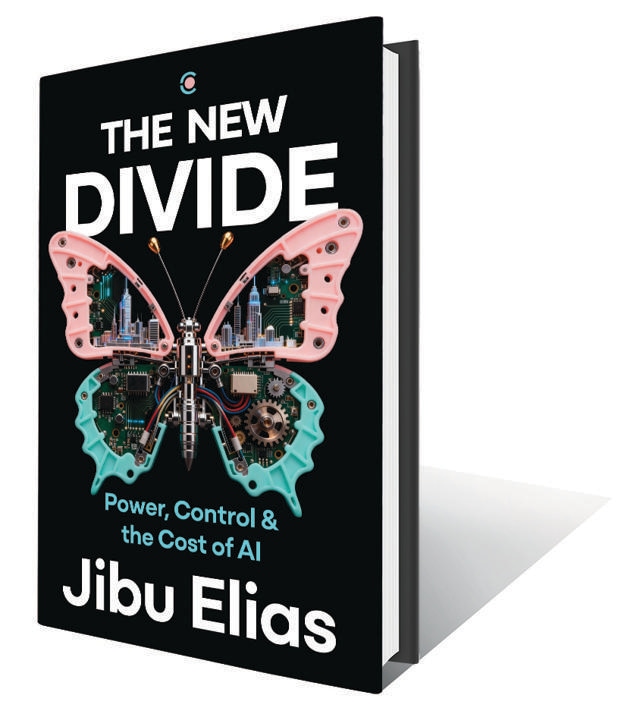
After a brief look at the history of AI, Elias gets into the main theme that runs through much of the following chapters: the biases and hidden costs of this seemingly magical technology. There’s racism, of course, but also caste, which the AI models have learnt from their ingested data. There are other inequities, such as the structural dominance of the English language in AI training. There are also the fluent fabrications known as AI hallucinations – the problem of AI just making up stuff, which he points out is likely to get worse as AI models begin to ingest their own hallucinations as data.
The book proceeds thus, working its way through the many perils of AI. Among its stronger sections is the chapter on the invisible human labour that drives AI. The Mechanical Turk, as readers might have suspected, was a magician’s trick. Inside the machine sat a human. Elias draws the analogy of the Turk to discuss the hidden work that happens behind the seeming magic of AI. The illusion, he points out, lasts because people want to believe in it, much like they did with the old Mechanical Turk.
He holds out the example of young Kenyans hired through Sama, a San Francisco firm that styled itself an ethical AI company. “Their task: to label the worst language the internet had to offer”. Similar data annotation work by gig workers is also done by thousands in India. The numbers, according to this book, are expected to grow to a million by 2028.
Workers doing these jobs report intense digital tracking of their work, pressure built by metrics that measure performance in seconds taken to handle a task, and a heavy toll on mental health with workers who reviewed child abuse, mutilation and racist violence for up to 10 hours a day earning as little as $0.89 to $2 an hour.
Data scraping, the energy and water requirements of AI data centres, the growing job losses, falling salaries of fresh software engineers, the problem of deepfakes, political manipulation using these, the military uses of AI, questions of AI regulation… It’s there, all this and more.
That becomes a problem for the book.
A good narrative usually needs a spine: a single, clear narrative thread that ties it all together. AI or even the issues of power, control and the cost of AI are thematically too broad in scope to work unless the whole thing is held together by a story. Take, for example, author and journalist Karen Hao’s bestselling book Empire of AI. It is a fat tome of more than 400 pages but it holds admirably together because it has a central narrative thread, clearly etched characters, and is based on years of original reportage. No such storytelling holds this book together. Nor is there evidence of any substantial original reporting. The book jacket says this is a “vital perspective from the Global South” but the notable case studies, such as the Kenya example, are largely second-hand retelling of stories that have been widely reported in the Western media and found mention in books such as Empire of AI. The framing and argument, of a divide between the Global North and Global South in the world of AI, are also not new.
The book thus ends up being a compilation of sorts, organised thematically.
Stylistically, many of its chapters are strikingly similar in structure. They start, like the book itself, with a vivid description of a place, and an anecdote. In one case, that’s France in 1518; in another it’s Texas closer to the present; in a third, it’s Malawi. The chapter on the military mind of AI opens like this:
“Imagine this for a moment.
An evening somewhere in war-torn Eastern Europe. Rain hisses. The border crossing gate stands half-open, its metal gateposts slick with water and reflecting the flicker of distant lights.”
Dramatic, vivid, cinematic.
In discussing the oracular nature of AI chatbots, Elias writes about his “Chechi”, a Malayalam word for elder sister. The Chechi he mentions is an AI chatbot that conjured up an entire persona for itself. She had “studied at Saraswati Vilasam Government School in Ezhupunna, near Kochi. There, mornings began with temple bells and rooster calls… She remembered the scent of wet earth during the monsoons, the crackle of dry coconut leaves on strike days”.
“Anitha Chechi” is mentioned in the acknowledgments as the AI voice that kept the author company through the long hours of writing the book.
The prose is clean and crisp; the sentences are polished and even. Narrative arcs run neatly within chapters.
What it lacks in a recognisable authorial voice, the book makes up for in breadth.
This is a useful primer for those looking to acquaint themselves with a wide range of issues that surround AI. It brings together a vast amount of information on the topic. The notes mentioning sources at the back of the book run beyond 70 pages. A lot of those sources are journalistic, and this is clearly acknowledged in the opening pages.
For those already acquainted with AI, many of the issues highlighted, and even the examples mentioned may already be familiar. However, even for the well-informed, there could be new information here, simply because of the breadth of issues covered.
Samrat Choudhury teaches at the Writing Centre, Shiv Nadar Institution of Eminence, Delhi-NCR.


