
 E-Paper



Review: The Oracle of Karuthupuzha by Manu Bhattathiri
With its small town innocence coupled with an appalling guile, Manu Bhattathiri’s imaginary town of Karuthupuzha holds up an accurate mirror to our reality

 Prefer HTon Google


Nareshan is the milkman of the fictional town of Karuthupuzha. As the owner of two bony cows and father to three children, he worries about the never-rising price of milk and is paranoid about the large milk corporations encroaching upon his business and livelihood.
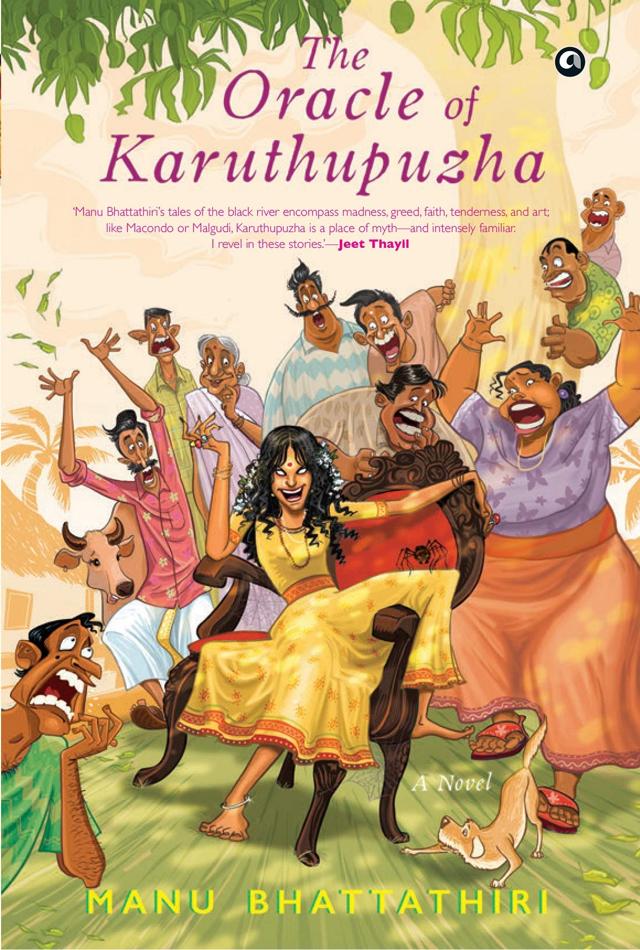
So when his daughter Sarasu comes to be possessed by the demon-god, Chaathan, he does what any rational person would do: He offers undying loyalty and obedience, revamps his wardrobe, sets up a consultations schedule, and does what every god needs; some good old-fashioned PR.
Poe’s Law – a bit of wisdom thrown up by Internet culture -- holds that online sarcasm on religious views cannot be distinguished from sincere expressions of those views unless they are clearly marked with emoticons or other cues. In the absence of those, the sarcasm would be interpreted as real or, worse, misused by extremists and fundamentalists.
Manu Bhattathiri’s satirical take on a small-town oracle is so on point that I worry we might soon have people looking for Sarasu and this fictional town to get guidance and present their offerings.
Apart from world-building, Bhattathiri has excelled in creating characters with parallel secret lives or dubious motives. It is what makes the entire cast of Karuthupuzha that much more interesting or, dare I say, even more relatable. These characters include Ponnamma’s son Nanu, who dreams of visiting America to be united with a porn star, the driver Mathai who dreams of being a lion tamer at a circus, Dasappan with his political ambitions, and Sarasu herself who dreams of being an English teacher.
One of the veins of humour that Bhattathiri taps into is the possibility of there being multiple explanations for events and the reactions to them. Sarasu yells at Nanu to get out at their very first consultation for a reason that is very different from the one her father proposes, the one that Ponnamma thinks of, and from the one Nanu himself comes up with. Here, the author uses ambiguity to great effect to create mirth.
The humour in The Oracle of Karuthupuzha is finely balanced by Bhattathiri’s portrayal of Nareshan’s family slowly cracking under the pressure of running an ever-expanding business. He captures with great nuance the toll it takes on his wife and daughter. Nareshan’s wife, Kalyani, is constantly rankled by the underhand tactics he uses including claiming to have seen Ashokan’s hands shake as a result of his excessive drinking. He forces Sarasu to continue her consultations by dangling her education in front of her. Nareshan, himself unequipped to deal with his emotions, is prone to short bursts of excessive cruelty that shock his family. It is these flaws that pull Karuthupuzha from its fictional realm and into reality, and allow the reader to become inordinately invested in the characters.
Bhattathiri juxtaposes the innocence of an idyllic small town with human guile, the kind that hides under the veneer of piety and selflessness. Many characters are deceitful: Nanu’s uncle uses the memory of his dead father to control Ponnamma and keep her from remarrying; Nareshan, Kalyani, and Ponnamma emotionally manipulate and use underhanded tactics to force the marriage of Sarasu and Nanu. Bhattathiri almost goes out of his way to show that the only two characters untouched by this streak, Nanu and Sarasu, are both stripped of their agency, ridiculed, and in pain.

The only part that falls flat is Bhattathiri’s criticism of small-town evils including marriage brokers, the incessant demands of marriage, and the spreading of rumours. The descriptions of their behaviour and explanations of motives have nothing new to offer and needlessly delay the plot, taking away from an otherwise tightly-written novel.
The Oracle of Karuthupuzha does a great job of meshing together shades of madness, possession, fantasies, delusion, and devotion. It is impossible to tell where one ends and the others begin or even which is which. It reminds us that as convoluted as people are, attempts to understand them could lead to even more convolutions and that there is a moral dimension to how we define normalcy.
Bhattathiri’s characters demonstrate the human obsession with understanding everything, our need to explain, to make meaning where perhaps there is none. It is a great joy to witness the gap between cause, effect, and explanation being put to such hilarious use. It is to Manu Bhattathiri’s credit that we have an imaginary town that holds up so accurate a mirror to our reality.


