
 E-Paper



Unlock Diaries: Isolation Word by Manohar Shetty
The reopening of the fish markets in Goa will be a relief for both seller and haggler, writes poet Manohar Shetty, who experienced unexpected bursts of creativity during the lockdown


Goa, despite being a tourism hub, has, at least so far, not been as badly affected by the virus as some other places like Mumbai or Delhi. The major problem here was getting the hundreds marooned abroad, mostly working on cruise liners, back home. This exercise took more time than anticipated, with a servile state government constantly seeking directions from the centre. Now almost all the ‘shippies’ who wished to return are back with their families, with one who had been given up for dead recovering miraculously in a hospital in Italy. Given the grimness all around, this was a heart-touching story.
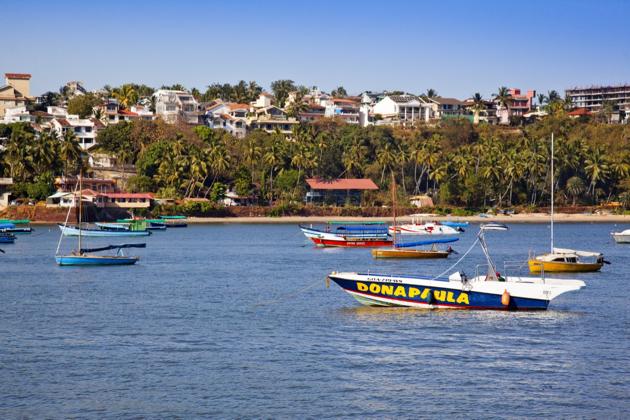
The lockdown did not affect me in any life-transforming fashion. I’m no party-hopping, backslapping extrovert. I stayed at home, here in Dona Paula, relieved that my younger daughter who works in Delhi was back with us. Not being much of a compulsive Facebooker, I’ve spent the days as I usually do, unearthing a dusty old novel I hadn’t read and writing the occasional poem. In fact, the number of poems, that drifted my way, related directly to the lockdown surprised me a little — five in all, of which I published two. Surprised because I’m blessed by poetry — any kind of poetry — six or seven times during an entire year. The poems don’t usually arrive as gift packages. But that’s how poetry can sometimes work. Poems are fickle, unreliable characters, mostly stingy and reluctant to part with themselves but on occasion generous and benevolent. Unusually for me, two of the poems came in the form of songs, and since I’m tone deaf, I wonder if I’ve got them right.
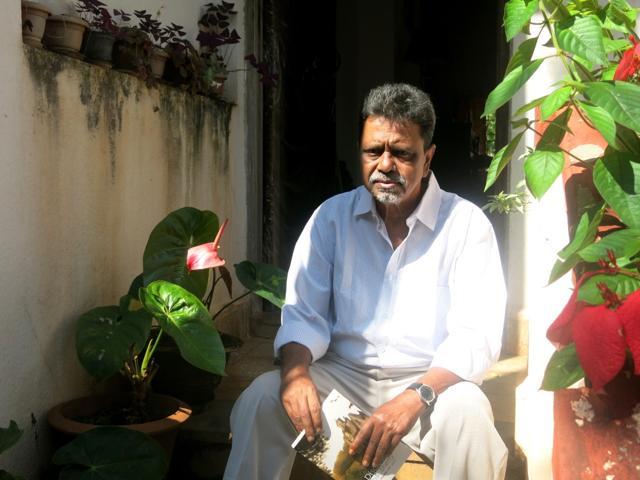
With so much time on my hands and with its publication deferred indefinitely, I’ve gone back time and again to fiddle and fret over my new manuscript of poems called Borderlines. I’m never sure if all the tinkering has actually improved it or made the bad worse. That’s how poetry works. In this craft, you can be your own worst enemy. After all these years, apart from soliciting suggestions from the publisher himself, I’ve long ago stopped sending out poems for a look-over by my peers. In any case, I’m now considered a ‘senior poet’, which only means that ‘the spontaneous overflow of powerful feelings’ is a thing of the past. I’m a little more crafty now. When I find myself fiddling around with poems already published several years ago, I know that I’m beginning to suffer from a loss of words; from a loss of what people puzzlingly call ‘inspiration’. Every new poem now is akin to an unexpected present.
I’m no globe trotter, and as the title of one of my books, Domestic Creatures, suggests, I’m the homebound sort, quite happy to help around with mundane chores. And though I say so myself, the home is beautifully located with a view of the sun dipping into the waters at a confluence of the sea and the Mandovi river. For some odd reason, I think of it as a lion-mane sunset.
Unlike several other cities, Panjim was never under a prison-like shutdown. It remained partially open and even during the most confining times, I was able to procure my cartons of cigarettes. I’m a heavy smoker, and though my tribulations are petty compared to the heartbreaking scenes I see every day on television, I still feel a little relieved to be able to continue with this bad habit. Indeed, its threatened absence only intensified the need. For many people here, the reopening of the fish market will be a relief, for both seller and haggler. I feel more at home in the vegetable and fruit market next to it, now fully open and graced by those huge murals by Mario Miranda looking down benevolently at us.

As I’ve suggested, moments of duress and suffocating confinement can set off a chord of poetry. Imprisonment has been the source of some great creative work. Just look back at the Russian poets and writers confined in the Gulag during Stalin’s regime. Comparatively, our tribulations are, of course, minor. But a poem is still a poem whatever its kickoff point. Here is a new one I’d like to share with you:
Corona Sonnets
1
Just another fanciful name
For a virus to soften the blow
As they do with hurricanes —
Bhola or Katrina — and little to do
With the life sustaining
Glow of the sun. It germinates
And breeds with the lightest
Touch or breath, leaving in its wake
Mass graves, quick cremations, the wheels
Of industry rusted, ore-rich mines
Caving in, exhaust pipes smokeless,
An exodus back to native
Villages and fields, the air
So pure you can barely breathe.
2
They can’t sleep out on a park bench,
The terrace or backyard but are
Crammed into their hutments
Drenched with the sweat of cousins,
Parents, siblings, infants, distant
Relatives and frayed pictures
Of benign gods and goddesses.
The nation at a standstill, the long
March home is the only road open
To them even if their roots have grown
Fallow, even if their villages
Are shuttered like ghost towns, those
Silent raptors circling above.
Manohar Shetty has published several books of poems including ‘Full Disclosure: New and Collected Poems (1981-2017)’. He lives in Goa.


