
 E-Paper



Gourmet Secrets: A mouthful of Indonesia
Why rice is food and food is rice in Bali


“If you are going to San Francisco, be sure to wear flowers in your hair…” The same lines of the same song can quite happily apply to what is often called “The Island of the Gods”, Bali. “Flowers” is the mood and frangipani is the intoxicating floral fragrance that fills the air.
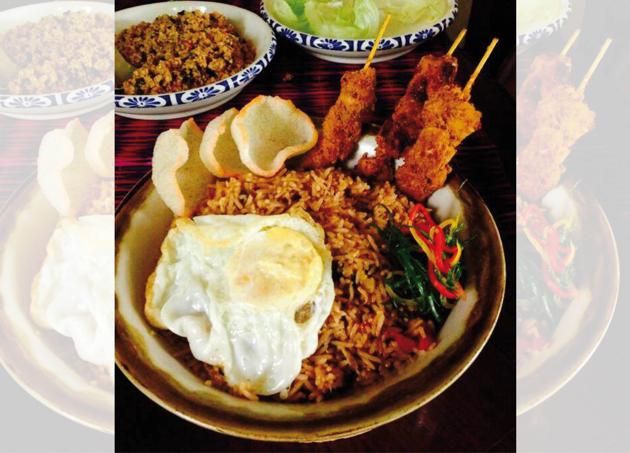
When I first visited this island to the East of Indonesia, about twenty years ago I thought it was no more than a sophisticated version of Goa, with great roads. I found Balinese cuisine disappointing and accommodation was limited to standard luxury resorts or family run little hotels. With the “upgraded” new version of millennia Bali comes immensely better food, both traditional and contemporary. We nicknamed their national dish Nasi Goreng, “nasty goreng” when we first visited. Left over rice was often tossed up in oil of dubious origin and smothered with bits of overpowering, smelly dried fish. And at breakfast or baking in the sun for several hours on the street, you really needed to have some stomach to try it. It was cheap and highly avoidable as were many Balinese dishes you would find on the street at that time. I was put off Nasi Goreng for a long time as a result of these initial experiences and chose to try it over the years in Singapore where authenticity and hygiene reign supreme. In Indonesia, rice is eaten three times a day with hot and spicy dishes whose preparation is very time consuming but is seldom a problem in the traditional multi-generation household. The women usually cook enough food to be able to welcome unexpected guests in the appropriate fashion and here as elsewhere a hearty appetite is taken as a compliment to the cooking. Family members and guests sit cross legged on the mat-covered floor and an assortment of poultry, meat fish and vegetable dishes is served with soup, rice and fiery sambals. Rice is not just important in the food culture of Bali – it is central. It is not just an accompaniment to other foods – it is the main dish and other side dishes accompany it. In fact, most Balinese people use the words “rice” and “food” interchangeably. An invitation to eat is commonly “Let’s go have rice”. Rice is sometimes called “Dewa” or “I Dewa”, “God”. Rice is the sekala (tangible) form of Dewi Sri, the Goddess of rice, wife of Visnu, together with whom she represents beauty, fertility, maintenance of life and all that is necessary and good in the Balinese cosmos.
I had a delightful version of the rice dish Nasi Goreng at a tiny eatery called The Asian Box in Pune; a tasty dish of rice fried with spices and soy and shrimp paste, topped with fresh red chilli, thinly sliced chicken and a fried egg. It was a bit like a much improved version of what “Indo-Chinese” restaurants used to call “American chop suey” where noodles replaces rice. The Asian Box is run and owned by Priya and Dheeraj Mahtani, a bundle of energy, passion and talent. Priya was born and brought up in Singapore, came to the city 12 years ago and only recently got into the business of food although she has been diligently doing food trials for several years. This is the food she grew up with and remembers and although she has no formal training, she manages to re-create with great authenticity, flavours from the streets of Singapore, Malaysia, Indonesia, Thailand and China. Priya also serves a lip smacking nasi lemak. This is a popular street breakfast in Singapore and Malaysia where rice is cooked in coconut milk and lemon grass and served with fried chicken, salted peanuts, boiled egg, sambal and prawn crackers. She omits the fried anchovies but will serve them on request. The benchmark of Indonesian food, nasi goreng is the one she gets completely spot on. Served with perfectly spiced chicken satay, fried egg, prawn crackers and her homemade sambal.
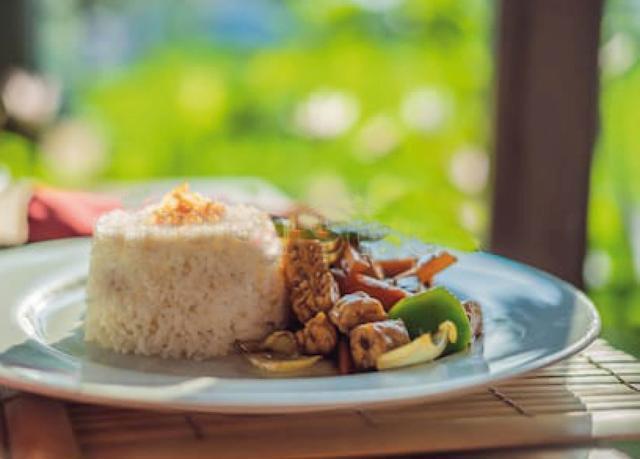
This is her recipe:
Ingredients
1 ½ cups of Basmati rice
150 g chicken breast cut into diced pcs and (quick tossed in a little oil)
OR if using prawns then 7 to 8pcs of medium sized prawns (quick tossed in a little oil)
1 tbsp sambal paste/sauce (chilis, garlic, ginger, onion, spring onion, palm sugar, lime juice, fish sauce, shrimp paste)
2 to 3 red chillies sliced into 6 to 9 pcs
2 tbsp dark soy sauce
1 tbsp sesame oil
2 tbsp vegetable oil for frying
½ tbsp sugar
1 egg (fried) for garnish
Method
Cook the rice and leave it to cool. Heat the veg oil and add the red chillies and sambal paste. Fry for some time. When the ingredients give off an aroma, add the chicken breast or prawns. Add the soy sauce and sesame oil and stir. Add the cooked basmati rice and stir fry until hot. Serve garnished with the fried egg on top.
Culinary expert and explorer Karen Anand has been writing extensively on the subject of food and wine for 30 years. Apart from having her own brand of gourmet food products, she has anchored top rated TV shows, run a successful chain of food stores, founded the hugely successful Farmers Markets, and worked as restaurant consultant for international projects, among other things. Her latest passion is food tours, a totally curated experience which Karen herself accompanies, the first of which was to Italy.
From HT Brunch, December 2, 2018
Follow us on twitter.com/HTBrunch
Connect with us on facebook.com/hindustantimesbrunch


