
 E-Paper



Gourmet Secrets by Karen Anand: High on ham
The Spanish Ibérico ham can make even the most average pork-eating person go weak in the knees


It’s been so long since I visited Spain that I had almost forgotten a couple of things - how nice the people are, how friendly and how accommodating. From the security officer at the airport who happily let me out to do some customs formalities and then let me in again, to the lady at the Camper shoe shop who opened 20 minutes early because I was banging on the window, to the little cook at the pintxos bar (tapas bar in the Basque country) who kept plying us with extra little dishes and didn’t even charge for them at the end. For me this is what Spain is all about. It really is a country with a heart. I was very happy to re-discover all this recently on a trip to attend the mega food conference and fair called Gastronomika held in the beautiful little seaside town of San Sebastian on the Bay of Biscay. Gastronomika has been running for 20 years now but it has really only opened itself to an international audience very recently.
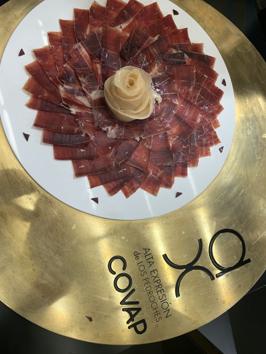
The other thing that I had almost forgotten about in Spain is the amazingly good produce from really fresh vegetables, mushrooms, tomatoes, lemons the size of grenades, to amazing fish in San Sebastian and of course the king of meat in Spain which is pork and cured pork products. I really didn’t miss pork till I went on this trip. I hardly ever eat it in the East or in India but when I saw that Ibérico ham being cut really thin by a gentleman called Jesús (of course), a chef from the region of Extremadura from where most of these amazing Ibérico hams come from, I went weak at the knees. I just couldn’t get enough of it! There were several producers at the Gastronomika - Alejandro who don’t produce ham but do make a mind boggling variety of cured sausages including my recent discovery from the Basque country - chistorra – a thin sausage which you have to cook and which tastes like a cross between peperami/pepperoni and the North African merguez. Alejandro products are gluten and lactose free. Jesús, works for the team called Dehesa de Extremadura, the company which produces the fantastic Ibérico ham from the south west of Spain about which I have just waxed eloquent. Izquierdo, again producing fabulous Ibérico ham from Salamanca and Covap, a farmer cooperative near Cordoba who do everything including raising the livestock themselves.
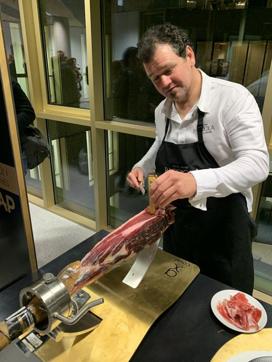
So what is so special about this ham? Well, Jesús, while he was cutting the ham, absolutely thin with this knife with a long blade, explained to me that the best ham has to be four years old, it has to be cut by hand and it is of course from the famous black pig of that region that eats acorns and so the ham is called “Bellota” meaning acorn. Oddly enough, as he sliced the small slices (about 4 cms by 4 cms) from different parts of the ham leg, they tasted very different. Closer to the thin bottom of the leg, it was a little bit drier while close to the part where it is attached to the body (where there was more fat), it was actually much sweeter. You shouldn’t really cut great big long thin slices of this ham, he told me. There are of course other cured hams in Spain – there’s a generic dry ham called Serrano which is produced everywhere in Spain and which is amazing but Jamon Ibérico is the undisputed king.
I went into a little café bar in Bilbao and noticed that the person sitting next to me was devouring a gigantic bowl of chickpea stew which looked and smelled absolutely delicious. The stew which is called cocido, fabada or podrida (depending on which part of Spain it’s from and the legume in question) is a sort of bean stew with large chunks of potatoes and carrots. What gives it its unique flavour is the knuckle of pork which has been braising along with it and the bits of cured ham and chorizo added towards the end for an extra depth of flavour. I had been away from home for ten days and was kind of hankering after something warming that seemed closer to home to me. This ticked my box. Below is my version. It is very similar to the garlicky version I had there, very easy to make because you basically throw everything into a pot. There’s no frying or oil involved. I just add Ibérico ham and a bit of chorizo. If you do have a ham bone or an Ibérico bone, throw that in when you’re boiling the channa and you will get a flavour that is unparalled.
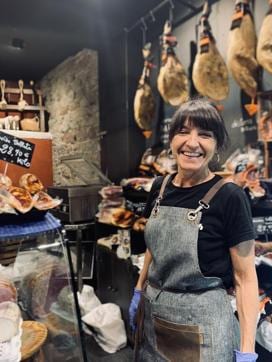
I am dying to go back to Spain again. I think that it is a country worth discovering. It has been a little under the radar all these years while Italy and Italian food has reigned supreme. This is Basque country, an area of beautiful little beaches, of wonderful pintxos bars and amazing Rioja wines…all at unbelievably reasonable prices.
I don’t think the Spanish with their laid back look at life and joie de vivre realise what gems they have in their culinary cupboard. Jamon Ibérico (pata negra) bellota from a pig which roams in oak forests and eats only acorns towards the end of its life, is really one of life’s great pleasures and should be considered up there with caviar, champagne and truffles – all the things chefs love most - because it is really something very very special.. Once you taste a slice of Ibérico, that salty, sweet, nutty flavor and wonderfully smooth slightly grainy texture, you really won’t eat any other ham again.
Olla Podrida (Castillian pork and bean stew)
Serves 6
Ingredients
300g dried chickpeas
250 g beef
500 g pork ribs (spareribs)
1 pig trotter
1 pig ear
100 g piece smoked bacon
100 g piece air dried ham
1 onion
2 bay leaves
2 cloves
2 carrots, chopped roughly
2 chorizo sausages, or similar pepper sausage
2 Spanish blood sausages
6 cloves of garlic, chopped
Salt and pepper
Method
Soak the chickpeas overnight in plenty of water. Drain and throw the chickpeas, the beef, pork ribs, pig trotter, pig ear (if using but not essential), bacon and ham into a large pan and add enough water to cover all of the ingredients. Add the onion, bay leaves and cloves and boil for approximately one hour. Stir the carrots into the stew and add the sausage. Crush the garlic with a little salt and add to the stew. Mix well. Season with pepper. Cook for an additional 15-20 minutes.
Take the meat, bacon, ham and sausages out of the stew and cut into small pieces. Strip all the meat from the ribs and pig trotter and cut into cubes. Return the meat to the pan and reheat in the stew. Season to taste with salt and pepper before serving.
NOTE: Many Spanish housewives are of the opinion that olla podrida has to be simmered for several hours before all the ingredients can develop their full flavour. This recipe worked well for me but I omitted the highlighted ingredients
Author bio: Culinary expert and explorer Karen Anand has been writing extensively on the subject of food and wine for 30 years. Apart from having her own brand of gourmet food products, she has anchored top rated TV shows, run a successful chain of food stores, founded the hugely successful Farmers Markets, and worked as restaurant consultant for international projects, among other things. Her latest passion is curated food tours.
This is a fortnightly column. The next edition will appear on November 10.
From HT Brunch, October 27, 2019
Follow us on twitter.com/HTBrunch
Connect with us on facebook.com/hindustantimesbrunch


