E-Paper



This Sunday, rediscover and explore Delhi for free
Go on art and poetry trails, soak in the city's history, try rock climbing – all this and more without spending a single rupee! Read on and pick your favourite free Sunday pursuit!


One of the oldest living cities in the world, Delhi offers hundreds of weekend pursuits on any given Sunday. You can see movies, eat out, attend concerts, go drinking, watch plays – but all that costs money.
So we decided to put together a list of things you can do, or rather, a list of experiences you can have (and in the process, explore and rediscover your city) which are absolutely free! You've probably passed many of these places or heard about them, but you've never bothered to actually check them out.
The Brunch team fanned out across the city and found out where you can go rock climbing, which monuments and museums don't charge an entry fee, the old libraries tucked away in Shahjahanabad where you don't need a membership, how you can see artists at work, all the parks and gardens where you can soak in the sun – and much, much more. (Of course, nothing beats just walking through the city).
We're sure we've left out many more unusual free activities so feel free to tell us more. Meanwhile, read on and pick your favourite Free Sunday pursuit!

One of the most enjoyable ways to discover Delhi in the winter is on foot. Whichever way you turn in the Capital – a city that ranks right up there with Cairo or Rome – you collide into history. Thanks to the Metro, you can get off at any station you want and start walking. You won't be disappointed. And it doesn't cost a thing.
Gateway to History
We took a walk around Kashmere Gate, which is teeming with decaying, historical structures. But that is just one of the hundreds of walking trails you can do. There’s more to Kashmere Gate than the old Bus Adda it had become synonymous with over the years, as we discovered during the three-hour walk from Ritz Cinema to the St Stephen’s cricket ground. Come walk with us…
Kashmere Gate was one of the 14 gates of the city of Shahjahanabad, the erstwhile capital that Shahjahan built, around 1649. If you head out of the station and begin walking in the direction of the Red Fort, Ritz cinema will be to your left.
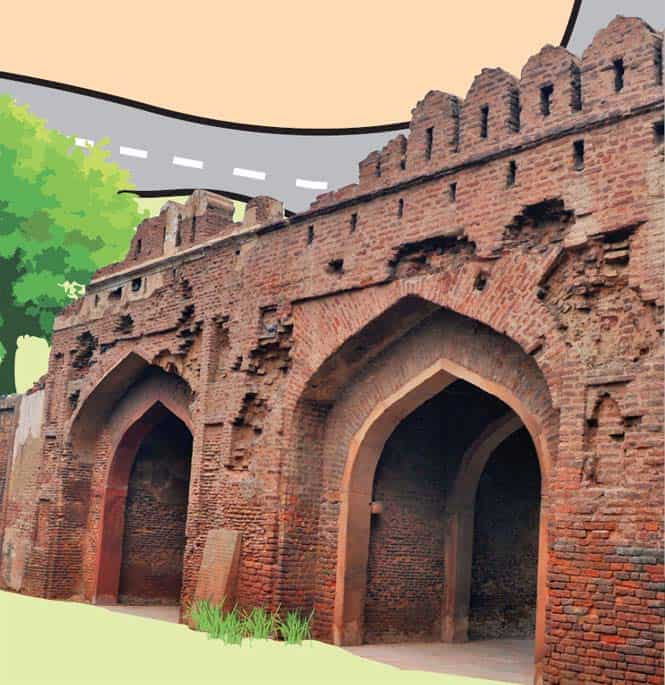
Across the road are the remains of the broken city wall of Shahjahanbad and the Kashmere Gate monument. When the Britishers first began settling in Delhi in 1803, they reinforced the city's walls and set up their residential estates in the area, which once housed the Mughal nobility. The gate next gained attention during the 1857 rebellion. The British used it to prevent the revolutionaries from entering the city. It was the scene of an important assault by the British Army on the morning of September 14, 1857, when the bridge and the left leaf of the Gate were destroyed, starting the assault on the rebels to end the siege of Delhi. After 1857, the British moved to Civil Lines, and Kashmere Gate became the happening commercial hub of Delhi, a reputation it lost in 1931, when New Delhi came into being.

When we visit the monument, a Wagon R is plonked in the middle of the approach. Polite enquiries from hangers-on sunning themselves about the whereabouts of the owner prove futile. But then, these are early days of the Aam Aadmi car and sarkar, one is reminded. Much water has flown down the Yamuna since Shahjahan, patron of arts and other things khaas, called the shots.
Across the road is the refurbished Ritz, one of the oldest single-screen cinemas in Delhi. A few years ago, owing to dwindling patronage, it had to shut shop. But in 2012, the cinema bounced back to life, and celluloid.
A Club in decay
A few hundred metres ahead of Kashmere Gate, on Boulevard Road, is a crumbling heritage building that houses the Bengali Club, which played host to Nobel laureate Rabindranath Tagore in 1932 after he performed his dance drama Valmiki Pratibha at Qudasia Gardens.
"The club also invites cultural luminaries to the Kashmere Gate Durga Puja, the oldest in the city. Sitarist Ravi Shankar even performed at the old Hindu College auditorium at our invitation, in 1952,” says club president Som Prakash Mitra. Today, the club, which once had a collection of more than 6,000 Bengali journals and books, is in disarray.
"At one point, Kashmere Gate was a unique part of the ethos of Mughal colonial Delhi,” says conservation architect Ratish Nanda. Old-timers recall that Carlton Café and Khyber Restaurant, once throbbing with life, have fallen by the wayside. And the old Stephen’s College today houses the office of the chief electoral officer of the Capital.
But if there’s one heritage building that can claim to have defied the ravages of time in the area, it has to be the St James Church. Built by Colonel James Skinner in 1835 to fulfil a vow he made as he lay wounded, the church’s history and neo-classical architecture attract university students. “On Sundays, our prayers begin at 9am,” says Lyra Paul, assistant to Rev Mohit Hitter, the priest-in-charge. Colonel Skinner died in December 1841. The graves of the Skinner family have insignia in Persian, the language the aristocracy preferred in that time.
Once you’ve had your fill of history, walk towards the St Stephen’s playground, where you might find an energetic game of cricket in full swing. The more things change, the more they remain the same: Like cricket and….Kashmere Gate.
(by Aasheesh Sharma)

State of the Art
You can't separate art from the artist. The struggle, the techniques, the back stories, have added to the legend of famous artists. So, spending a Sunday at Lalit Kala Akademi’s regional office in the heritage site of Garhi Village makes sense.

Once you manage to find your way through the maze of noisy cars, cattle and rickshaws on a tiny road close to Lady Shri Ram College, you enter (through a stone gate) into the secret world of artists: Painters working on canvasses, sculptors carving in stone or wood, potters at the furnace. You might also see graphic artists taking a break from their work and enjoying the sun. Established in 1976, Garhi Village was supposed to meet the needs of practising artists – equipment, basic raw materials, infrastructure and space – so that they could carry forward their artistic adventures. "Most of the established artists in India were at one point of time here," says Rajan Fulari, in-charge, printmaking and painting, looking up while scanning a submission. The park in the centre is speckled with artworks – bronze, stone, metal sculptures put out to dry.
Art connoisseurs can check out works of new artists or chat with them, they will be happy to show you their work. Sculptor Bhupender Panwar took us on a walk-through of his very interesting work, and let us in on his technique. A Sunday, artfully spent.
Art of the street
The Kathputli Colony near Shadipur Depot could pass off as any other basti in the city. But enter its narrow gullies, and you'll see that it's a goldmine of talent: 1,500 street magicians and performers, puppeteers, dancers, wood-carvers and jugglers, who represent India all over the world, live here.

Curator and founder-chairman of the Asian Heritage Foundation, Rajeev Sethi, founded the Bhule Bisre Kalakaar Cooperative Society, to protect dying art forms. This is where they live.
Eager children are ready to guide you to whichever artist you want to meet. Go there because it’s a one-of-its-kind artist colony in Delhi. Dilip Bhaat, the secretary of the society, has a workshop, where puppets are made. You can also meet puppeteer Puran Bhaat, who, sitting on his little roof, will regale you with fun stories. "People here put up a show after dark, when they are happy and high," he jokes.
(by Parul Khanna)
| Lose yourself in books |
| Delhi is full of libraries. There are historic libraries, modern digitised ones in international cultural centres and smaller ones in clubs and neighbourhoods. But most are closed on Sundays. The few that are open are only for members. A blink-and-miss door right next to the Haldiram’s in Chandni Chowk leads to the Marwari library. After you climb up the steep staircase, you’re greeted by a big board that tells you that this library is nearly 100 years old (it was set up in 1915) and that it played a role in the freedom movement (Gandhiji and other nationalist leaders held secret meetings here). It’s a small library, with sunlight streaming in through the windows. You can hear the hustle-bustle of Chandni Chowk, interrupted only by the crisp sound of newspaper pages being turned. You can spend all day reading, working or simply staring out of the window. A tall shelf of the book catalogues sits in one corner. There are books in all categories: Shastra (religious texts), upanyas (novels), naatak (plays), kavita (poems), arthashastra (economics), jeevani (biographies)... most books are old, some older than the library itself and they’re in Hindi but there is a collection of English books too. Suresh Kumar Singhania, president of the Marwari library, says, "We don’t concentrate on acquiring new books so much because we specialise in old books." Of all the hidden gems in the dusty shelves on the second floor, don't miss the ladies’ magazines from the early 1900s – Saraswati, Chaand, Kalyan – all beautifully illustrated and filled with inspiring stories, some jokes and household "tips." (by Saudamini Jain) |
Go climb a rock
How can clambering over rocks, often hanging by the tips of your fingers, with a harsh sun beating down your back, be a remotely fun activity? Ask rock climbing enthusiasts who scale artificial walls in indoor gyms or natural rocks, in order to test their upper body strength, stamina, sense of balance and mental endurance. A city like ours, uniquely positioned between the Aravallis and blessed with a lush green cover, is perfect for such enthusiasts.
Even if you find yourself on the wrong side of fit, rock climbing could still be for you. With a little training in technique, safety measures, and a basic knowledge of the kind of rocks to climb, of course.

Now that we’ve established your status as the modern primitive – on the hunt for novel adventures – let’s tell you where you can do this for free. Qutub Minar supplies a charming setting for this park, called the ‘DDA Park MP Green Area’ on the Mehrauli-Badarpur road. A trail flanked by trees, steel bars and blue notices explaining the kind of exercises to perform on them leads to a clearing with a big rock with a minaret on top – named the Old Man – and two medium-sized rocks on the side. Famously called the Old Rocks of Lado Sarai, these make for some satisfying climbing even for a novice like me.
Though a group of little boys, who were keenly watching my odd gymnastics, gleefully shouted, “Aapse nahin hoga”, and cut me to size! But I could see that with some training and practice, these rocks with their neat cracks (helpful for positioning one’s feet while climbing) and moderate steepness could be a Sunday afternoon delight.
Apart from the Old Lado Sarai rocks, we discovered steeper rocks at the PBG Rocks, in Parade Grounds on the Mother Teresa Crescent Road, opposite Gyarah Murti in Central Delhi. But we found the entry restricted, perhaps because Republic Day is around the corner. Avid adventurers could check it out. We’ve heard it's a dream come true for rock climbers.
(by Yashica Dutt)

Back on campus
Get down at the Vishwavidyalaya Metro station if you want to feel the vibrant energy of the youth of India. Walk down the roads that Amitabh Bachchan, Shah Rukh Khan and other celebrated alumni walked on. A cluster of 10 colleges around the station forms the North campus of Delhi University. The three original colleges that contributed to the founding of the University, St Stephen’s (1881), Hindu College (1899) and Ramjas College (1917), are all part of North campus.
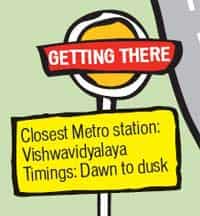
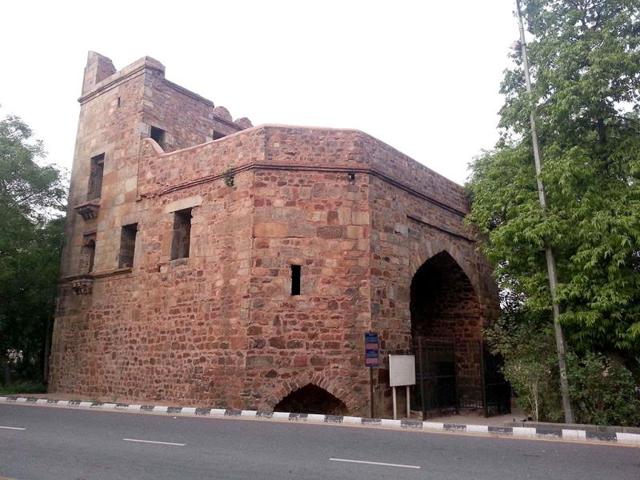
Unfortunately, access to college premises is not open to the general public. Still, you can take a walk down the green belt, better known as the ridge. Originally, the remains of the ancient Aravalli Hills, today it’s a hotspot for wild monkeys and furtive couples looking for a clandestine outing. Walk up to the Flagstaff Tower, where many British families took shelter during the 1857 rebellion. It’s locked up now, so one can’t go up to the top of the tower. Further deep into the forest area is the Khooni Khan Lake. It has a deserted look with overgrown bushes and lots of monkeys. The lake got its name when its waters were believed to have turned red with the blood of the wounded and the dead from days of fighting during the rebellion. Today, it seems more like a personal swimming pool of the resident monkeys.
But you could walk through the ridge simply for a peaceful date with nature. If nothing else, it’ll do wonders to your lungs!
(by Tavishi Paitandy Rastogi)